

Malenadu Travel
Malenadu forts stand on forest hilltops and ghat passes across the Western Ghats of Karnataka, built by Keladi kings, Hoysala chiefs, Tipu Sultan and the rajas of Kodagu. This guide covers seven forts you can visit, with their history, what still stands, how to reach them, how hard the climb is and when to go.

On this page
What are the main Malenadu forts?
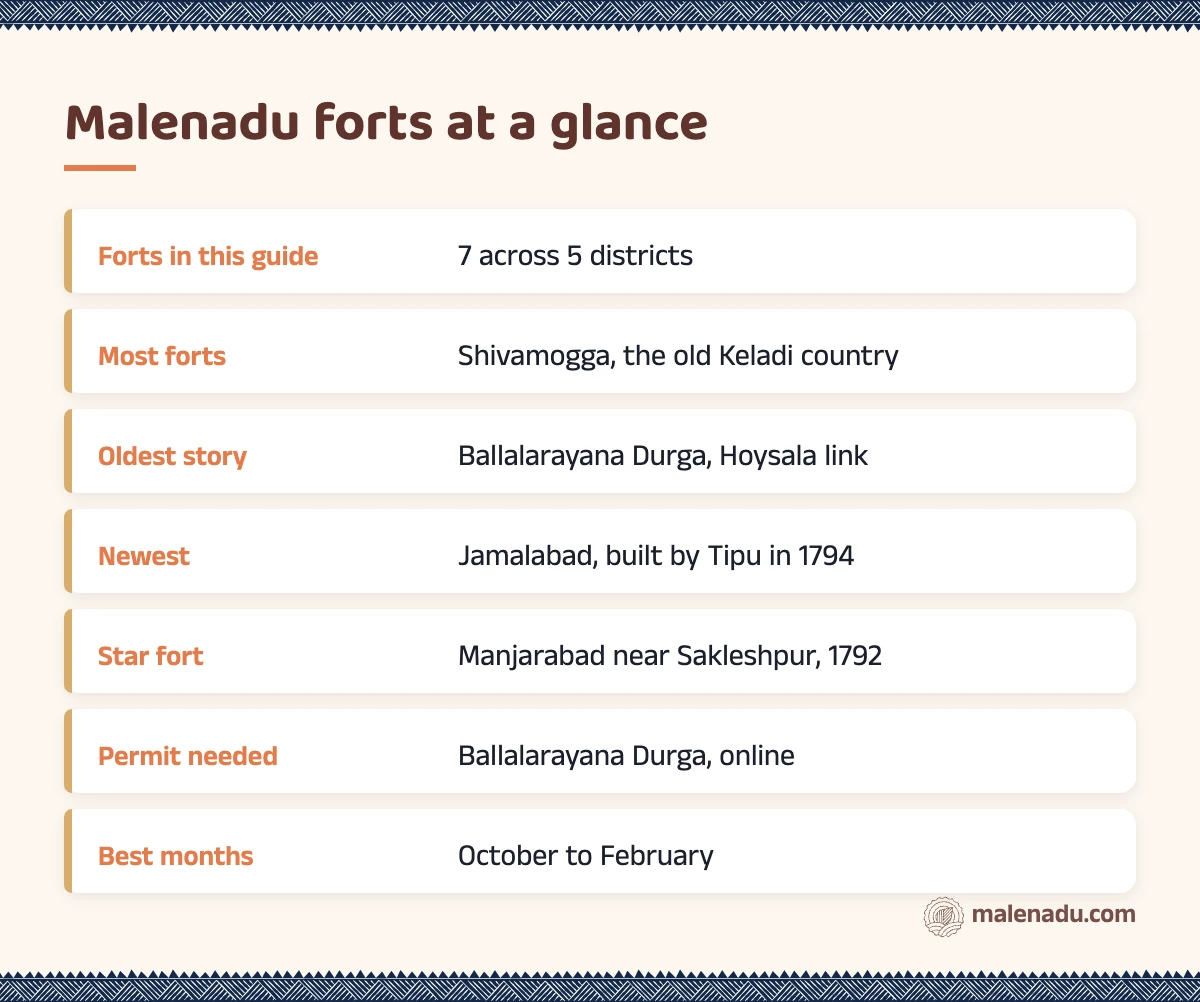
The main Malenadu forts are Kavaledurga, Nagara (old Bidanur), Chandragutti, Manjarabad, Ballalarayana Durga, Jamalabad and Madikeri. Some are easy town visits. Others are proper forest treks that need a Forest Department permit.
Most Malenadu forts were built to guard two things: a ruler’s capital and the passes down the ghats to the ports of the coast. Pepper, areca and rice went down those passes while salt and goods came up. Whoever held the hilltops held the trade.
These are the seven Malenadu forts in this guide:
- Kavaledurga, Thirthahalli taluk, Shivamogga
- Nagara (Bidanur), Hosanagara taluk, Shivamogga
- Chandragutti, Soraba taluk, Shivamogga
- Manjarabad, near Sakleshpur, Hassan
- Ballalarayana Durga, Chikkamagaluru
- Jamalabad (Gadaikallu), Belthangady taluk, Dakshina Kannada
- Madikeri fort, Kodagu
If you are new to the region, our pages on Malenadu in Karnataka and the Malenadu districts and taluks show where each fort sits. For the kings behind them, read our Malenadu history timeline.
Malenadu forts at a glance
This table lists the Malenadu forts in this guide with district, era and how you get in.
| Fort | District | Era | Access |
|---|---|---|---|
| Kavaledurga | Shivamogga | Old hill fort, Keladi stronghold in the 16th century | Short climb from the base village, fixed hours |
| Nagara (Bidanur) | Shivamogga | Keladi capital from about 1640 | Roadside, easy walk, free entry |
| Chandragutti | Shivamogga | Old hill fort above a temple | Steep climb on steps and rock |
| Manjarabad | Hassan | Tipu Sultan, 1792 | About 250 steps from the highway |
| Ballalarayana Durga | Chikkamagaluru | Linked to the Hoysalas | Forest trek, online permit |
| Jamalabad | Dakshina Kannada | Tipu Sultan, 1794 | Steep rock steps, Forest Department control |
| Madikeri | Kodagu | Haleri rajas, 17th century, rebuilt by Tipu | In town, walk in |
Forts in Shivamogga: Kavaledurga, Nagara and Chandragutti
The best forts in Shivamogga sit in the old Keladi country between Thirthahalli, Hosanagara and Sagara. This district has more Malenadu forts than any other, because the Keladi Nayakas ruled from here for over 250 years.
Kavaledurga fort
Kavaledurga fort is a hilltop fort about 18 km from Thirthahalli, also known as Bhuvanagiri. Karnataka Tourism describes it as a fort of the 9th century that became a stronghold of the Keladi Nayakas in the 16th century.
What remains is impressive for a forest fort:
- Three rings of stone walls climbing the hill
- Ruins of a palace, a bath, guard rooms and store houses
- A freshwater pond near the top that still holds water
- The Srikanteshwara temple with a Nandi mantapa on the summit
- Smaller shrines and a mosque credited to Venkatappa Nayaka
The climb starts from Kavaledurga village and follows stone steps and rock through the gateways. Fit walkers need about 2 to 3 hours to climb and explore. The difficulty is easy to moderate, but the rock gets slippery when wet.
Entry closes at 5 pm. There is only a tea shop near the parking, so carry water. Of all the Malenadu forts, this is the one to give a full morning. Our Thirthahalli guide covers stays nearby.
Nagara (Bidanur) fort
Nagara fort is the ruin of Bidanur, the last capital of the Keladi Nayakas, in Hosanagara taluk. The court moved here from Ikkeri around 1640. Shivappa Nayaka fortified the city in the middle of the 17th century. Haidar Ali captured it in 1763.
Nagara is the easiest of the Malenadu forts to visit. It sits about 17 km from Hosanagara and about 36 km from Thirthahalli, on the road towards Kollur. The laterite walls are largely intact. Inside you can see:
- The main gateway and the platform of the old durbar hall
- Akka Thangi Honda, twin rainwater tanks inside the walls
- A round watchtower on the top with an old iron cannon
- Guard rooms, steps and storage cells
About 4 km away are the Devagange ponds, a set of seven linked stepped pools fed by springs. Entry is free. The site is looked after by the Archaeological Survey of India. Plan 3 to 4 hours for the fort and the ponds.
The Keladi kings grew rich on pepper sent down the ghats from these forests. Vines still climb the areca palms around Nagara. Our black pepper comes from the same hills.

From the malenadu pantry
The Keladi kingdom was built on the pepper trade. The vines still grow around Nagara and Hosanagara. This is sun dried pepper from Malenadu, an easy thing to carry home after a fort day.
Chandragutti
Chandragutti is a tall rocky hill in Soraba taluk with the Renukamba temple on its slope and the remains of an old hill fort above. It is a popular short trek. The way up is steep, on steps and bare rock, so go in dry weather and wear shoes with grip.
Manjarabad fort: Tipu’s star on the Hassan ghats
Manjarabad fort is an eight pointed star fort built by Tipu Sultan in 1792 on a hill about 5 to 6 km from Sakleshpur, close to the Bengaluru to Mangaluru highway. Karnataka Tourism puts the hill at about 988 m. The name comes from manju, the Kannada word for mist, which still rolls over the walls most mornings.
Tipu built Manjarabad to guard the road from Mysore down the ghats to the coast. Before him the area belonged to local chiefs and was taken by Shivappa Nayaka of Keladi in 1659. The outer walls are granite set in lime mortar, with brick inside.
What you can see today:
- The star shaped walls with a lookout at each point
- A moat around the walls, now overgrown
- A well in the middle and two cool cellars once used to store gunpowder
- Wide views over coffee and cardamom estates
It is one of the most visited Malenadu forts because it is so easy to reach. You climb about 250 steps from the road.
The fort is open from 8 am to 6 pm and there is no entry fee. The difficulty is easy, though the steps are slippery in rain. Our Sakleshpur guide has a full day plan around it.
The slopes below the fort are cardamom and coffee country. If you like the smell of the estates, take home some cardamom from these hills.

From the malenadu pantry
The estates around Manjarabad grow cardamom in the shade of tall trees. This is green cardamom from Malenadu, picked by hand and dried. A pinch in tea brings back the misty fort walls.
Forts in Chikkamagaluru: Ballalarayana Durga
The best known of the forts in Chikkamagaluru is Ballalarayana Durga, a ruined hill fort on a grassy ridge on the Kottigehara side, near Sunkasale. Local tradition links it to the Hoysala king Veera Ballala, which gives it the name: the fort of Ballala.
Very little of the fort stands today. You will find low lines of foundation stones, bits of wall and a few carved stones on the summit. People come for the walk and the views over the shola grasslands towards Kudremukh more than for the ruins.
This is the one Malenadu fort in this guide that is a true forest trek:
- Start. The base is near the Kalabhyraveshwara temple at Durgadahalli, a few kilometres from Sunkasale.
- Difficulty. Easy to moderate. The trail is not technical, but the grass slopes are steep in places and very slippery in the rain.
- Permit. You need an online Forest Department permit (see the permit section below).
- Nearby. Bandaje falls lies further along the ridge. It is a separate trek with its own permit. See our Malenadu waterfalls guide.
Kalasa is the nearest town with a hospital and police station. Our guide to Malenadu trekking covers Ballalarayana Durga along with Kudremukh, Kurinjal and other peaks in the same area.
Jamalabad (Gadaikallu) above Belthangady
Jamalabad is a fort built by Tipu Sultan in 1794 on top of a huge granite rock near Belthangady, in Dakshina Kannada. Local people call the rock Gadaikallu or Narasimha Gad. It rises sharply above the plain at the foot of the ghats, not far from Dharmasthala.
The way up is a narrow path and steps cut into the rock face. The trek is rated medium, with steep, exposed stretches near the top. Little is left of the buildings, but the views over the forest and towards the Kudremukh range are wide.
Access is controlled by the Forest Department. In heavy monsoon rain, water runs over the rock and moss grows on the steps, so trekking is often closed for the season. Check before you go.
Madikeri fort in Kodagu
Madikeri fort stands in the middle of Madikeri town and is the easiest of the Malenadu forts to walk into. Mudduraja of the Haleri dynasty built the first fort in the 17th century.
Tipu Sultan later took it and rebuilt it in stone. Dodda Veerarajendra won it back in 1790. The British took Kodagu in 1834.
Inside the walls is the old palace of the Kodagu rajas. For many years government offices used the rooms. The Archaeological Survey of India has since been carrying out repairs on the palace, so some parts may be closed. Near the fort stands St Mark’s church, built by the British in 1859, now used as a museum.
Madikeri fort is in town, so unlike the forest Malenadu forts it needs no trek and no permit. Combine it with Raja’s Seat and the Kodagu temples in our guide to Malenadu temples.
Do you need a permit to visit Malenadu forts?
Some Malenadu forts need a Forest Department permit while others do not. The rule of thumb is simple: if the fort is inside forest land and reached by a trail, expect a permit or a seasonal closure.
| Fort | Permit or rule |
|---|---|
| Ballalarayana Durga | Online Forest Department permit, daily cap |
| Jamalabad | Forest Department control, closed in heavy rain |
| Kavaledurga | Fixed hours, entry closes at 5 pm |
| Manjarabad | Open 8 am to 6 pm, no fee |
| Nagara | Free entry, daylight hours |
| Madikeri | Open in town, parts may be under repair |
Forest trek permits in Karnataka are booked on the Forest Department’s Aranya Vihaara portal. You pick the trail and date, pay online and carry the permit with the same photo ID to the check post. Many trails also need a local guide and a return before dark.
Local tip
Book the permit for a forest fort before you book your stay. Daily caps fill up fast on weekends from October to January. A homestay near the start can usually help with a jeep and a guide once you have the permit.
When is the best time to visit Malenadu forts?
The best time to visit Malenadu forts is October to February, when the rain has stopped, the rock is dry and mornings are cool. December and January bring clear views from the summits.
- June to September: The hills are green and misty, but trek forts like Jamalabad are often closed and rock steps everywhere are slippery. Town forts like Madikeri and Nagara are still fine in light rain. Read our guide to the Malenadu monsoon first.
- October to February: The best months for all seven forts.
- March to May: Hot and hazy at midday. Climb early in the morning.
Safety and manners at Malenadu forts
Most Malenadu forts are ruins in forest, so a little care goes a long way. These simple rules apply to every one of the Malenadu forts in this guide.
- Start early and come down before dark. No night walking in forest areas.
- Stay on the path. Old walls and rock edges can crumble.
- Carry water and a snack. Most forts have no shops on top.
- Watch for snakes and leeches. Wear closed shoes. If anyone is bitten by a snake, keep them still and calm and get them to a hospital with antivenom. No cutting, no sucking and no home remedies.
- Do not climb wet rock in the monsoon. Respect closures.
- Leave no trace. Carry back plastic and do not scratch names on walls.
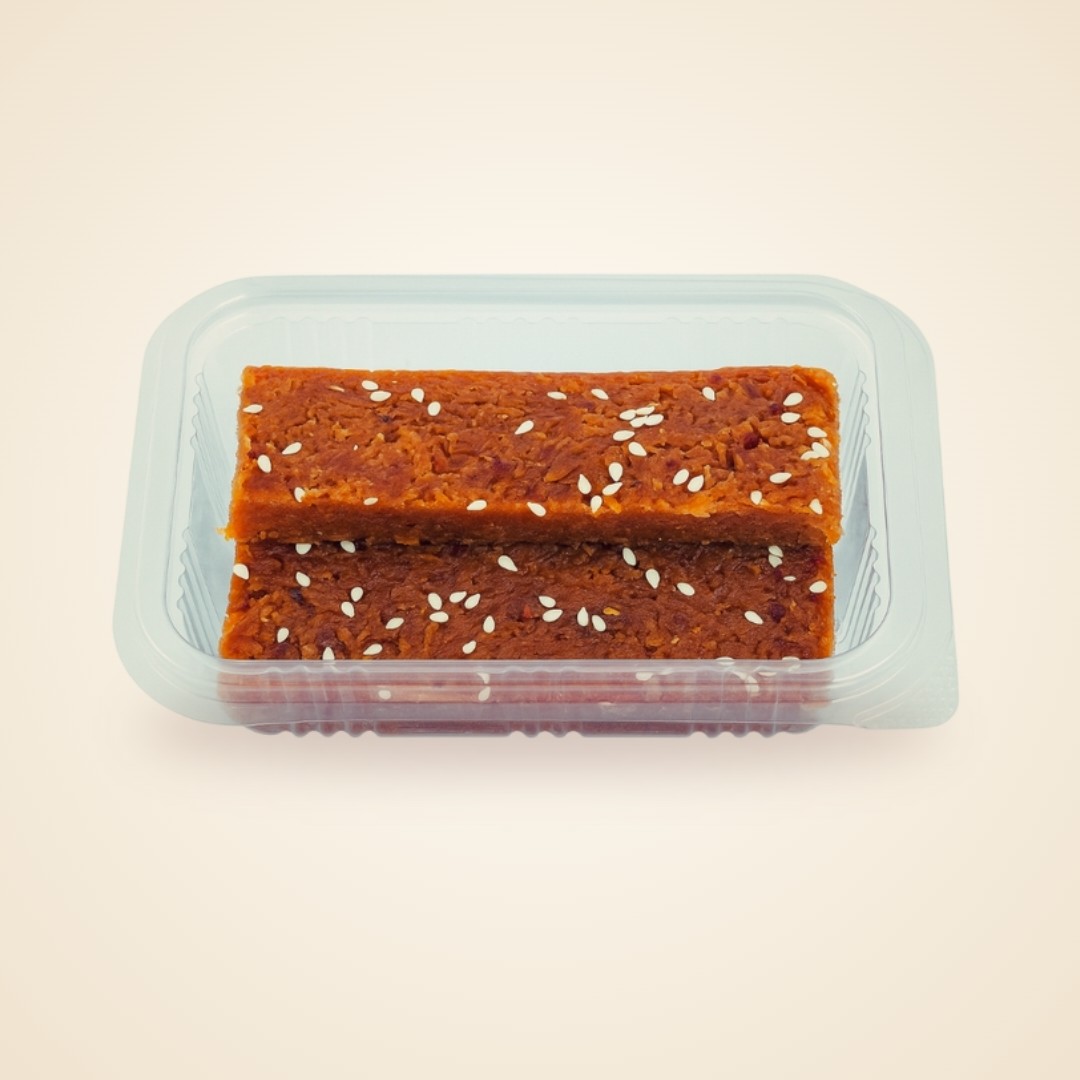
A sweet with jaggery and coconut is a good trail snack. Our coconut jaggery burfi packs flat in a day bag.
From the malenadu pantry
A simple sweet of coconut and jaggery that gives quick energy on a hill climb. Keep a few pieces in your day bag for the walk down from Kavaledurga or Ballalarayana Durga.
A simple Malenadu forts route
The easiest way to see Malenadu forts is in two short trips, one in the north around Shivamogga and one in the south.
| Trip | Forts in order | Base | Days |
|---|---|---|---|
| Keladi country | Kavaledurga, Nagara, Chandragutti, with Keladi and Ikkeri temples | Thirthahalli or Sagara | 2 to 3 |
| Southern ghats | Manjarabad, Ballalarayana Durga, Jamalabad, Madikeri | Sakleshpur, Kalasa side, Madikeri | 3 to 4 |
Nagara is about 27 km from Kavaledurga, so the two fit in one day. Our Sagara guide covers Keladi, Ikkeri and Chandragutti.
Where to go next
The Malenadu forts make more sense once you know who built them and why. Read the Malenadu history timeline linked above, then plan the rest of your trip with the Malenadu travel guide.
Bring Malenadu home
Grown and made by Malenadu farmer families, packed by malenadu, a farmer owned producer company in Honnavar.
-
8% OFF

Black Pepper
Price range: ₹165 through ₹299 -
19% OFF

Cardamom
Price range: ₹130 through ₹330 -
Coconut Jaggery Burfi
₹120 -
29% OFF

Honey
Price range: ₹249 through ₹449 -
51% OFF

Small Jute Bag
Original price was: ₹200.₹99Current price is: ₹99. -
17% OFF

Kokum Rind
Original price was: ₹240.₹200Current price is: ₹200.
Frequently asked questions about Malenadu forts
Which are the best Malenadu forts to visit?
Kavaledurga, Nagara and Manjarabad are the best for first visits. Ballalarayana Durga and Jamalabad suit people who want a proper trek.
Who built Kavaledurga fort?
Its origins are old and unclear, but it was a stronghold of the Keladi Nayakas in the 16th century. The mosque inside is credited to Venkatappa Nayaka.
How far is Manjarabad fort from Sakleshpur?
Manjarabad fort is about 5 to 6 km from Sakleshpur, close to the Bengaluru to Mangaluru highway. You climb about 250 steps from the road.
Do I need a permit for Ballalarayana Durga?
Yes. You need an online Forest Department permit, booked on the Aranya Vihaara portal. Carry the same photo ID you used to book.
What are the main forts in Shivamogga?
The main forts in Shivamogga are Kavaledurga near Thirthahalli, Nagara (Bidanur) in Hosanagara taluk and Chandragutti in Soraba taluk.
Can I visit Malenadu forts in the monsoon?
Town forts like Madikeri and Nagara are fine in light rain. Trek forts like Jamalabad are often closed. Rock steps everywhere get slippery.
Why is Manjarabad fort star shaped?
The star shape, a European design, let defenders cover every wall from the points. Tipu Sultan built it in 1792 to guard the road down the ghats to the coast.
Explore more of Malenadu
Malenadu TravelMalenadu Travel GuideRoutes, stays and seasons for the rain hills of Karnataka
Malenadu TravelMalenadu Monsoon and RainfallWhy the hills get so much rain and how life bends to it
Malenadu TravelMalenadu Peaks and TreksPeaks, permits and seasons for walking the Western Ghats
Malenadu TravelMalenadu Waterfalls22 falls across the hills, with access and best season
Malenadu TravelMalenadu WildlifeTigers, macaques, king cobras and the forests farms need
Malenadu TravelMalenadu TemplesRiver shrines, hill goddesses and carved stone
Malenadu TravelBangalore to MalenaduDistances, routes and plans for the drive to the hills
Malenadu TravelMalenadu RiversTen rivers that rise in the hills and shape life below
Start hereMalenadu in KarnatakaWhere Malenadu is, what the name means