

Malenadu Travel
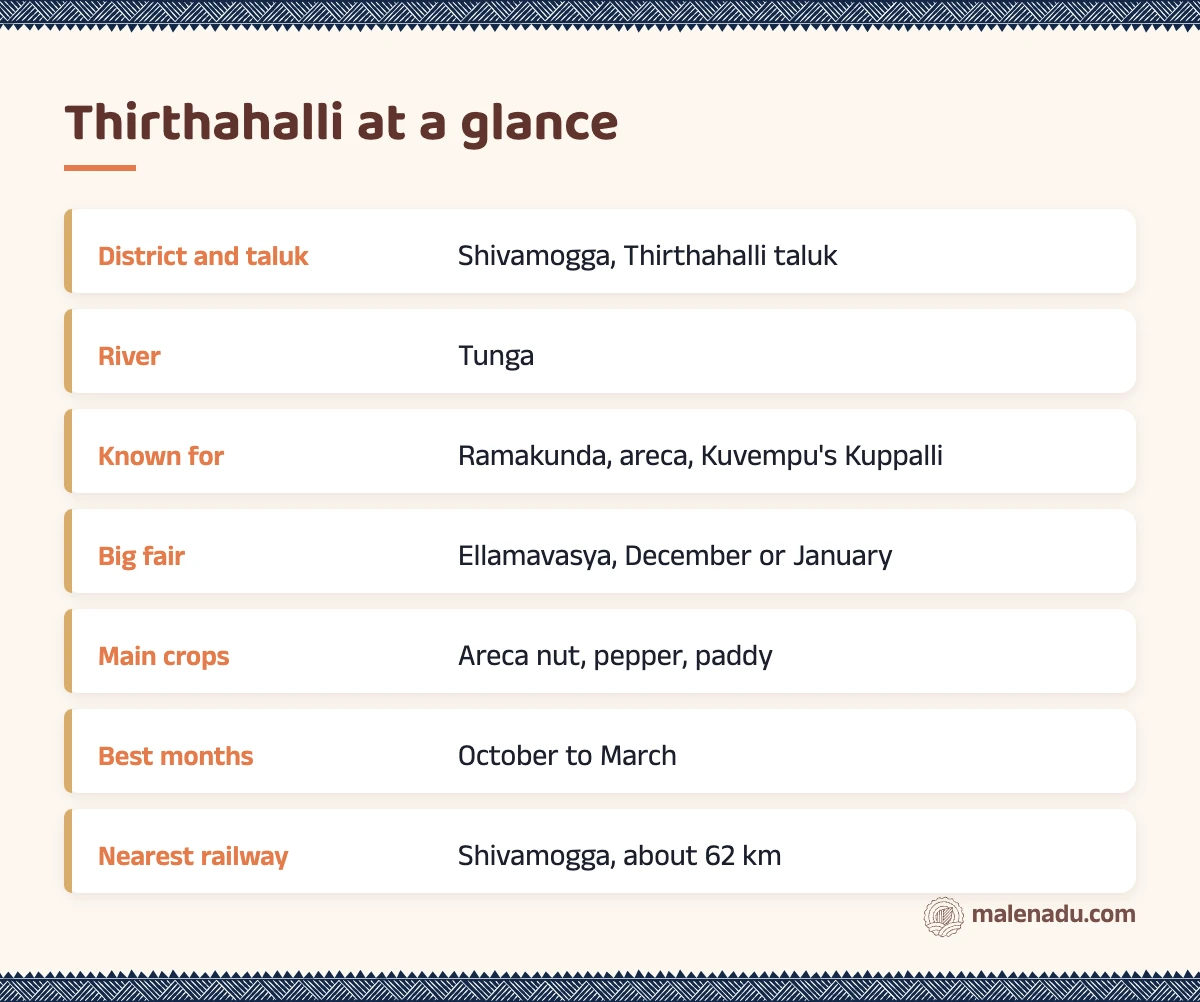
Thirthahalli is a quiet taluk town on the Tunga river in Shivamogga district, ringed by areca gardens and forested hills. It is known for the Rameshwara temple and Ramakunda on the river, the Ellamavasya fair and its nearness to Kuppalli, the home of the poet Kuvempu. This guide covers what to see, eat and plan in and around the town.

On this page
What is Thirthahalli known for?
Thirthahalli (ತೀರ್ಥಹಳ್ಳಿ) is known for the Tunga river, its areca gardens and its writers. The river runs right past the town, with an old temple and a holy pool on its bank. All around, areca palms with pepper vines fill the valleys between low, forested hills.
The area is also known as the home ground of Kannada literature. The poet Kuvempu grew up at Kuppalli nearby and the novelist U.R. Ananthamurthy was born in the same taluk. For a small town it has a lot of history, from the Keladi Nayaka fort at Kavaledurga to the yearly fair on the river.
The town is the headquarters of its own taluk in Shivamogga district, which also takes in Agumbe. For how the taluks of the region fit together, see our list of Malenadu districts and taluks.
How did Thirthahalli get its name?
The town gets its name from the sacred water of the Tunga. Tirtha means holy water and halli means village, so the name means the village of holy water.
A local legend explains why the water here is holy. The sage Parashurama is said to have tried washing the bloodstains from his axe in many rivers. The last stain came off only when he dipped it in the Tunga at this spot. The pool where this happened is Ramakunda, also called Rama Tirtha.
The story of the town after that is the story of the hills. This area was ruled for long by the Keladi Nayakas, whose fort at Kavaledurga still stands nearby. In the 20th century it became known for its writers and for its areca.
Thirthahalli Tunga river: Ramakunda, Rameshwara temple and the bridge
The Thirthahalli Tunga river front has three things to see within a short walk: Ramakunda, the Rameshwara temple and the old arched bridge. Go in the early morning, when the river is quiet and people come down to bathe and pray.
Ramakunda and the Rama Mantapa
Ramakunda is the holy pool in the rocky bed of the Tunga where, by legend, Parashurama washed his axe. A small stone pavilion called the Rama Mantapa stands in the river nearby. When the water is low after the rains, the smooth black rocks around it are a lovely place to sit.
Rameshwara temple
The Rameshwara temple is a stone temple to Shiva on the bank of the Tunga, close to Ramakunda. Its linga is said to have been installed by Parashurama himself. The temple is the centre of the Ellamavasya fair. For other shrines in the region, see our guide to Malenadu temples.
The Tunga bridge
The Tunga bridge is an old arched bridge that carries the road across the river from the town to Kuruvalli on the other bank. Its row of arches is the picture most people take home. During the Ellamavasya fair the bridge is lit up with lights.
Our guide to Malenadu rivers follows the Tunga from its source to where it meets the Bhadra.
When is the Ellamavasya fair in Thirthahalli?
The Ellamavasya fair is held on Ellu Amavasya, the new moon of the Margashira month, which falls in December or January. It is the town’s best known fair and draws people from villages all over the taluk.
The deity of the Rameshwara temple is taken to the river for a holy bath, a temple car is pulled through the street and a teppotsava (float festival) is held on the Tunga. Fireworks light up the riverbank at night.
Stalls sell toys, bangles, sweets and household goods, as at any village jatre. Check the exact date each year, since it follows the lunar calendar. Our guide to Malenadu festivals explains other fairs of the hills.
Thirthahalli tourist places at a glance
The main Thirthahalli tourist places are the river front, Kuppalli, Kavaledurga, Kundadri, Agumbe and Mandagadde. This table gives rough road distances from the town so you can plan a day or two.
| Place | Rough distance | What it is |
|---|---|---|
| Ramakunda and Rameshwara temple | in town | Holy pool and Shiva temple on the Tunga |
| Tunga bridge | in town | Old arched bridge to Kuruvalli |
| Kavaledurga | about 18 km | Hill fort of the Keladi Nayakas |
| Kuppalli | about 18 to 20 km | Kuvempu’s home, now a museum |
| Kundadri | off the Agumbe road | Jain temple on an 826 m hill |
| Agumbe | about 30 km | Rainforest village and sunset point |
| Mandagadde | roughly halfway to Shivamogga | Bird island in the Tunga |
| Sakrebailu | about 14 km short of Shivamogga | Forest Department elephant camp |
| Shivamogga | about 62 km | District town and railway |
Places to visit near Thirthahalli
The best places to visit near Thirthahalli are Kuppalli for literature, Kavaledurga for history, Kundadri and Agumbe for views and Mandagadde for birds. Each needs a half day at most, so you can see two or three in one day.
Kuppalli: Kuvempu’s home
Kuppalli is the village where the poet Kuvempu (K.V. Puttappa) grew up, about 20 km from town according to Deccan Herald. His family house, called Kavimane, is now a museum. It is a large three storey Malenadu house with wooden pillars and stairs. It holds his books, awards and everyday things.
A short walk away is Kavishaila, a hilltop of tall stone slabs where Kuvempu sat with friends to talk about literature. He was laid to rest here. The memorial to his son, the writer Poornachandra Tejaswi, is also at Kavishaila.
Kuvempu received the Jnanpith in 1967 for Sri Ramayana Darshanam. His novels Kanuru Heggadithi and Malegalalli Madumagalu are set in these villages. Our guide to Malenadu writers covers him, U.R. Ananthamurthy and the other writers of the region.
Kavaledurga fort
Kavaledurga is a hill fort about 18 km from town, also called Bhuvanagiri. Karnataka Tourism describes it as a stronghold of the Keladi Nayakas in the 16th century, with three rings of stone walls and the remains of a palace on the way up. Small shrines and a pond of fresh water sit near the top.
The walk up through forest and rock takes some effort. Fit visitors need two to three hours to see the fort. Entry closes by 5 pm and there are few facilities beyond a tea shop near the parking, so carry water.
On clear evenings you can see the sun set towards the Arabian Sea from the top. Our guide to Malenadu forts has more hill forts like this one.
Kundadri and the rainforest ghat
Kundadri is a forested hill off the road to Agumbe, with a 17th century Jain temple of Parshwanatha on top at about 826 m. The last stretch of road is steep and narrow. Sunrise from the top is worth the early start.
Agumbe, about 30 km away, is the rainforest village known for very heavy rain, its sunset point and king cobras. Our full guide to Agumbe covers its falls, permits and a day plan.
Mandagadde bird sanctuary
Mandagadde is a small island in the Tunga on the Shivamogga road, roughly halfway between the two towns. In the rainy months, egrets, little cormorants and darters nest in its trees in large numbers. July to September is the time to go, with August usually the busiest.
Watch from the bank and keep your voice low, since the birds are nesting. Our guide to Malenadu birds has more places to watch birds in the hills.
Sakrebailu elephant camp
Sakrebailu is an elephant camp run by the Karnataka Forest Department on the same road, about 14 km before Shivamogga. Visitors come in the morning to watch the elephants being bathed in the river. Check timings before you go, since they change.
What to eat in Thirthahalli
Food here is Malenadu home food, built on rice, coconut, areca country greens and a lot of pepper. Breakfast is often akki rotti (rice flour flatbread), kadubu (steamed rice dumplings) or dosa. Lunch is rice with saaru, a tambuli (a cool, curd based side) and a vegetable palya.
In the monsoon, look for kalale palya, a dry curry of tender bamboo shoot. Bamboo shoot must be soaked and boiled well before cooking and never eaten raw. Wild mushrooms are another rainy season treat, but eat them only if a local person who knows them has picked them.
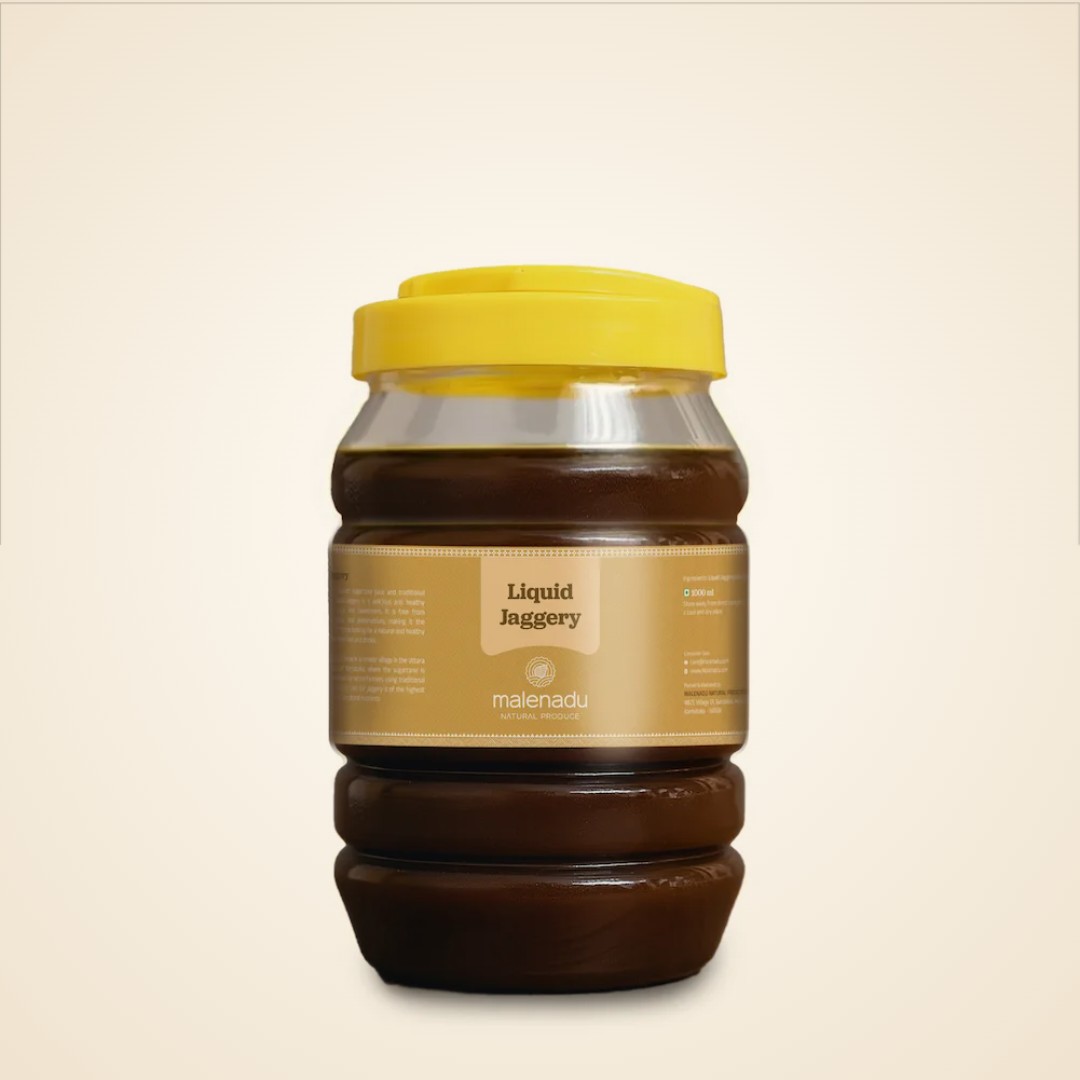
Many homes here eat their dosa and rotti with a spoon of ghee and joni bella, the soft liquid jaggery of the hills. It is also stirred into payasa on festival days.
From the malenadu pantry
Our Liquid Jaggery is the joni bella that Malenadu families pour over hot dosa and akki rotti. It is the easiest way to bring a Malenadu breakfast to your own kitchen.
The town’s eateries serve simple meals and coffee. For home cooking, a homestay with a farming family is the best bet.
What crops grow around Thirthahalli?
The main crops around Thirthahalli are areca nut and black pepper, with paddy in the low fields. Areca gardens fill almost every valley and pepper vines climb up the palms. Coconut, banana and a little cardamom grow in the same shady gardens.
Areca from this taluk has a strong name in the market. In 2024 the areca research centre of the state agricultural university at Shivamogga rated it the best in quality among several areca types in a blind test. Researchers linked this to the care of small growers who farm two to five acres. Our guide to areca nut farming in Malenadu explains how the crop is grown and dried.

From the malenadu pantry
Our Black Pepper comes from these areca and pepper gardens, picked by hand from vines on the palms and dried in the sun. It has the bite that cooks here want in their saaru.
Cardamom likes the same cool shade and steady rain. In these homes it goes into payasa, tea and festival sweets.

From the malenadu pantry
Our green Cardamom is grown in the shaded gardens of these hills. A few crushed pods in payasa or evening tea taste of a Malenadu kitchen.
When is the best time to visit Thirthahalli?
The best time to visit Thirthahalli is October to March, when the rain has eased, the river is calm and the roads are dry. Each season has something different to offer.
| Season | Months | Good for |
|---|---|---|
| After the rains | October to November | Green hills, full river, clear forts |
| Winter | December to February | Ellamavasya fair, cool mornings, Kundadri sunrise |
| Summer | March to May | Quiet town, mango and jackfruit season |
| Monsoon | June to September | Heavy rain, Mandagadde birds, Agumbe mist |
How to reach Thirthahalli
You reach Thirthahalli by road, usually through Shivamogga, which is about 62 km away according to Karnataka Tourism. Buses run often from Shivamogga, Agumbe, Udupi and Sringeri. Overnight buses come from Bengaluru.
- From Bengaluru: a six to seven hour drive or an overnight bus. Our Bangalore to Malenadu guide gives the routes.
- By train: Shivamogga is the nearest railhead, about 62 km away.
- By air: Shivamogga airport is the closest. Mangaluru airport lies across the ghats via Agumbe.
A 2 day Thirthahalli plan
Two days are enough to see the town and the best places around it without rushing. If you have only one day, keep the first morning and the Kuppalli afternoon.
Day 1
- Morning: walk the river front. See Ramakunda, the Rama Mantapa and the Rameshwara temple, then cross the Tunga bridge.
- Afternoon: drive to Kuppalli. See Kavimane and walk up to Kavishaila before sunset.
- Evening: back in town for a simple dinner of rice, saaru and palya.
Day 2
- Morning: drive to Kavaledurga early. Climb the fort before the day gets hot and keep in mind that entry closes by 5 pm.
- Afternoon: go on towards Agumbe, stopping at Kundadri if you have a confident driver.
- Evening: watch the sunset from the Agumbe sunset point, then stay there or return to town.
In the monsoon, swap Kavaledurga for Mandagadde to see the nesting birds.
Local tips for Thirthahalli
A few local tips will make your visit safer and easier. Most are about the river and the rain.
- River safety: the Tunga looks calm but has strong currents and deep pools. Do not swim. Keep away from the water when it rises in the monsoon.
- Leeches: expect them on forest walks from June to November. Leech socks and a little salt help.
- Fair days: book a stay early for Ellamavasya, when the town fills up.
- Fort timings: reach Kavaledurga by early afternoon to have enough time before entry closes.
- Respect homes: areca gardens are private land. Ask before you walk in for photos.
Local tip
Ask your host where the areca is dried. In winter you will see the nuts spread on mats in every yard. Most farmers are happy to explain how they are boiled, dried and graded.
Where to go next
From here, go south to Agumbe for the rainforest or north towards Sagara and Jog. For a sweet or a spice to take home from these gardens, browse the pepper, jaggery and cardamom in our shop.
Bring Malenadu home
Grown and made by Malenadu farmer families, packed by malenadu, a farmer owned producer company in Honnavar.
-
8% OFF

Black Pepper
Price range: ₹165 through ₹299 -
14% OFF
Liquid Jaggery
Original price was: ₹349.₹299Current price is: ₹299. -
19% OFF

Cardamom
Price range: ₹130 through ₹330 -
17% OFF

Kokum Rind
Original price was: ₹240.₹200Current price is: ₹200. -
40% OFF
Desi Cow Ghee
Original price was: ₹1,500.₹899Current price is: ₹899. -
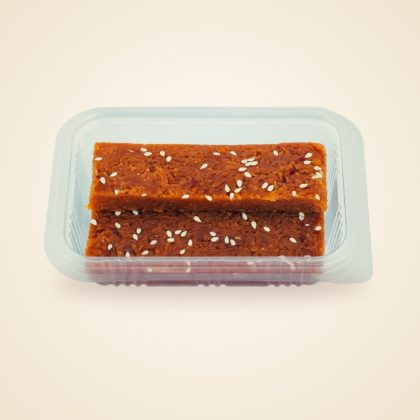
Coconut Jaggery Burfi
₹120
Frequently asked questions about Thirthahalli
What is Thirthahalli famous for?
It is famous for the Tunga river, the Rameshwara temple and Ramakunda, its areca nut and its link with the poet Kuvempu. The yearly Ellamavasya fair is its biggest event.
What are the best places to visit near Thirthahalli?
Kuppalli, Kavaledurga, Kundadri, Agumbe and Mandagadde bird sanctuary are the best. Most can be seen in two days.
How far is Kuppalli from Thirthahalli?
Kuppalli is about 18 to 20 km from Thirthahalli. Kuvempu’s home there is now a museum called Kavimane.
How far is Kavaledurga from Thirthahalli?
Kavaledurga is about 18 km from Thirthahalli. Plan two to three hours for the fort and reach before entry closes at 5 pm.
Which river flows through Thirthahalli?
The Tunga flows past the town. Ramakunda and the Rameshwara temple are on its bank and an old arched bridge crosses it.
When is the Ellamavasya fair held in Thirthahalli?
It is held on Ellu Amavasya, the new moon of the Margashira month, which falls in December or January. The exact date changes each year.
How far is Thirthahalli from Shivamogga and Agumbe?
Thirthahalli is about 62 km from Shivamogga and about 30 km from Agumbe.
What is the best time to visit Thirthahalli?
October to March is best for dry roads and calm rivers. July to September is the time for nesting birds at Mandagadde.
Explore more of Malenadu
Malenadu TravelMalenadu Travel GuideRoutes, stays and seasons for the rain hills of Karnataka
Malenadu TravelMalenadu Monsoon and RainfallWhy the hills get so much rain and how life bends to it
Malenadu TravelMalenadu Peaks and TreksPeaks, permits and seasons for walking the Western Ghats
Malenadu TravelMalenadu Waterfalls22 falls across the hills, with access and best season
Malenadu TravelMalenadu WildlifeTigers, macaques, king cobras and the forests farms need
Malenadu TravelMalenadu TemplesRiver shrines, hill goddesses and carved stone
Malenadu TravelBangalore to MalenaduDistances, routes and plans for the drive to the hills
Malenadu TravelMalenadu RiversTen rivers that rise in the hills and shape life below
Start hereMalenadu in KarnatakaWhere Malenadu is, what the name means