

Malenadu Travel
The Malenadu monsoon reaches the Western Ghats hills of Karnataka in early June and keeps the rain coming until late September, making Agumbe and Hulikal some of the wettest places in India. This guide explains why it rains so hard, where it rains most and what each month is like. It also covers how the rain shapes food and farming and the best time to visit.

On this page
When does the Malenadu monsoon arrive?
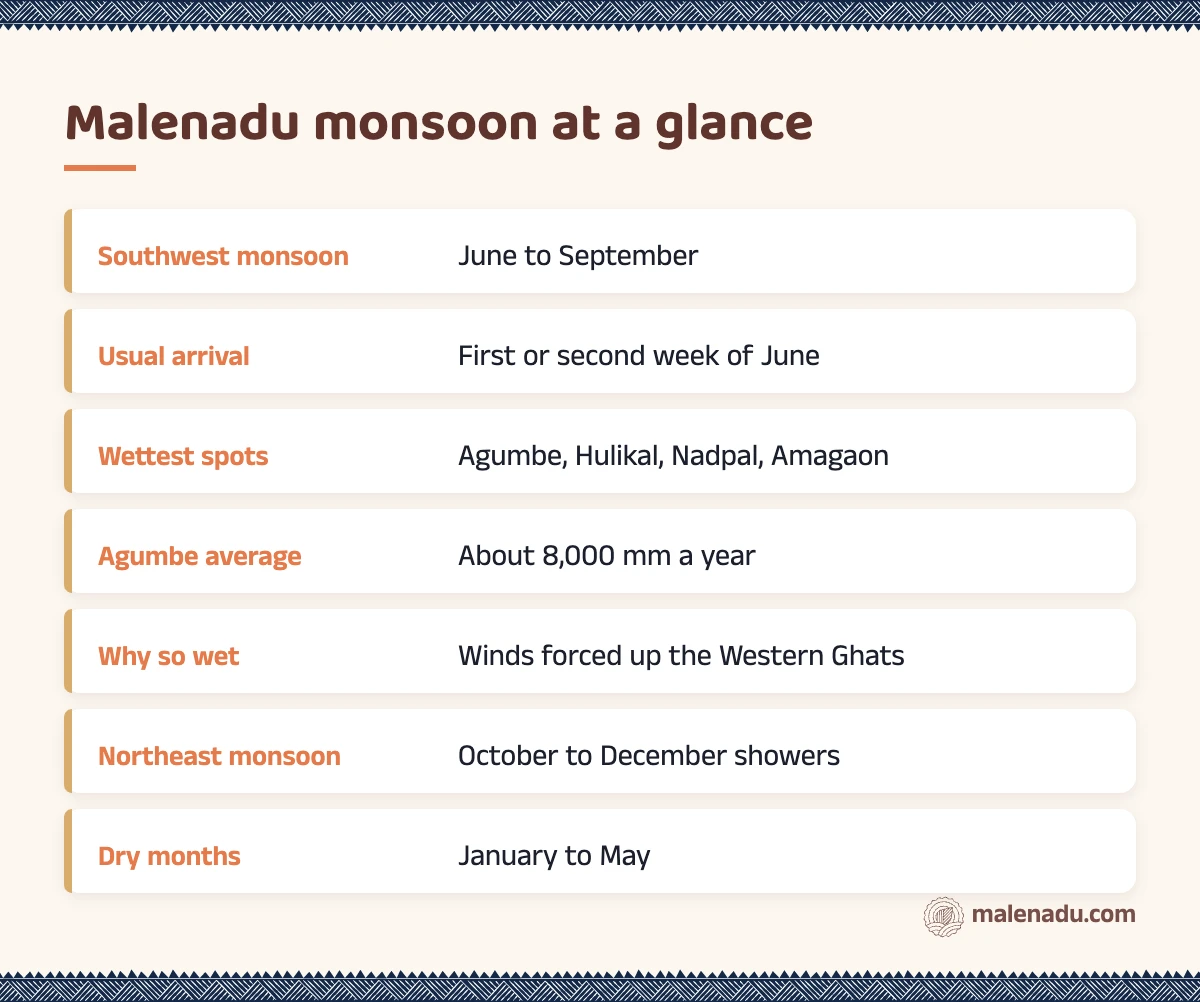
The Malenadu monsoon usually arrives in the first or second week of June, a few days after the southwest monsoon reaches Kerala. The India Meteorological Department treats 1 June as the normal onset date over Kerala. From there the rain clouds move up the coast and climb into the hills of Udupi, Dakshina Kannada, Shivamogga, Chikkamagaluru, Kodagu and Uttara Kannada.
The date shifts every year. In 2017 the IMD declared the onset over Karnataka on 7 June, while in 2023 the monsoon covered the whole state only on 23 June. Kannada farmers name each spell of rain after a nakshatra (male means rain). Mrigashira male in early June is the one they expect to bring the monsoon.
Once it sets in, the Malenadu monsoon runs hard from June to September. Rain eases through late September and October, when the southwest winds weaken and the northeast monsoon takes over. If you want to understand the region before the rain, our guide to Malenadu in Karnataka explains where the hills begin and end.
Why is Malenadu rainfall so heavy?
Malenadu rainfall is so heavy because the Western Ghats stand like a wall in front of the wet southwest winds from the Arabian Sea. As these winds hit the hills they are forced upward, the air cools and its moisture falls as rain. Scientists call this orographic lift. It is the engine of the Malenadu monsoon.
The rain falls hardest on the western slopes and the crest of the Ghats, where places like Agumbe, Hulikal and Kollur sit. Once the clouds cross the crest they have lost most of their water, so the land just to the east lies in a rain shadow. Bhadra Tiger Reserve, only a short drive east of the crest, gets about 1,500 to 1,700 mm a year, a fraction of what Agumbe receives.
That is why Malenadu rain can be so local. It can pour all day in Thirthahalli while Shivamogga town, about 60 km away, sees only light showers. It also explains the change in farms as you drive east, from areca, pepper and cardamom under shade to open fields of paddy, maize and ragi.
Which are the wettest places in Malenadu?
The wettest places in Malenadu are Agumbe, Hulikal and the villages around them on the crest of the Ghats, along with Amagaon, Talakaveri, Bhagamandala and the Kollur area. Rain gauges run by the Karnataka State Natural Disaster Monitoring Centre (KSNDMC) now track rain across the state, so the record changes hands from year to year. In one recent Malenadu monsoon season, Hulikal, Nadpal and Agumbe each crossed 6,000 mm, according to KSNDMC figures.
Agumbe rainfall: is it still the wettest?
Agumbe rainfall has long been the benchmark for the whole state, which is why Agumbe is called the Cherrapunji of the South. The British set up the first rain gauge here in 1882. Meteorological department figures put the long-term average at about 8,000 mm a year, with a record 11,343 mm in 1962 and only about 5,000 mm in 2015, as Deccan Herald reported.
In recent years Agumbe has sometimes been beaten. KSNDMC gauges at Hulikal in Shivamogga district and at Nadpal and Mudradi in Udupi district have recorded more rain than Agumbe in some seasons, according to Down To Earth. Scientists link the drop at Agumbe partly to forest loss and changing land use around it.
Other very wet places
- Hulikal near Hosanagara in Shivamogga district, on the steep ghat road down to the coast, is now often among the wettest spots in the state.
- Amagaon in Khanapur taluk of Belagavi district, near the Goa border, is another village often named among Karnataka’s wettest.
- Talakaveri and Bhagamandala in Kodagu get some of the heaviest rain in that district. The Kaveri and its feeder streams rise fast here in July and August.
- Kollur and the Kodachadri slopes in Udupi and Shivamogga districts catch the full force of the monsoon as it hits the hills.
What happens after the southwest monsoon?
When the main Malenadu monsoon ends in late September, the hills get a second, lighter rainy spell from the northeast monsoon in October and November, followed by a long dry season. October often brings warm mornings and loud afternoon thunderstorms. By December the sky clears, the mornings turn cool and mist settles in the valleys.
January to March are the driest months, though streams fed by the forest keep running in good years. In Chikkamagaluru and Kodagu, a good shower between February and April is called the blossom shower, because it sets coffee into white, scented flower. April and May bring hot, sticky afternoons and the first pre-monsoon thunderstorms, which farmers watch closely.
Malenadu weather month by month
Malenadu weather follows a clear pattern: heavy rain from June to September, showers in October and November, then dry weather from December to May. The table below follows the Malenadu monsoon and the dry months after it, with what each month is good for.
| Month | Malenadu weather | What to do |
|---|---|---|
| January | Cool, dry, misty mornings | Treks, birding, pepper harvest on farms |
| February | Dry and pleasant, warmer afternoons | Treks, safaris, hornbill festival at Dandeli |
| March | Hot in the valleys, cool on the hills | Safaris, coffee blossom if showers come |
| April | Hot and humid, first thunderstorms | Safaris near water, jackfruit and mango season |
| May | Pre-monsoon storms, very humid | Last dry trips, farms get ready for rain |
| June | Monsoon arrives with strong wind and rain | Rain stays, frogs, first green paddy nurseries |
| July | Heavy, steady rain and thick mist | Monsoon food, homestays, waterfalls from safe points |
| August | Very wet, rivers in flood | Waterfalls, green paddy fields |
| September | Rain eases, sunny breaks | Waterfalls at their fullest, quiet roads |
| October | Afternoon thunderstorms, fresh green hills | Trails reopen, festivals |
| November | Drying out, cool nights | Treks, areca harvest begins in many areas |
| December | Cool, dry and clear | Treks, coffee picking, pepper harvest begins |
For the farm side of each month, see our Malenadu crop calendar. It follows the same seasons from the farmer’s point of view.
How to travel safely in the Malenadu monsoon
The safe way to travel in the Malenadu monsoon is to drive only in daylight, check road and weather alerts every morning and keep a spare day in your plan. The rain is beautiful, but it brings real risks on ghat roads and near rivers.
During the Malenadu monsoon, ghat roads such as Agumbe, Charmadi, Shiradi and Sampaje are often hit by landslides and fallen trees in July and August. District officials sometimes ban heavy vehicles on these roads during the rains or close them for days after a slip. Low bridges and causeways can go under water overnight.
The worst recent disaster came in August 2018, when days of extreme rain set off landslides across Kodagu. Twenty people were killed, 4,056 homes were damaged and around 18,000 people had to be moved to safety. Since then Kodagu takes red alerts very seriously. Visitors should too.
- Follow IMD and KSNDMC alerts and the local news. Do not travel on red alert days.
- Avoid stopping under steep cuttings on ghat roads. Never cross a flooded causeway.
- Keep away from the edge of swollen waterfalls and rivers. Rocks are slippery and water rises fast.
- Wear leech socks and carry salt for forest walks, as leeches are everywhere in the rain.
- Pack for the Malenadu monsoon: a good raincoat, quick-dry clothes, a torch and a power bank. Power cuts are common.
Local tip
Book a homestay with a sit-out facing the valley and plan fewer drives. The best part of the Malenadu monsoon is watching the rain roll in over the hills with a hot cup of coffee in hand.
How does the Malenadu monsoon shape daily life and food?
The Malenadu monsoon shapes daily life by keeping people indoors for weeks, so homes stock up on food, firewood and warmth before the rain starts. In April and May families dry and store everything that will be hard to get in July. Food in the rainy months is hot, sour and peppery.
The monsoon store cupboard
Before the Malenadu monsoon, most kitchens fill up with things that keep for months:
- Murugalu (dried kokum rind), for sour saaru and huli all through the rains.
- Pickles (uppinakai), especially appe midi, the small tender wild mango pickled whole in brine and chilli.
- Halasina happala, thin jackfruit papads dried in the summer sun and fried or roasted in the rains.
- Dried jackfruit seeds, rice and coconut, stored with dried chillies and stacks of firewood.
From the malenadu pantry
Kokum rind is the backbone of the monsoon store cupboard. Our sun dried murugalu keeps for months in a dry jar, ready for a quick sour saaru on a cold, wet evening.
Hot saaru, kashaya and sambrani smoke
Hot saaru (a thin rasam) with plenty of black pepper is the daily comfort food of the Malenadu monsoon. Our kokum saaru recipe shows the simple version made in almost every home. Wild mushrooms, tender bamboo shoots and colocasia leaves also appear in the rains and go into special dishes, explained in our guide to Malenadu food.
When someone has a cold in the rains, Malenadu homes boil a kashaya, a hot drink of crushed pepper, dry ginger and coriander seeds sweetened with liquid jaggery or block jaggery. It is an old family habit rather than a medicine, but few things feel better on a wet evening.

From the malenadu pantry
Joni bella, our liquid jaggery, stirs straight into kashaya or coffee without needing to be grated. It is the sweetener many Malenadu homes keep near the stove in the rainy months.
Damp gets into everything during the Malenadu monsoon. Many families burn sambrani (benzoin resin) on coals and wave the fragrant smoke through rooms and over clothes to keep them fresh. Some still use the smoke to dry a baby’s hair after a bath.
How does rain shape farming in Malenadu?
Rain decides the whole farming year in Malenadu, from when pepper flowers to when areca needs spraying. The Malenadu monsoon is both the farmer’s best friend and the season of most worry, because too little rain at the start or too much in July can cut a crop badly.
- Pepper: Vines flower around May and June as the first showers of the Malenadu monsoon arrive. The spikes then set fruit through the rains. In one recent year, 25 days of nonstop rain and wind in July damaged spikes on many Karnataka farms. The berries ripen for harvest from late November to February.
- Areca: The big Malenadu monsoon worry on areca farms is koleroga, a fruit rot also called mahali that strikes during the southwest monsoon. Farmers climb the palms to spray 1 percent Bordeaux mixture before and during the rains, as CPCRI advises.
- Cardamom: New plants go in with the monsoon. Too much rain later makes pods drop early and makes drying hard.
- Paddy: Fields in the valleys are planted in the heaviest rain of July, often by groups of neighbours working together.
Read more about the palm and its monsoon care in our guide to areca nut farming in Malenadu. The crop calendar linked above shows every farm job month by month.
From the malenadu pantry
Our black pepper grows on vines that flower with the first Malenadu rain and ripen through the wet months. The heavy monsoon is a big part of why these berries are so bold and sharp.
What is the best time to visit Malenadu?
The best time to visit Malenadu for most people is October to February, when the hills are green, the air is cool and roads and trails are open. But the right month really depends on what you want to see.
| Interest | Best months | Why |
|---|---|---|
| Waterfalls | July to September | Full flow, best viewed from safe points |
| Rain and homestays | June to August | The Malenadu monsoon at its strongest |
| Trekking | October to February | Open trails, clear views, no leeches |
| Wildlife safaris | October to May | Animals easier to see as the forest dries |
| Birding | November to February | Cool weather and active birds |
| Frogs and snakes | June to August | Night walks in the wet forest |
| Coffee blossom | February to April | Only after a good blossom shower |
| Farm harvests | November to February | Pepper, areca and coffee picking |
Waterfalls and the Malenadu monsoon go together, so read our Malenadu waterfalls guide for where to go. For safaris and the rainforest, see our Malenadu wildlife guide. Trekkers should plan with our guide to peaks and treks, since most trails close or turn dangerous in the rain.
Plan your trip around the rain
The Malenadu monsoon is the heartbeat of the region. Knowing it will make any trip better. Start with our Malenadu travel guide to put the places together. To bring a little of the rainy season home, try our spices from Malenadu farms, grown on land that drinks this rain every year.
Bring Malenadu home
Grown and made by Malenadu farmer families, packed by malenadu, a farmer owned producer company in Honnavar.
-
8% OFF
Black Pepper
Price range: ₹165 through ₹299 -
17% OFF

Kokum Rind
Original price was: ₹240.₹200Current price is: ₹200. -
14% OFF

Liquid Jaggery
Original price was: ₹349.₹299Current price is: ₹299. -
40% OFF

Desi Cow Ghee
Original price was: ₹1,500.₹899Current price is: ₹899. -
6% OFF
Monkey Jack Powder
Original price was: ₹399.₹375Current price is: ₹375. -
13% OFF

Turmeric Powder
Price range: ₹70 through ₹120
Frequently asked questions about the Malenadu monsoon
When does the monsoon start in Malenadu?
The Malenadu monsoon usually starts in the first or second week of June, a few days after it reaches Kerala. It stays strong until about late September.
Which place gets the most rain in Karnataka?
Agumbe has long been famous as the wettest place, with a long-term average of about 8,000 mm. In recent years gauges at Hulikal, Nadpal and Mudradi have sometimes recorded more.
Is it safe to visit Malenadu during the monsoon?
Yes, with care. Travel in daylight, follow IMD and KSNDMC alerts, avoid ghat roads on red alert days and stay away from swollen rivers and waterfall edges.
What is the best time to visit Malenadu?
October to February suits most visitors, with cool weather and open trails. Come in July to September for waterfalls and the full Malenadu monsoon.
Why does Agumbe get so much rain?
Agumbe sits on the crest of the Western Ghats. Wet winds from the Arabian Sea are forced up the hills, cool down and drop their moisture as heavy rain.
What is Malenadu weather like in December?
December is cool, dry and clear, with misty mornings and cold nights in the hills. It is a good month for treks, coffee estates and the start of the pepper harvest.
Are there leeches in Malenadu in the rainy season?
Yes, leeches are common on forest trails through the Malenadu monsoon, from June to September. Wear leech socks, carry salt and check your feet after every walk.
Explore more of Malenadu
Malenadu TravelMalenadu Travel GuideRoutes, stays and seasons for the rain hills of Karnataka
Malenadu TravelMalenadu Peaks and TreksPeaks, permits and seasons for walking the Western Ghats
Malenadu TravelMalenadu Waterfalls22 falls across the hills, with access and best season
Malenadu TravelMalenadu WildlifeTigers, macaques, king cobras and the forests farms need
Malenadu CultureMalenadu CulturePeople, arts and old ways of Karnataka’s rain hills
Malenadu FarmingMalenadu CropsWhat grows in Karnataka’s rain hills and why it grows
Start hereMalenadu in KarnatakaWhere Malenadu is, what the name means