
Malenadu Culture
Malenadu history is the story of the forested hill country of the Western Ghats in Karnataka, from Iron Age burials and the first Kannada kings at Banavasi to the Keladi Nayakas, Tipu Sultan, the coffee planters and the tenant farmers of Kagodu. This guide walks through each era in order, with a timeline table and places you can still visit.
On this page
What is Malenadu history about?
Malenadu history is the story of how people lived, ruled and farmed in the rain forest hills of Karnataka over roughly two thousand years. It is a story of small hill kingdoms, big empires on the plains that wanted the hills’ pepper and timber. It is also the story of farmers who held on through all of it.
If you are new to the region, start with our page on Malenadu in Karnataka and the list of Malenadu districts and taluks. This page sticks to the story. For the stone temples and forts that history left behind, see our guides to Malenadu temples and Malenadu forts.
Why the history of Malenadu is different from the plains
The history of Malenadu is shaped by rain and forest. Armies found the ghats hard to cross, so hill chiefs often kept real power at home even while they paid tribute to a distant emperor. At the same time, the hills sat right above the ports of the Kanara coast, so pepper, areca, cardamom and timber pulled traders and kings towards them.
That mix of remote forest and rich trade runs through every era of Malenadu history. It is also the history of the Western Ghats Karnataka holds, the long green stretch between Goa and Kerala.
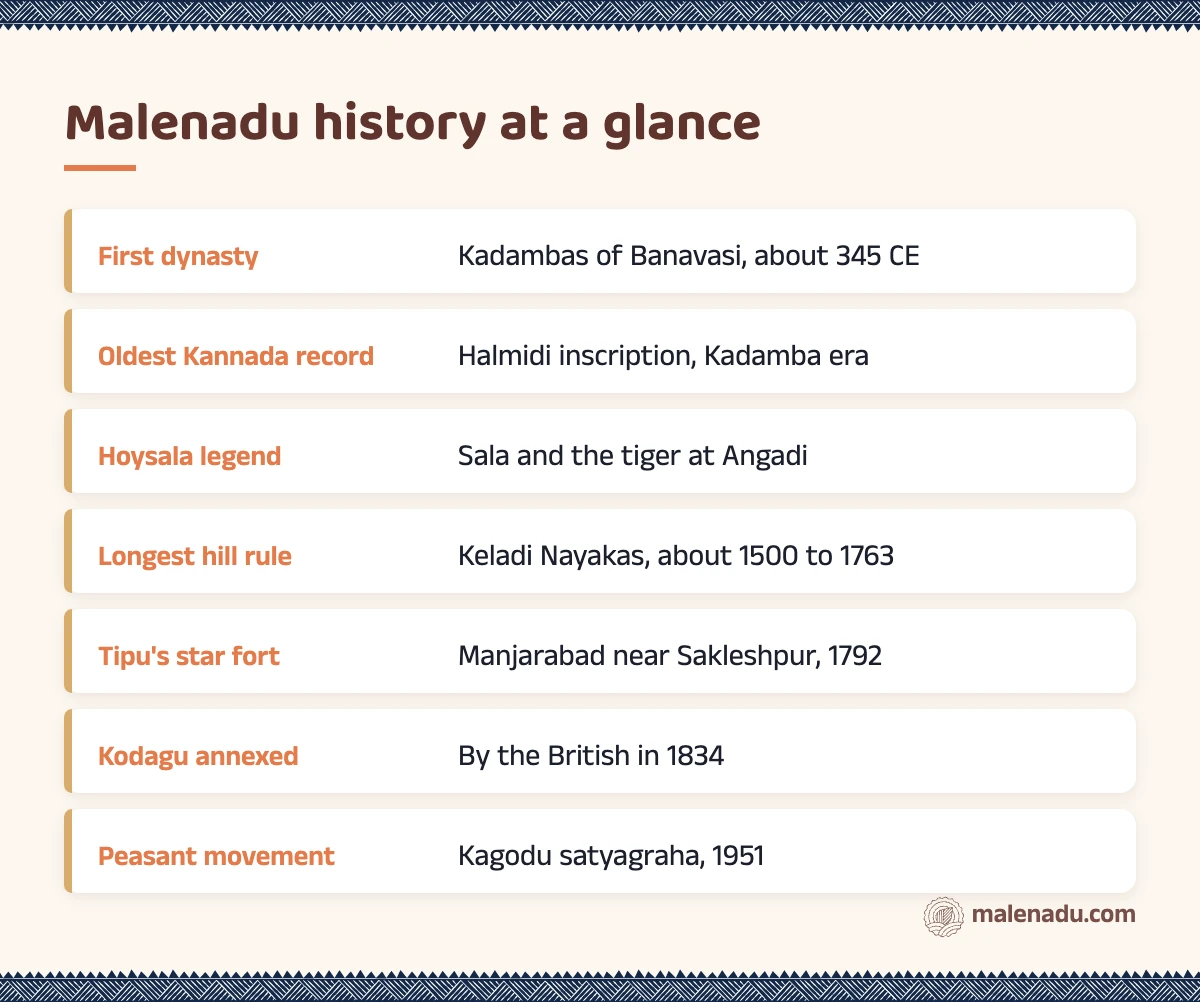
Malenadu history timeline at a glance
This table gives the Malenadu history timeline in one place. Dates in Malenadu history are approximate where sources differ.
| Period | Who held power | Main centres | What you can still see |
|---|---|---|---|
| Iron Age, before the Common Era | Early farming and herding peoples | Edges of the hills, such as Kodagu | Megalithic burials |
| About 345 to 525 CE | Kadambas | Banavasi | Madhukeshwara temple town, Talagunda pillar |
| 6th to 12th century | Chalukyas, Rashtrakutas, Gangas (overlords) | Banavasi province | Inscriptions, old temples |
| About 9th to 17th century | Santaras (local Jain rulers) | Humcha, later Kalasa and Karkala | Jain basadis at Humcha |
| About 11th to 14th century | Hoysalas | Sosevur (Angadi), then Belur and Halebidu | Angadi ruins, Belur and Halebidu |
| 14th to 16th century | Vijayanagara and its hill chiefs | Sonda, Gerusoppa, Keladi | Temples and forts of the chiefs |
| About 1500 to 1763 | Keladi Nayakas | Keladi, Ikkeri, Bidanur (Nagara) | Keladi and Ikkeri temples, Nagara fort |
| 1763 to 1799 | Haidar Ali and Tipu Sultan | Bidanur, Manjarabad | Manjarabad and Jamalabad forts |
| About 1600 to 1834 | Haleri rajas of Kodagu | Madikeri | Madikeri fort and palace |
| 1799 to 1947 | Mysore state and British India | Plantation towns | Coffee estates, old bungalows |
| 1951 to 1974 | Tenant farmers, land reform | Kagodu, Sagara | Village memory, novels |
| 1960s to today | Dams, parks and new farms | Sharavathi, Bhadra | Reservoirs, national parks |
Early forest peoples and the first traces
The earliest Malenadu history is the least written down. Forest peoples lived in these hills long before any king, gathering honey, hunting, fishing and clearing small patches for crops. Their descendants still live here. Many of their old gods live on in village shrines and sacred groves.
Hard evidence from this early Malenadu history is thin, because rain and forest swallow most traces. On the edges of the hills, archaeologists have reported Iron Age megalithic burials, including sites in Kodagu. These stone burials, common across south India, belong to the centuries before the first inscriptions.
The old respect for forest gods also explains why some patches of forest were never cut. Our guide to devara kadu, the sacred groves, tells that part of the story.
The Kadambas of Banavasi: the first Kannada kings
The Kadambas of Banavasi were the first royal family of Karnataka to rule from the land itself and use Kannada in government. Their capital, Banavasi, sits on the Varada river near Sirsi in Uttara Kannada, at the northern end of the hills.
The founder was Mayurasharma. According to the Talagunda pillar inscription, he went to Kanchi to study, was humiliated by a Pallava guard, gave up his books for the sword and won a kingdom. His line ruled from about 345 CE to around 525 CE. Talagunda lies in Shikaripura taluk of Shivamogga district.
Later Kadamba kings such as Kakusthavarma made marriage ties with the great houses of north and south India. The Halmidi inscription of the Kadamba period is counted as the oldest known inscription in Kannada. For Malenadu history this matters: Kannada as a language of rule began on the edge of these very hills.
Banavasi still has the Madhukeshwara temple and holds a yearly festival of the Kadambas. Our Sirsi guide covers how to get there.
Gangas, Chalukyas and the Santaras of Humcha
After the Kadambas, the hills became the edge of bigger kingdoms. In the later 6th century the Chalukyas of Badami took Banavasi. Over the next centuries the Rashtrakutas and the Chalukyas of Kalyani ruled the province, which inscriptions call the Banavasi Twelve Thousand. To the south, the Western Ganga kings of Talakad held the country reaching towards Hassan and Kodagu.
Inside the forest, local families did the real ruling, which is typical of Malenadu history. The most interesting are the Santaras, a Jain dynasty with its seat at Humcha (also called Hombuja) in Hosanagara taluk.
- Founder story. Tradition says the founder, Jinadatta, arrived at Humcha carrying only an image of the Jain goddess Padmavati and built his kingdom around it.
- Overlords. The Santaras served the Rashtrakutas, the Chalukyas of Kalyani, the Hoysalas, Vijayanagara and finally the Keladi chiefs.
- Branches. By the 12th century they split into a Kalasa branch and a Hosagunda branch. The Kalasa line later ruled from Karkala.
- End. The Keladi chiefs finally overpowered them in the 17th century.
Humcha’s Padmavati temple and basadis still draw Jain pilgrims. It is an easy side trip from Thirthahalli.
The Hoysala origin at Angadi (Sosevur)
The Hoysala dynasty traces its origin to Angadi, a small village in Mudigere taluk of Chikkamagaluru district, known in old records as Sosevur. It is about 18 km from Mudigere, in coffee country, according to a Deccan Herald report on Angadi.
The legend is the most famous story in Malenadu history. A teacher named Sudatta and his pupil Sala were at worship in the goddess temple at Sosevur when a tiger sprang at them. The teacher cried out Hoy Sala, meaning “strike, Sala”.
Sala killed the tiger with one blow. The teacher then blessed him to found a kingdom. Hoy Sala became Hoysala.
The scene of Sala fighting the tiger became the royal emblem. You can see it carved at the Hoysala temples. At Angadi itself the goddess temple is still in worship, while the nearby Chennakeshava, Patalarudreshwara and Mallikarjuna temples and several Jain basadis stand in ruins among the coffee.
The Hoysalas soon moved their capital down to Belur and then to Dwarasamudra (Halebidu). They ruled much of south India until the 14th century. Belur and Halebidu are now on the UNESCO World Heritage List as the Sacred Ensembles of the Hoysalas.
Vijayanagara and the hill chiefs
From the 14th century the Vijayanagara empire ruled south India while its chiefs held the hills. Tradition links the founding of Vijayanagara with the sage Vidyaranya of Sringeri, so the hill town on the Tunga mattered to the empire from the start.
The chiefs ran their own small states:
- Sonda, near Sirsi. Inscriptions show Sonda chiefs as Vijayanagara subordinates from at least 1432.
- Gerusoppa, on the Sharavathi near Honnavar. Its queen Chennabhairadevi is believed to have ruled for about 54 years in the 16th century. The Portuguese called her the Pepper Queen, because pepper from these forests went out through her ports.
- Keladi, near Sagara, where a family of village chiefs rose around 1500 to become the Keladi Nayakas.
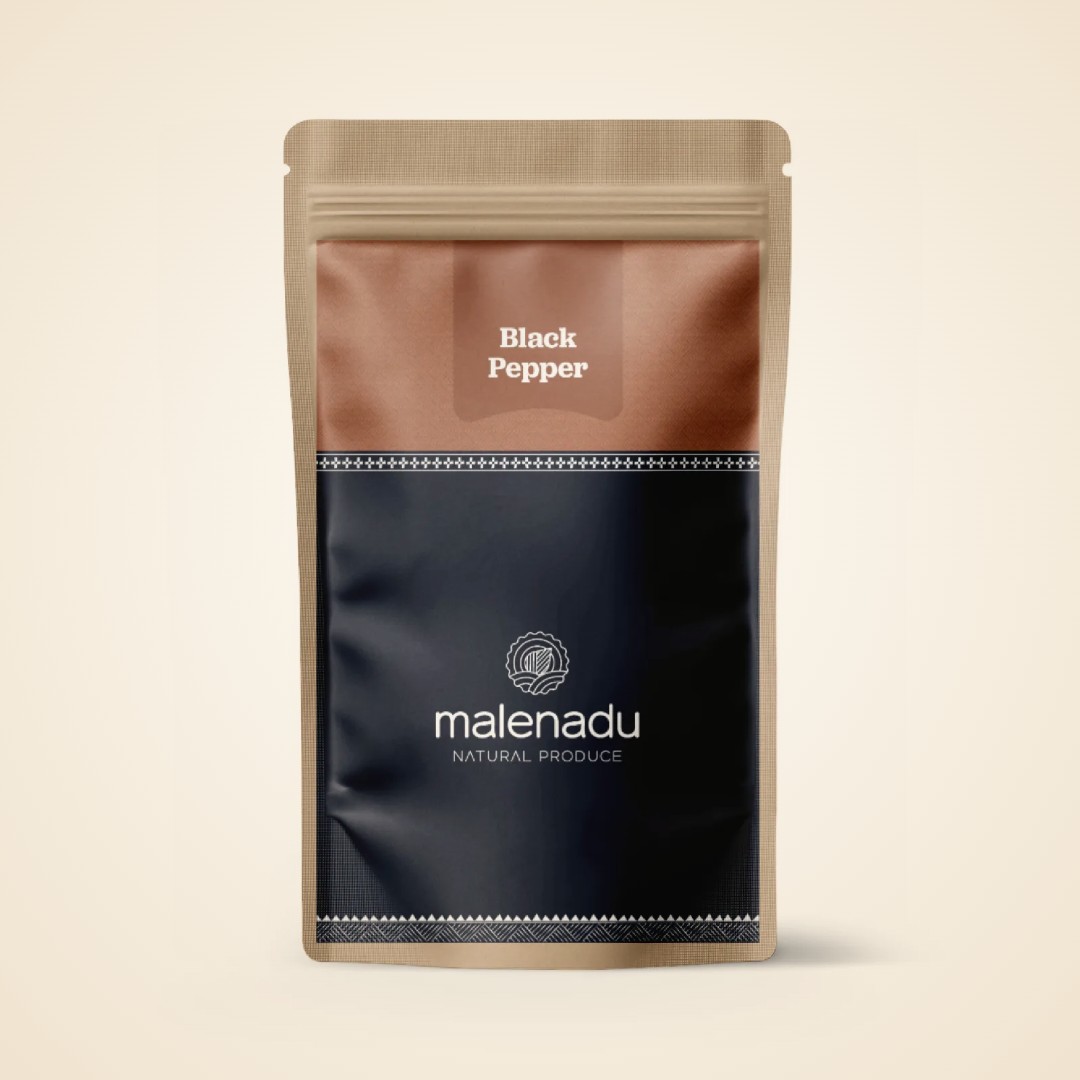
Pepper was the gold of Malenadu history, the reason outsiders cared about these hills at all. Portuguese, Arab and later Dutch and English traders all came to the Kanara coast for it. The vines still climb the areca palms of the same valleys. Our black pepper comes from these hills.
From the malenadu pantry
The spice that drew the Portuguese to the Pepper Queen’s ports still grows on vines in these valleys. This is sun dried pepper from Malenadu, the same crop that paid for forts and temples for centuries.
When the Vijayanagara army lost the great battle of 1565, the empire broke up. The hill chiefs became independent. The strongest of them were the Keladi Nayakas. The next chapter of Malenadu history belongs to them.
The Keladi Nayakas: Keladi, Ikkeri and Bidanur
The Keladi Nayakas were the longest ruling home-grown kings in Malenadu history, holding the hills and much of the coast from around 1500 until 1763. They began as Vijayanagara chiefs at Keladi near Sagara, then moved to Ikkeri and then to Bidanur.
| Capital | When | What happened there |
|---|---|---|
| Keladi | From about 1500 | First seat of the family, Rameshwara temple |
| Ikkeri | 16th century to about 1640 | Aghoreshwara temple, mint and court |
| Bidanur (Nagara) | About 1640 to 1763 | Fortified capital, renamed Nagara |
The best known Keladi Nayakas are these:
- Shivappa Nayaka (mid 17th century). He fortified Bidanur, drove the Portuguese from their coastal strongholds and reformed land tax with a system called sist. In 1659 he took the Manjarabad country around Sakleshpur.
- Keladi Chennamma. In 1689 she gave shelter to Rajaram, son of Shivaji, when he was fleeing the Mughal emperor Aurangzeb. She is still a hero in Sagara.
According to Karnataka Tourism’s page on Nagara, Haidar Ali captured Bidanur in 1763 and briefly named it Hyder Nagar. That ended the Keladi Nayakas. Our Sagara guide covers Keladi and Ikkeri today.
Haidar Ali, Tipu Sultan and the Kodagu rajas
After 1763 the hills became the western frontier of Mysore under Haidar Ali and his son Tipu Sultan. They wanted the hill passes, because the roads from Mysore to the ports of Mangaluru ran through them.
Tipu built forts to guard these routes. They are still the most visible Malenadu history on the hilltops. Manjarabad near Sakleshpur, a star shaped fort, dates from 1792. Jamalabad above Belthangady followed in 1794.
Tipu died defending Srirangapatna in 1799. The British then handed the Mysore throne back to the Wodeyar family.
Kodagu had its own Malenadu history. The Haleri rajas ruled it from around the start of the 17th century, with Madikeri as their capital. Mudduraja built the first fort there.
Tipu later took the Madikeri fort and rebuilt it in stone, but Dodda Veerarajendra won it back in 1790. In 1834 the British deposed the last raja and annexed Kodagu.
Colonial Malenadu history: coffee, plantations and the Nagar revolt
The colonial chapter of Malenadu history is the story of coffee. Tradition says the Sufi saint Baba Budan brought seven coffee seeds from Yemen to the Chikkamagaluru hills around 1600. Commercial planting began in the 18th century. In the 19th century European planters cleared large blocks of forest for estates in Kodagu, Chikkamagaluru and the Manjarabad country.
Plantations changed the hills for good. Roads and ghat passes were cut and labour came from the plains and the coast. Towns like Sakleshpur, Mudigere and Madikeri grew around coffee.
Our guide to Malenadu coffee tells that part of Malenadu history in full. Cardamom and pepper were planted under the same shade trees.

From the malenadu pantry
Cardamom grows in the cool shade of the same estates the planters opened in the 19th century. This is green cardamom from these hills, picked by hand and dried, a small taste of plantation history for your tea.
There was also resistance. Around 1830 the peasants of the old Bidanur country rose against heavy taxes in what is called the Nagar revolt. The British blamed misrule and took over the direct running of Mysore state in 1831.
Kagodu satyagraha and land reforms
The Kagodu satyagraha of 1951 is the best known farmers’ movement in Malenadu history. Kagodu is a hamlet in Sagara taluk on the Varada river. Its tenant farmers, mostly from the Deevara community, worked land owned by big landlords.
The fight began over a measuring basket. Landlords used a small kolaga (grain measure) when lending paddy and a bigger one when the tenants repaid. The tenants refused to pay, formed a farmers’ union and went to jail.
The socialist leader Ram Manohar Lohia visited Kagodu in June 1951 and was arrested at Sagara railway station on his way back. The slogan of those days, that the tiller should own the land, stayed alive.
The movement ended without a clear win, but it changed Malenadu history and the politics of Karnataka. In 1974 the state’s land reform law gave ownership to many tenants who tilled the land. Novels from Sagara, such as Na D’Souza’s Kolaga, kept the memory alive. Our guide to Malenadu writers has more.
Dams, displacement and Malenadu today
The most recent chapter of Malenadu history is about water and power. From the middle of the 20th century, rivers like the Sharavathi and Bhadra were dammed for electricity and irrigation. The Linganamakki dam on the Sharavathi, built in 1964, flooded a huge stretch of valley above Jog Falls.
Thousands of farming families lost their land to the reservoirs. Many were resettled on forest land. Some still wait for proper title deeds decades later.
The novel Dweepa by Na D’Souza, about a family on an island in rising water, tells this story better than any report. Our guide to Malenadu rivers covers the valleys themselves.
Today’s Malenadu history is still being written:
- Protected forests. The Western Ghats became a UNESCO World Heritage Site in 2012, with parts in Karnataka.
- Mining stopped. Iron ore mining at Kudremukh ended in 2005 after a Supreme Court order.
- New farms. Areca has spread into old paddy fields. Coffee, pepper and cardamom remain the hill crops. See our guide to areca nut farming.
Where to see Malenadu history
The easiest way to feel Malenadu history is to visit the places in this guide in one or two trips:
- Banavasi and Sirsi: the Kadamba capital and the Madhukeshwara temple.
- Humcha and Thirthahalli: the Santara seat and Jain basadis.
- Angadi near Mudigere: the Hoysala origin village and its ruins.
- Keladi, Ikkeri and Nagara near Sagara: the three Keladi capitals.
- Sakleshpur: Tipu’s Manjarabad fort.
- Madikeri: the fort of the Kodagu rajas.
- Kagodu near Sagara: a quiet village where the tenant farmers stood up.
Local tip
Carry water and go early to the ruined sites like Angadi and Nagara. There are few shops nearby. Local people often know a story or a hidden carving that no signboard mentions. Ask politely and listen.
Where to go next
Malenadu history makes more sense when you see what people grew, cooked and believed. Read our guide to Malenadu culture for the people and arts, then plan a trip with the temples and forts guides above.
Bring Malenadu home
Grown and made by Malenadu farmer families, packed by malenadu, a farmer owned producer company in Honnavar.
-
8% OFF

Black Pepper
Price range: ₹165 through ₹299 -
19% OFF

Cardamom
Price range: ₹130 through ₹330 -
51% OFF

Small Jute Bag
Original price was: ₹200.₹99Current price is: ₹99. -

Coconut Jaggery Burfi
₹120 -
29% OFF

Honey
Price range: ₹249 through ₹449 -
17% OFF

Kokum Rind
Original price was: ₹240.₹200Current price is: ₹200.
Frequently asked questions about Malenadu history
Who were the first rulers in Malenadu history?
The first well known dynasty is the Kadambas of Banavasi, founded by Mayurasharma around 345 CE. They were the first Karnataka-based kings to use Kannada in government.
Where is the Hoysala origin Angadi temple?
Angadi, the old Sosevur, is a village in Mudigere taluk of Chikkamagaluru district, about 18 km from Mudigere. The goddess temple where the tiger story is set is still in worship, with older ruins nearby.
Who were the Keladi Nayakas?
The Keladi Nayakas were a hill dynasty that began as Vijayanagara chiefs around 1500 and ruled from Keladi, Ikkeri and Bidanur. Haidar Ali ended their rule in 1763.
What was the Kagodu satyagraha?
It was a tenant farmers’ movement of 1951 in Sagara taluk, sparked by landlords using unfair grain measures. Ram Manohar Lohia visited and was arrested. The movement shaped later land reforms in Karnataka.
When did Kodagu become part of British India?
The British deposed the last Haleri raja and annexed Kodagu in 1834.
Why did Tipu Sultan build forts in Malenadu?
Tipu wanted to guard the hill roads from Mysore to the ports of the coast. Manjarabad near Sakleshpur (1792) and Jamalabad near Belthangady (1794) date from this time.
What is the history of the Western Ghats Karnataka region in brief?
It moves from forest peoples and Iron Age burials to the Kadambas, Hoysalas, Vijayanagara chiefs and Keladi Nayakas, then Mysore rule, coffee estates, land reform and the big dams of the 20th century.
Explore more of Malenadu
Malenadu CultureMalenadu CulturePeople, arts and old ways of Karnataka’s rain hills
Malenadu CultureFestivals of MalenaduA year of harvests, jatres and sweets in the rain hills
Malenadu CultureThe Malenadu HouseCourtyards, verandas and attics built for the rain
Malenadu CultureLanguages of MalenaduKannada, its hill dialects and the tongues around them
Malenadu CultureMalenadu Village LifeFarmhouses, areca gardens, paddy and the long rains
Malenadu CultureMalenadu Quotes and CaptionsShort lines for rain, mist, coffee and home
Malenadu Cultureಮಲೆನಾಡು: ಕನ್ನಡದಲ್ಲಿ ಮಾಹಿತಿಬೆಟ್ಟ, ಕಾಡು, ಮಳೆ ಮತ್ತು ತೋಟಗಳ ನಾಡಿನ ಪರಿಚಯ
Malenadu CultureMalenadu WritersThe Kannada authors who put the hills into books
Start hereMalenadu in KarnatakaWhere Malenadu is, what the name means