
Malenadu Culture
A devara kadu (ದೇವರ ಕಾಡು, “god’s forest”) is a patch of forest that a Malenadu village keeps for its deity and never cuts. This guide explains what these sacred groves are, their local names from Kodagu to Sirsi, the rules people follow inside them, the rare life they shelter, what threatens them and how to visit one with respect.
On this page
What is a devara kadu?
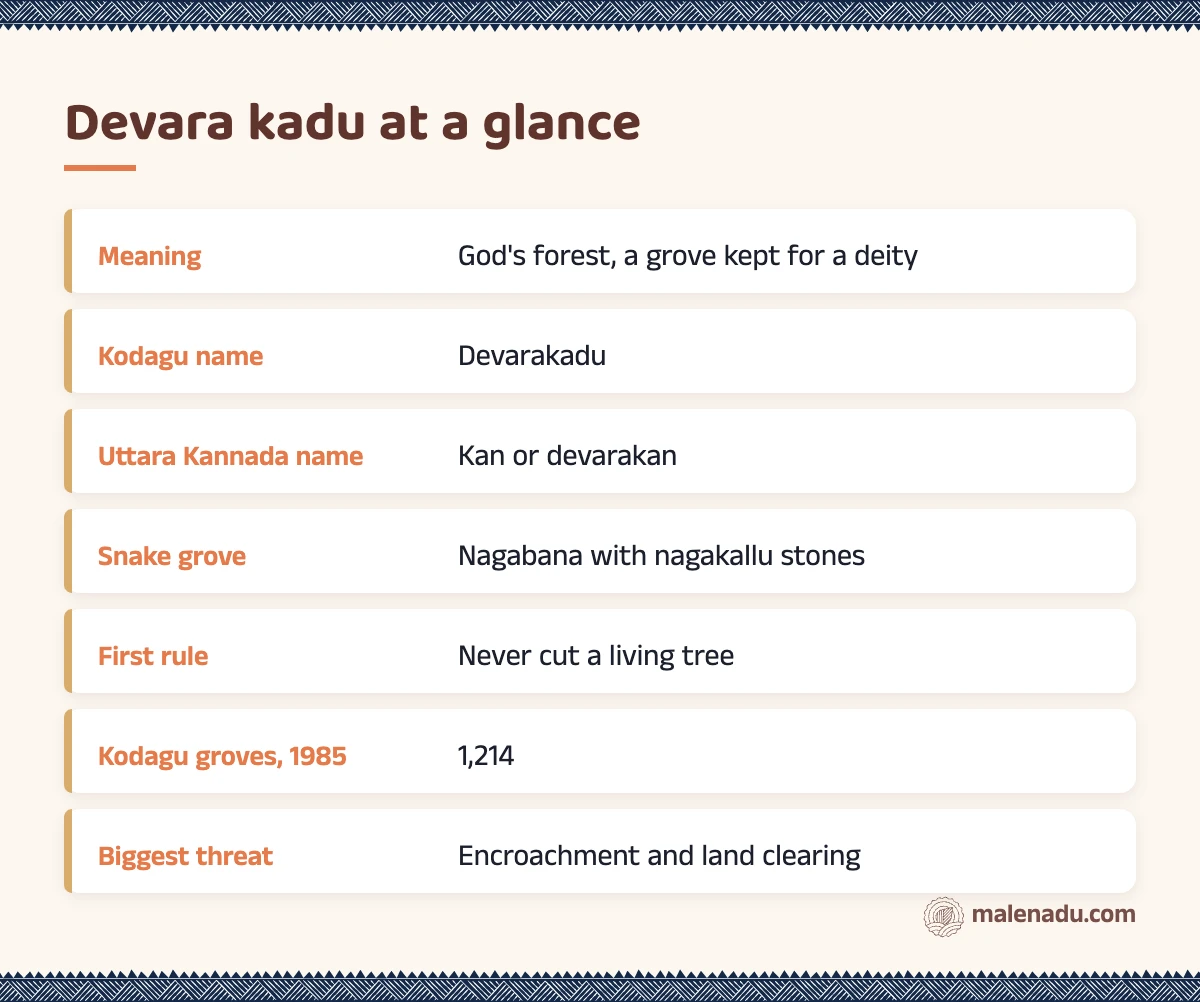
A devara kadu is a sacred grove: a piece of natural forest set aside for a god or goddess, where green trees are not cut. Devaru means god and kadu means forest in Kannada, so the name simply means god’s forest. You will also see it spelt devara kaadu or devarakadu.
The deity in a devara kadu is usually a local one. It may be a forest goddess, a guardian spirit, the snake god Naga, a tiger god or a form of Ayyappa or Bhagavathi. Often there is no temple at all, just a stone, a trident or a few clay figures under a big tree. The forest itself is the shrine.
A devara kadu can be smaller than a cricket ground or as big as a whole hillside. What makes it a devara kadu is not its size but the promise the village keeps: this forest belongs to the god, so people do not take from it.
If you are new to the region, start with our page on Malenadu in Karnataka and the list of Malenadu districts and taluks. Sacred groves are found in almost every one of them.
Local names for sacred groves in Malenadu
Sacred groves in Malenadu go by several names, depending on the district, the language and the god. The idea behind each is the same: a forest that belongs to a deity.
| Name | Where you hear it | What it means |
|---|---|---|
| Devara kadu, devara kaadu | Across the Kannada-speaking hills | God’s forest |
| Devarakadu | Kodagu | God’s forest, the usual Kodagu word |
| Kan, kaan, devarakan | Uttara Kannada, Shivamogga | Evergreen forest, often linked to a deity |
| Nagabana | Across Malenadu and the coast | Snake grove, a small grove for Naga |
| Devarabana | Uttara Kannada | God’s grove |
Similar groves are called kavu in Kerala and devrai in Maharashtra. Together these make up the sacred groves of the whole Western Ghats.
Devarakadu in Kodagu
Devarakadu in Kodagu is one of the best studied sacred grove systems in India. Almost every Kodava village has one or more. Many are tied to village festivals. Each devarakadu Kodagu families gather in at festival time has its own customs.
Researchers at the Indian Institute of Science note that the groves of Kodagu are protected in the name of about 65 deities. The most common are Ayyappa, Bhagavathi, Bhadrakali and Mahadeva.
People from many communities in Kodagu, including Muslim families, have a stake in their local devarakadu. Some groves are owned by the Forest Department and looked after by village committees. Others are private or linked to a temple.
Kaan forests of Uttara Kannada and Shivamogga
Kaan forests (also written kan or kanu) are old evergreen forests in Uttara Kannada and Shivamogga, often on hilltops or around springs. Many are linked to a deity and are then called devarakan. In the Sirsi and Siddapur taluks, village forest registers list more than a hundred devarakan in each taluk.
Kaan forests were not always small. In the old days many were large blocks of tall forest that villages protected for water, shade and the god. The best known today is Kathalekan near Siddapur. Our Sirsi guide covers that side of the hills.
Nagabana: the snake grove
A nagabana is a small grove kept for the snake god, with carved snake stones (nagakallu) under the trees. Many old farm families in Malenadu have a nagabana on their own land, sometimes just a few trees around a snake mound. On Nagara Panchami families offer milk and flowers there. Our guide to Malenadu festivals tells more.
What are the rules of a devara kadu?
The basic rule of every devara kadu is simple: do not cut a living tree. Beyond that, the rules change from grove to grove and are set by the village and the priest, not by any book.
Rules you will commonly meet:
- No felling. Green trees are never cut. In many groves even fallen branches are left to rot.
- Limited use in larger groves. In some bigger groves people may collect dead wood, fallen leaves for manure or forest fruit. In small groves usually nothing at all is taken.
- No hunting. Animals inside are under the god’s protection.
- Purity. Many groves ask people to remove footwear, avoid alcohol and meat and enter only after a bath.
- Festival days. Some groves are entered only on the yearly festival, when the village gathers to worship.
Behind the rules is fear and faith. Many villages tell of a man who cut a tree in the devara kadu and then fell sick, lost his cattle or saw his house burn. Whether you believe the stories or not, they have kept these forests standing for generations.
How many sacred groves of Karnataka are there?
No one has an exact current count of the sacred groves of Karnataka, but the best studied districts give a good idea of the scale. Most published figures come from Forest Department records and from work by the Indian Institute of Science on sacred groves.
| Area | What the records show |
|---|---|
| Kodagu, 1873 | 873 groves covering about 4,398 hectares |
| Kodagu, 1985 | 1,214 groves covering about 2,550 hectares |
| Sirsi taluk | 106 devarakan in village forest registers |
| Siddapur taluk | 116 devarakan in village forest registers |
| Uttara Kannada district | Over 1,000 sacred groves, by researchers’ estimate |
| Sagar forest division | 314 kan survey numbers on record |
Look at the Kodagu numbers closely. The count of groves went up between 1873 and 1985 while the area went down by about 42 percent. Big groves were broken into small pieces.
About 45 percent of Kodagu’s groves are now under one acre. Researchers say Kodagu may still have more sacred groves for its size than almost anywhere in the world, but a small devara kadu is easy to lose.
Why a devara kadu matters for nature
A devara kadu matters because it is often the last patch of old, untouched forest in a landscape of farms. Many groves have never been cleared, so they keep trees, frogs, insects and plants that have vanished from the land around them.
Springs and water
Many a devara kadu stands at the head of a valley, around a spring or above a village tank. The forest holds rain like a sponge and lets it out slowly through the dry months. Farmers say plainly that when the grove goes, the spring dries up.
Myristica swamps
The rarest groves sit on Myristica swamps, wet forests of wild nutmeg trees whose stilt roots stand in water for much of the year. A study cited by the Indian Institute of Science found 51 Myristica swamps in Uttara Kannada, nine of them with a history of protection as sacred groves.
The best known is at Kathalekan near Siddapur. A study of Kathalekan’s swamp forest found that the swampy stream sides had far more trees found only in the Western Ghats than the drier forest nearby. A tree named after the place, Semecarpus kathalekanensis, was described from here. Another swamp tree, Gymnacranthera canarica, is listed as vulnerable.
Rare trees and wildlife
Sacred groves keep big old trees that are rarely seen elsewhere. Researchers have recorded the evergreen dhupa tree (Vateria indica), whose resin was burnt as incense, in an isolated kan in Kumta taluk. Wild figs, the fishtail palm (bagani), wild mango, jackfruit and wild pepper are common in groves.
These trees feed hornbills, fruit bats, squirrels and monkeys. The damp floor holds frogs, snakes and fungi. Our guides to Malenadu wildlife and Malenadu birds show what you might spot. Many of the plants are also part of the old home remedies in our guide to Malenadu medicinal plants.
Sacred groves Malenadu farmers depend on
The sacred groves Malenadu farmers live beside do more than shelter the god. They help the farm next door in plain, practical ways.
- Water. Springs from the grove feed areca and pepper gardens below. Read our guide to areca nut farming to see how much water a garden needs.
- Bees. Wild bees nest in the tall trees of the devara kadu and visit the farms around it.
- Shade and cool air. A grove keeps the edge of the farm cooler and damper in summer.
- Seeds. Birds and bats carry seeds from the grove into the garden and the nearby forest.
Bees are the easiest to see. Many families keep bee boxes in their gardens. Our guide to beekeeping in Malenadu explains how hill families keep bees. Our honey comes from these same hills.

From the malenadu pantry
Honey from the Malenadu hills, where bees work the gardens and the forest edges around villages. Keep it in a cool corner of the kitchen, away from the stove, the way hill families do.
Wild pepper vines climb many old grove trees. The pepper in Malenadu gardens is the cultivated cousin of that forest vine. Our black pepper grows on vines in gardens at the edge of the forest.
From the malenadu pantry
Wild pepper still climbs the old trees in many sacred groves. This is the garden kind, grown on vines in Malenadu gardens near the forest and sun dried after the winter harvest.
What threatens the devara kadu today?
The biggest threats to the devara kadu today are encroachment and land clearing at the edges. A grove rarely disappears in one day. It shrinks a few trees at a time, as gardens, fences and roads creep in.
The main pressures recorded by researchers:
- Encroachment. Neighbouring land owners slowly push fences into the grove. In Kodagu, coffee estates next to groves have taken grove land.
- Coffee and areca expansion. High crop prices push farmers to plant every last corner, including grove edges.
- Tree felling and firewood. Illegal cutting for timber and fuel thins the grove from inside.
- Leaf and soil removal. Taking too much leaf litter or soil for gardens starves the forest floor.
- New plantations. Silver oak and eucalyptus planted in or around groves replace native trees.
- Concrete temples. Turning a simple grove shrine into a big built temple often clears the trees the shrine was meant to protect.
History adds to the problem. Records show Kodagu’s grove area fell by about 42 percent between 1873 and 1985. In Uttara Kannada, more than 4,000 hectares of kan land were once opened to timber felling. In Sagara, kan lands lost their separate status after about 1970 and were merged into other forest classes.
How are sacred groves protected?
Sacred groves are protected by a mix of law, the Forest Department and village custom. In Kodagu, groves were notified as protected forests in the 19th century. A 1985 order brought them back under the Forest Department after years as revenue land. Today many are looked after by village devarakadu committees with Forest Department help.
The Forest Department has also run surveys of devara kadu land with villagers and moved to evict encroachments. Still, the strongest protection is the oldest one: a village that believes the grove belongs to the god and will not let anyone touch it.
How to visit a devara kadu respectfully
You can visit a devara kadu, but treat it as a place of worship first and a nature walk second. Always go with someone from the village or ask permission at the nearest house.
- Ask before you enter. Some groves are open only on festival days. Some have inner parts that only the priest enters. Follow the local rule.
- Remove footwear near the shrine if asked.
- Take nothing. No flowers, seeds, wood, leaves or stones.
- Leave nothing. Carry back every bit of plastic.
- Keep quiet. No music, no shouting, no smoking or alcohol.
- Photograph with care. Ask before photographing the shrine or people at worship.
- Stay on the path. Groves are home to snakes and leeches. Wear closed shoes and watch where you step. If someone is bitten by a snake, keep them still and get them to a hospital with antivenom. No cutting, sucking or home remedies. Our guide to Malenadu snakes explains more.
- Go by day. Never walk in a grove or forest after dark.
Local tip
The easiest way to see a devara kadu is at a village festival held in the grove. Ask your homestay host whether one is coming up. You will see the grove in use, the way it was meant to be.
Where to go next
A devara kadu is one small part of a bigger way of life in these hills. Read our guide to Malenadu culture for the people and beliefs behind the groves, then browse the honey and spices from the hills around them.
Bring Malenadu home
Grown and made by Malenadu farmer families, packed by malenadu, a farmer owned producer company in Honnavar.
-
29% OFF

Honey
Price range: ₹249 through ₹449 -
8% OFF
Black Pepper
Price range: ₹165 through ₹299 -
19% OFF
Cardamom
Price range: ₹130 through ₹330 -
17% OFF

Kokum Rind
Original price was: ₹240.₹200Current price is: ₹200. -
51% OFF

Small Jute Bag
Original price was: ₹200.₹99Current price is: ₹99. -

Coconut Jaggery Burfi
₹120
Frequently asked questions about devara kadu
What is a devara kadu?
A devara kadu is a sacred grove, a patch of natural forest kept for a village deity where living trees are not cut. The name means god’s forest in Kannada.
What is a devarakadu in Kodagu?
Devarakadu is the Kodagu name for a sacred grove. Kodagu has more than a thousand of them, many tied to village festivals of deities such as Ayyappa and Bhagavathi.
What are kaan forests?
Kaan or kan forests are old evergreen forests in Uttara Kannada and Shivamogga, often protected for a deity and around springs. Kathalekan near Siddapur is the best known.
How many sacred groves are there in Kodagu?
An inventory in 1985 counted 1,214 sacred groves in Kodagu covering about 2,550 hectares. Many are now under one acre.
Why are sacred groves important?
They protect springs, rare trees, Myristica swamps and wildlife that have vanished from the farmland around them. They also hold a village’s faith and festivals.
Can tourists visit a sacred grove?
Yes, with permission from the village. Remove footwear near the shrine if asked, take nothing, leave nothing and follow the local rules.
What is a nagabana?
A nagabana is a small grove kept for the snake god, with carved snake stones under the trees. Families offer milk and flowers there on Nagara Panchami.
Explore more of Malenadu
Malenadu CultureMalenadu CulturePeople, arts and old ways of Karnataka’s rain hills
Malenadu CultureFestivals of MalenaduA year of harvests, jatres and sweets in the rain hills
Malenadu CultureThe Malenadu HouseCourtyards, verandas and attics built for the rain
Malenadu CultureLanguages of MalenaduKannada, its hill dialects and the tongues around them
Malenadu CultureMalenadu Village LifeFarmhouses, areca gardens, paddy and the long rains
Malenadu CultureMalenadu Quotes and CaptionsShort lines for rain, mist, coffee and home
Malenadu Cultureಮಲೆನಾಡು: ಕನ್ನಡದಲ್ಲಿ ಮಾಹಿತಿಬೆಟ್ಟ, ಕಾಡು, ಮಳೆ ಮತ್ತು ತೋಟಗಳ ನಾಡಿನ ಪರಿಚಯ
Malenadu CultureMalenadu HistoryKings, planters and farmers of the Western Ghats
Start hereMalenadu in KarnatakaWhere Malenadu is, what the name means