

Malenadu Travel
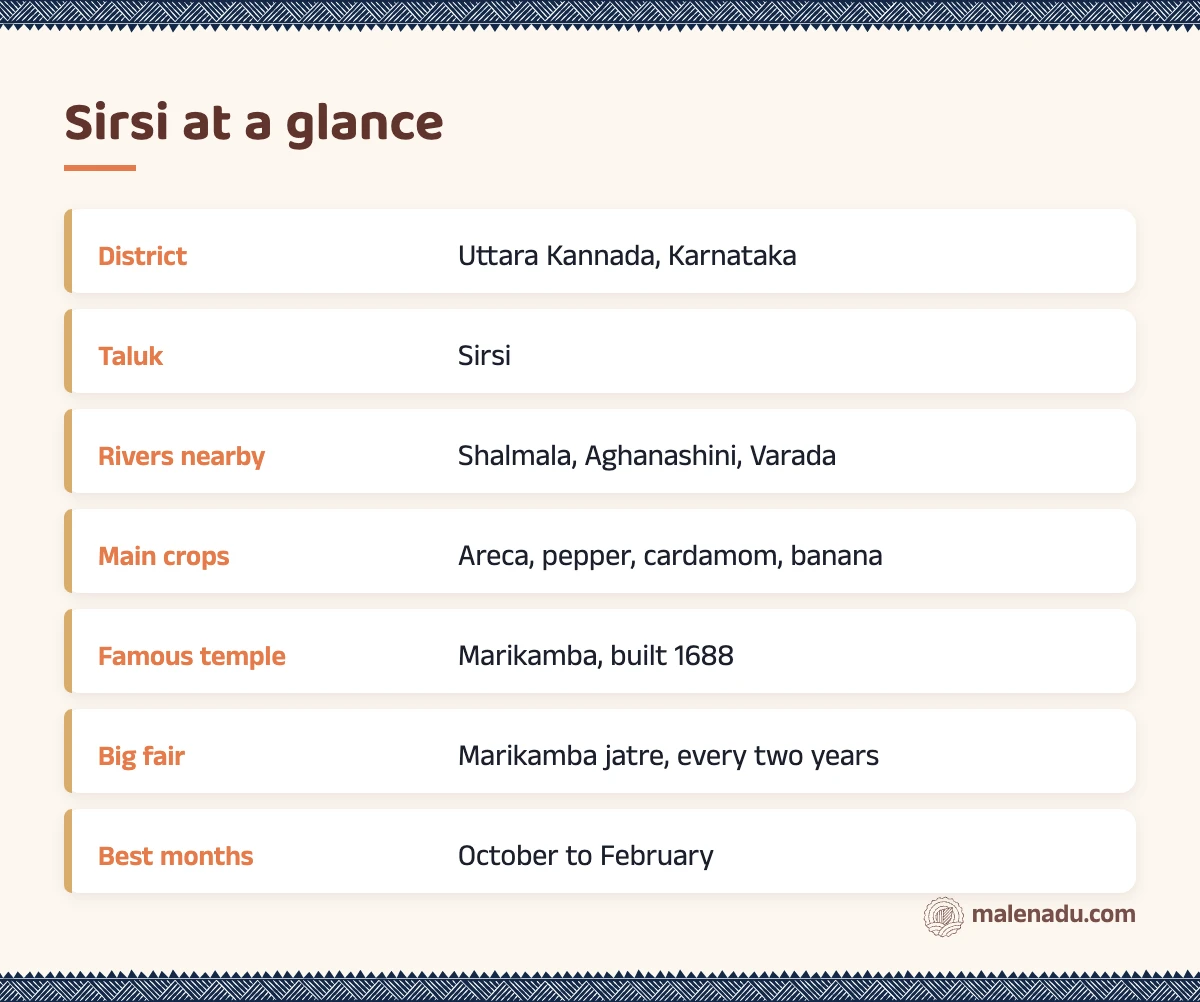
Sirsi is the green market town of the Uttara Kannada hills, known for the Marikamba temple, areca and spice gardens, Havyaka home food and waterfalls in every direction. This guide covers what the town is known for, its history, places to see with rough distances, food, crops, the best season, how to get there and a 2 day plan.

On this page
What is Sirsi known for?
Sirsi is known for the Marikamba temple and its huge jatre, for areca nut and the spice gardens around it and for the falls, rocks and old capitals within an hour’s drive. It is one of the largest areca trading towns in Karnataka, so farmers from across the district come here to sell.
Sirsi Uttara Kannada is the headquarters of the taluk of the same name, in the hills above the Uttara Kannada coast. Siddapur, Yellapur and Mundgod are among its neighbouring taluks. Our list of Malenadu districts and taluks shows where each one sits.
This is a working town, not a resort. Mornings start with temple bells and the smell of areca being boiled in courtyards. The best way to see it is from a village homestay, where a family will take you round their garden before breakfast.
Sirsi Malenadu life
Sirsi Malenadu life follows the areca garden (thota). The rains decide everything from June to September, the harvest fills the cool months and the dry season brings weddings, temple fairs and the Marikamba jatre. Many families in the villages around town are Havyaka Brahmins, whose cooking and customs shape much of what you eat here.
A short history of Sirsi
This area has been settled for a very long time. Banavasi, about 22 km away, was the capital of the Kadambas, the first royal family to rule from Karnataka and use Kannada in government.
Much later, the area was ruled by the Nayakas of Sonda (also called Swadi or Sode), whose seat was a short drive away. The river carvings of Sahasralinga date to their time, around the late 17th and early 18th century. The region later passed to Hyder Ali and Tipu Sultan of Mysore and then to the British.
The Sirsi Marikamba temple was built in 1688, according to a Deccan Herald travel feature. In the 20th century the town grew as the trading centre for areca and spices from the hills.
Places to visit in Sirsi with rough distances
The places to visit in Sirsi are the Marikamba temple in town and, around it, Sahasralinga, Sonda, Banavasi, Unchalli, Shivaganga Falls and Yana. The table gives rough road distances from the town centre. Roads are narrow, so allow extra time.
| Place | What it is | Rough distance from town |
|---|---|---|
| Marikamba temple | Temple of the town goddess | In town |
| Sonda (Sode) | Old seat of the Sonda Nayakas | about 15 km |
| Sahasralinga | Shiva lingas carved in the Shalmala river | about 15 to 17 km |
| Banavasi | Kadamba capital, Madhukeshwara temple | about 22 km |
| Unchalli Falls | Aghanashini falls 116 m into a gorge | about 35 km |
| Shivaganga Falls | Tall fall seen across a forest valley | about 40 km |
| Yana | Tall black limestone rocks and a cave shrine | about 40 to 55 km |
| Hubballi | Nearest airport | about 105 to 110 km |
Sirsi Marikamba temple
This is the temple of the goddess Marikamba, a form of Durga, in the middle of town. The image is about seven feet tall with eight arms and shows the goddess riding a tiger. The temple is busy every day of the week.
The Sirsi Marikamba jatre is held once every two years, usually in February or March. The goddess is taken in procession through town and huge crowds of devotees come from across Karnataka. It is one of the biggest temple fairs in the state. Our guide to Malenadu festivals explains how the jatre fits into the year.
Local tip
In a jatre year, book a room months ahead or stay in a village outside town and come in early in the morning. The crowds thin a little before 8 am.
Sahasralinga on the Shalmala
Sahasralinga is a stretch of the Shalmala river near Sonda where hundreds of Shiva lingas and a Nandi are carved into the rocks of the riverbed. The carvings are linked with the Sonda rulers, around the late 17th and early 18th century. A small hanging bridge crosses the river above them.
The lingas are best seen from about October to March, when the water is low. In the monsoon most are under water. Many pilgrims come on Maha Shivaratri. The rocks are slippery, so wear sandals with grip and keep children close.
Sonda
Sonda (also called Sode or Swadi) was the seat of the Sonda Nayakas, about 15 km from town. Today it is a quiet village with old temples and ruins in the forest. Combine it with Sahasralinga on the same morning.
Banavasi
Banavasi, about 22 km away on the Varada river, was the capital of the Kadambas. The Madhukeshwara temple, dedicated to Shiva, stands at the heart of the village and shows work from many later dynasties. Banavasi holds the Kadambotsava, a yearly festival of music and literature. Our guide to Malenadu temples covers Banavasi in more detail.
Unchalli Falls
Karnataka Tourism describes Unchalli Falls as a 116 m drop of the Aghanashini, about 35 km from Sirsi and from Siddapur. It is also called Lushington Falls after J D Lushington, the British officer who recorded it in 1845. A road reaches within about 1 km and you walk the rest to a viewing deck.
Shivaganga Falls
Shivaganga Falls is a tall fall about 40 km from town, seen from a Forest Department viewpoint across a deep valley. The last part is a walk through forest. People have drowned in the pools here, so never enter the water near the falls. Our guide to Malenadu waterfalls lists more falls on the Yellapur side.
Yana
Yana is a forest site with two huge black rock outcrops, Bhairaveshwara Shikhara and Mohini Shikhara. Karnataka Tourism gives Yana as about 40 to 55 km from town, with Bhairaveshwara about 120 m tall and Mohini about 90 m, both of black crystalline limestone. A cave shrine sits at the foot of Bhairaveshwara. Thousands come on Maha Shivaratri.
From the inland side, the walk in is a forest trail of a few km. Leave footwear outside the shrine, do not climb the rocks and carry your plastic back out.
More Sirsi tourist places for a longer stay
Other Sirsi tourist places for a longer stay are the falls on the Yellapur side, such as Magod and Sathodi. The Devimane ghat road down to Kumta on the coast is another fine drive. North and east, the land flattens towards Haveri and the plains.
It is also a long half day’s drive south to Jog Falls and on to Sagara, which makes a good second base. Many travellers join the two towns in a 4 or 5 day loop.
Crops grown around Sirsi
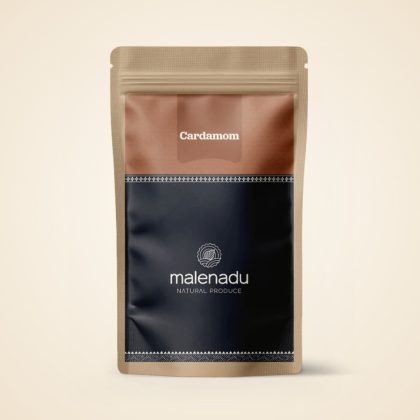
Areca nut is the main crop around Sirsi, grown in shaded gardens with pepper, cardamom, banana, nutmeg and betel leaf in the same space. These mixed gardens are what people mean by the spice gardens here. Paddy grows in the valley floors below.
Areca and spice gardens
A garden here is built in layers. Tall areca palms form the roof, pepper vines climb their trunks, banana and cardamom grow in the shade below and nutmeg and clove trees stand at the edges. The harvest of areca runs from about November to February, when courtyards fill with nuts being boiled and dried. Our guide to areca nut farming in Malenadu explains the whole year.
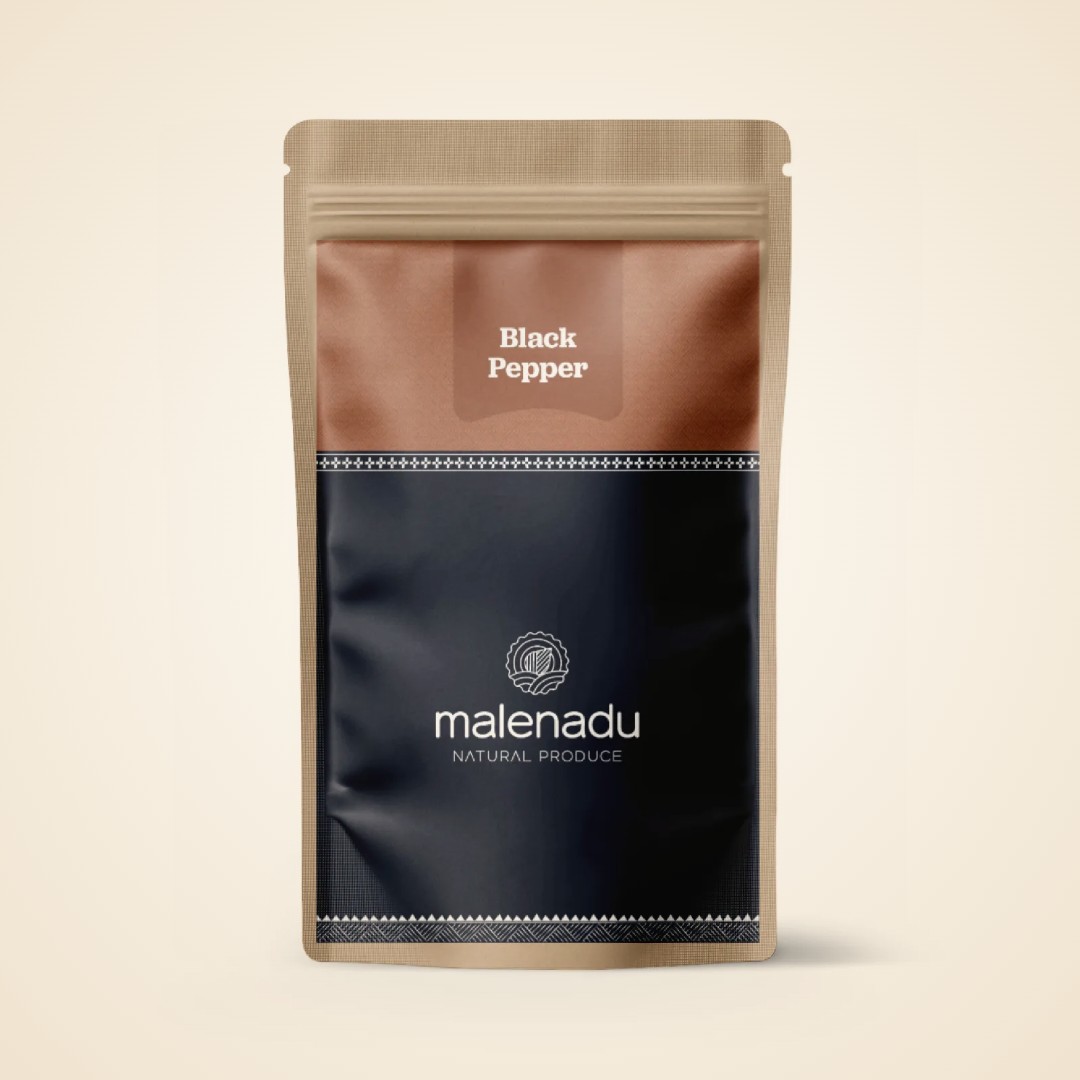
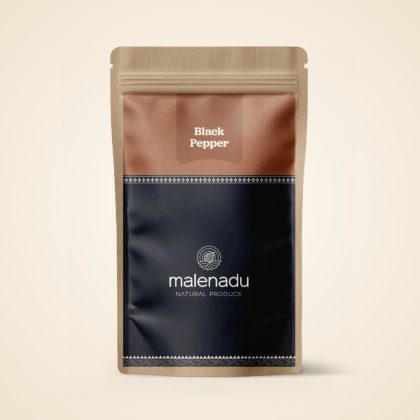
Pepper is picked in winter from ladders leaned on the palms, then dried on mats until it turns black. Our Malenadu black pepper is grown and dried in gardens like these.
From the malenadu pantry
Black pepper from vines that climb areca palms in Malenadu gardens, hand picked and dried in the sun. It is the same spice you see spread on mats in village courtyards every winter.
Spice gardens: jaykai, javitri and elakki
Nutmeg trees grow at the edges of many gardens. When the fruit splits, you see the dark seed wrapped in a red lacy cover. The seed is nutmeg and the red cover is mace. Both are dried in the shade.
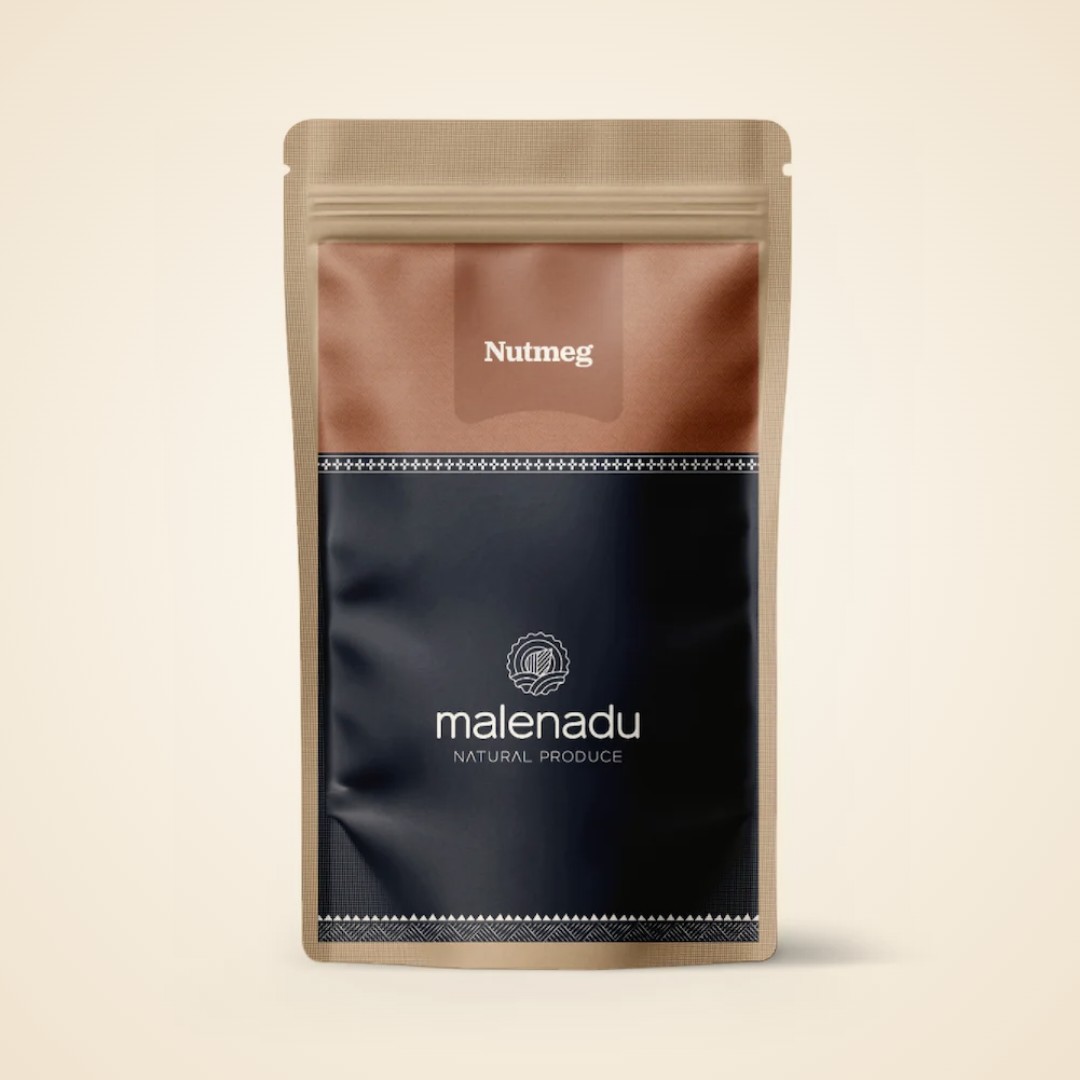
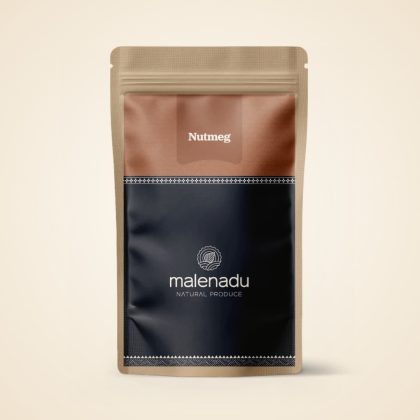
Our Malenadu nutmeg is dried the slow, traditional way.
From the malenadu pantry
Whole nutmeg from mixed spice gardens in the Malenadu hills, dried slowly in its shell. Grate a little into payasa or a warm glass of milk, the way Havyaka kitchens do.
Bee boxes in the gardens and forests
Many families here keep a few bee boxes in their gardens, because the bees pollinate the crops and give a little honey. An Indian Institute of Science survey of Uttara Kannada beekeepers found Sirsi taluk had the highest honey yield per box. Our guide to beekeeping in Malenadu explains how it works.
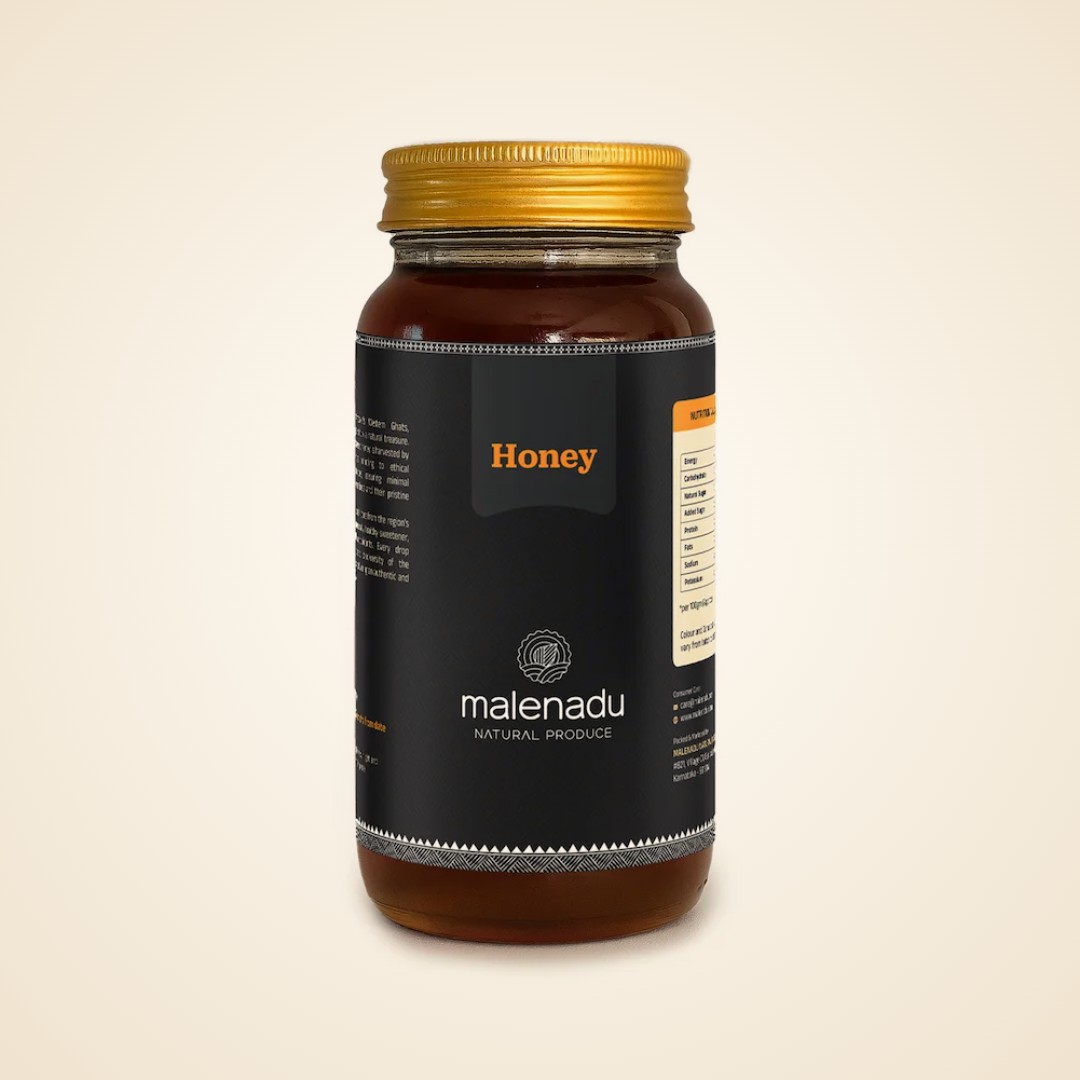
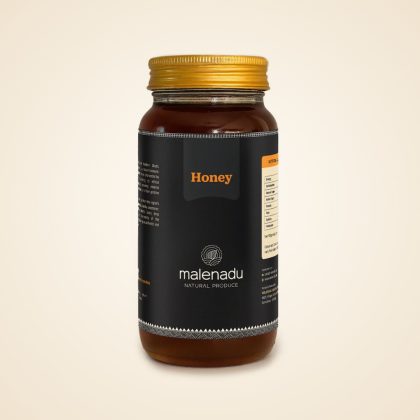
Wild honey is also gathered from the forests around town. Our honey from the Malenadu hills comes from these forests and gardens.
From the malenadu pantry
Honey from the forests and gardens of the Malenadu hills, the kind hill homes keep in a jar by the stove. Drizzle it on dose or stir it into warm water with lemon. Do not give honey to babies under one year.
Sirsi Havyaka food to try
Food here is Havyaka home food at its best: rice with mild, tangy tambulis, sour gojjus, appe midi pickle and steamed kadubu. It is simple, fresh and made from what the garden gives that day.
- Tambuli: a cool curry of curd, coconut and one green or spice. Try our menthya tambuli recipe, made with fenugreek seeds.
- Appe midi pickle: tender wild mangoes pickled whole, a Havyaka speciality.
- Kadubu: steamed rice dumplings, often with jackfruit in season.
- Gojju: sweet, sour and spicy, made with jaggery and tamarind or kokum.
- Ottu shavige: pressed rice noodles, eaten with coconut milk and jaggery or a spicy curry.
- Kashaya: a warm drink of spices and herbs, served instead of tea in many homes.
Wild mushrooms and bamboo shoots appear in the monsoon. Eat only mushrooms a local person knows well. Bamboo shoots must be soaked and boiled before cooking and never eaten raw. For more dishes, see our Malenadu food guide.
When is the best time to visit Sirsi?
The best time to visit Sirsi is October to February, when the rains have stopped, the falls are still flowing and the weather is cool and dry. The areca harvest is on and the gardens are busy.
| Season | Months | What to expect |
|---|---|---|
| Monsoon | June to September | Heavy rain, full falls, closed trails, leeches |
| Post monsoon | October to November | Full falls, green gardens, clear days |
| Winter | December to February | Cool, dry, areca and pepper harvest |
| Summer | March to May | Hot afternoons, thin falls, Sahasralinga fully visible |
If you want to see the Marikamba jatre, check the dates for the jatre year, usually in February or March. In the monsoon, keep away from the edges of falls and do not wade into rivers or pools.
How to get to Sirsi Uttara Kannada
The town is reached by road from Bengaluru, Hubballi, Sagara and the coast. It has no railway station.
- From Bengaluru: about 405 km by road through Haveri. Our Bangalore to Malenadu guide covers routes and drive times.
- By air: Hubballi airport is the nearest, about 105 to 110 km away.
- By train: Kumta on the coastal railway line is the nearest station on the coast, down the Devimane ghat. Hubballi is the nearest big junction.
- By bus: state buses run here from Bengaluru, Hubballi, Shivamogga, Sagara and coastal towns.
A 2 day plan for Sirsi
This 2 day plan covers the main places to visit in Sirsi at an easy pace. It works best by car or hired taxi.
Day 1: town, river and Banavasi
- Early morning: darshan at the Marikamba temple.
- Morning: drive to Sahasralinga and Sonda.
- Lunch: a Havyaka meal in the town’s eateries or at your homestay.
- Afternoon: Banavasi and the Madhukeshwara temple.
- Evening: walk an areca and spice garden with your host.
Day 2: falls and rocks
- Morning: Unchalli Falls, with the 1 km walk to the viewing deck.
- Afternoon: Yana. Choose Shivaganga Falls instead if you prefer a shorter day.
- Evening: back to town. You can also drive on towards Kumta and the coast.
Local tips for Sirsi
These local tips will make your trip easier and safer.
- Stay in a village. Homestays in the villages show you garden life that the town cannot.
- Drive in daylight. Forest roads to Unchalli, Yana and Shivaganga are narrow and dark early.
- Forest rules: some trails need Forest Department permission and no forest walks are allowed at night.
- Snakes: keep to paths. If someone is bitten, keep them still and go straight to a hospital with antivenom. No cutting, sucking or folk remedies.
- Leeches: carry salt or wear leech socks in the rains.
- Temple dress: cover shoulders and knees at Marikamba, Banavasi and Yana.
- Market days: the town is busiest when farmers come in to sell areca. Ask your host which day that is.
Local tip
Ask your homestay family to cook a full Havyaka lunch for you. Most will happily do it with a day’s notice and it is the best meal of the trip.
Where to go next
From here you can go south to Jog Falls and Sagara or west down to Kumta and Gokarna. You can also stay longer and see the falls towards Yellapur. Our Malenadu travel guide helps you join these towns into one trip. Take some of the hills home too: the spices from these gardens are all in our shop.
Bring Malenadu home
Grown and made by Malenadu farmer families, packed by malenadu, a farmer owned producer company in Honnavar.
-
29% OFF
Honey
Price range: ₹249 through ₹449 -
8% OFF
Black Pepper
Price range: ₹165 through ₹299 -
8% OFF
Nutmeg
Original price was: ₹60.₹55Current price is: ₹55. -
19% OFF
Cardamom
Price range: ₹130 through ₹330 -
8% OFF
Nutmace
Original price was: ₹60.₹55Current price is: ₹55. -
6% OFF
Clove
Price range: ₹150 through ₹440
Frequently asked questions about Sirsi
What is Sirsi famous for?
Sirsi is famous for the Marikamba temple and its jatre held every two years, its areca and spice gardens, Havyaka food and nearby sights such as Sahasralinga, Unchalli Falls, Yana and Banavasi.
Which district is Sirsi in?
It is the headquarters of Sirsi taluk in Uttara Kannada district, Karnataka.
When is the Sirsi Marikamba jatre held?
The jatre is held once every two years, usually in February or March. Check the exact dates for the jatre year before you plan.
How far is Sahasralinga from Sirsi?
Sahasralinga is about 15 to 17 km from the town, near Sonda. The carvings are best seen from October to March when the river is low.
How far is Unchalli Falls from Sirsi?
Unchalli Falls is about 35 km away by road. A road goes to within about 1 km and you walk the rest.
How far is Banavasi from Sirsi?
Banavasi is about 22 km away, on the Varada river. It was the capital of the Kadambas.
What is the best time to visit Sirsi?
October to February is best, with dry roads, full falls and the areca harvest under way.
Is 2 days enough for Sirsi?
Two days are enough for the Marikamba temple, Sahasralinga, Banavasi, Unchalli and Yana. Add a day for the falls towards Yellapur.
Explore more of Malenadu
Malenadu TravelMalenadu Travel GuideRoutes, stays and seasons for the rain hills of Karnataka
Malenadu TravelMalenadu Monsoon and RainfallWhy the hills get so much rain and how life bends to it
Malenadu TravelMalenadu Peaks and TreksPeaks, permits and seasons for walking the Western Ghats
Malenadu TravelMalenadu Waterfalls22 falls across the hills, with access and best season
Malenadu TravelMalenadu WildlifeTigers, macaques, king cobras and the forests farms need
Malenadu TravelMalenadu TemplesRiver shrines, hill goddesses and carved stone
Malenadu TravelBangalore to MalenaduDistances, routes and plans for the drive to the hills
Malenadu TravelMalenadu RiversTen rivers that rise in the hills and shape life below
Start hereMalenadu in KarnatakaWhere Malenadu is, what the name means