
Malenadu Travel
Malenadu birds include some of the rarest and loudest birds in India, from great hornbills over the Kali river to the Malabar whistling thrush singing by every forest stream. This guide covers about 20 signature and endemic birds, the common birds of areca and coffee gardens, the best places and seasons to watch them and how to do it kindly.
On this page
Why are Malenadu birds so special?
Malenadu birds are special because these hills sit in the wettest and greenest part of the Western Ghats, one of the world’s biodiversity hotspots. Tall evergreen forest, grassy hilltops, rivers and old shade gardens lie within a short drive of each other. Each habitat holds its own Malenadu birds. Several of them live nowhere else on earth.
The other reason is people. Malenadu families have grown areca, pepper, coffee and cardamom under tall trees for generations. Those shaded gardens act like an extension of the forest, so many Malenadu birds live right next to farmhouses. You can often watch a hornbill, a barbet and a paradise flycatcher from a homestay verandah.
If you are planning a trip, our guide to Malenadu in Karnataka explains where the region begins and ends. The birds on this page are found across the Malenadu districts, from Uttara Kannada and Shivamogga to Chikkamagaluru, Hassan and Kodagu.
Western Ghats endemic birds you can see in Malenadu
Western Ghats endemic birds are species found only in these hills and nowhere else in the world. Malenadu holds most of them. Spotting these Malenadu birds is the main goal of many birdwatchers who come here. The table lists endemics that occur in the Karnataka ghats, with a simple tip for each.
| Bird | Where in Malenadu | What to look for |
|---|---|---|
| Malabar grey hornbill | Forests and old gardens across the region | Grey hornbill with a pale bill, cackling call |
| Malabar parakeet | Evergreen forest edges | Blue-grey parakeet, also called blue-winged parakeet |
| White-bellied treepie | Agumbe, Sharavathi, Dandeli forests | Long tail, white belly, chestnut back |
| Malabar barbet | Fruiting fig trees | Small green barbet with a crimson face |
| White-cheeked barbet | Gardens and towns | Loud “kutroo” call from treetops |
| Crimson-backed sunbird | Gardens, forest edges, flowers | Tiny sunbird, male has a crimson back |
| Grey-headed bulbul | Wet forest near streams | Olive bulbul with a grey head |
| Flame-throated bulbul | Forest edges and scrub | Black head, bright orange-red throat |
| Rufous babbler | Thick undergrowth, bamboo | Noisy groups with rufous brown feathers |
| Nilgiri wood pigeon | Higher evergreen and shola forest | Large dark pigeon with a chequered neck |
| Nilgiri flycatcher | Kudremukh and other high hills | Dusky blue flycatcher of the sholas |
Many more birds of Malenadu are not strictly endemic but are rare elsewhere in India. The Malabar trogon, Malabar whistling thrush and Sri Lanka frogmouth fall in this group. These Malenadu birds are covered in their own section below.
Hornbills in Karnataka: the biggest Malenadu birds
Hornbills are the biggest and most famous Malenadu birds. Four species live in the forests of Karnataka. In Kannada they are called mangatte (ಮಂಗಟ್ಟೆ). Karnataka Tourism notes that all four South Indian hornbills can be seen around Dandeli: the great hornbill, Malabar pied hornbill, Malabar grey hornbill and Indian grey hornbill.
- Great hornbill: the largest, black and white with a big yellow casque on its bill. You hear its wingbeats, a loud whooshing sound, before you see it.
- Malabar pied hornbill: black and white with a large casque, often seen near rivers such as the Kali.
- Malabar grey hornbill: smaller and grey, found only in the Western Ghats. It is the hornbill most people see in Malenadu gardens.
- Indian grey hornbill: a bird of drier forest, more common on the eastern edge of the hills.
A Zoological Survey of India report on these four species surveyed Dandeli, Sharavathi, Bhadra and the Jog area. Hornbills need old, tall trees with natural holes to nest. The female seals herself inside the hole with mud, leaving only a narrow slit. The male feeds her and the chicks through that slit for weeks.
Because they need big trees and fruiting figs, hornbills are a sign of a healthy forest. Our Malenadu wildlife guide has a short section on hornbills and the parks where they live.
Signature forest birds of Malenadu
Signature Malenadu birds are the colourful, unusual forest species that birders travel long distances to see. Most of them need patient, quiet walks in good forest.
Malabar whistling thrush
The Malabar whistling thrush is a dark blue-black bird with shining blue patches that lives along streams and waterfalls. It is often called the whistling schoolboy because its song sounds like a boy whistling a tune and stopping halfway. You will hear it at dawn near almost any forest stream in Malenadu, even next to busy roads.
Malabar trogon
The Malabar trogon is a shy bird of evergreen forest. The male has a black head, a white band across the chest and a crimson belly. It sits very still in the middle of the canopy, so it is easy to miss. Forest walks around Agumbe and the Sharavathi valley are good places to look.
Sri Lanka frogmouth
The Sri Lanka frogmouth is a small night bird with a wide mouth and feathers that look exactly like dead leaves. By day, pairs sit side by side on a low branch and rely on camouflage. Researchers have recorded it in Uttara Kannada, the Sharavathi valley, Kodagu, Udupi and Chikkamagaluru. Local guides sometimes know a regular roost, but please keep your distance.
White-bellied treepie and the forest crowd
The white-bellied treepie is a long-tailed member of the crow family with a clean white belly. It often travels with mixed flocks of drongos, babblers, woodpeckers and flycatchers that move through the forest together. When one of these flocks passes, you may see ten kinds of Malenadu birds in five minutes and then nothing for an hour.
Nilgiri wood pigeon
The Nilgiri wood pigeon is a large, shy pigeon of the higher evergreen and shola forests. It feeds on wild fruits high in the canopy and flies off with a clatter of wings. Look for it in the Kudremukh and Kodagu hills.
Garden birds around areca and coffee plantations
The most common Malenadu birds are the ones that live in gardens, around houses and in the shade of areca and coffee plantations. You do not need a forest permit to see them; a cup of coffee on the verandah at sunrise is enough.
- Oriental magpie robin: black and white, sings from rooftops at dawn.
- Red-whiskered bulbul: crested, cheerful, always in pairs near fruit trees.
- Greater coucal (kembootha): a big black bird with chestnut wings that walks through the garden with a deep “hoop hoop” call.
- Asian koel: heard more than seen, its rising call fills the hot months.
- Sunbirds: purple-rumped, Loten’s and crimson-backed sunbirds visit hibiscus and banana flowers.
- Kingfishers (minchulli): white-throated kingfishers sit on wires above paddy fields and areca channels.
- Racket-tailed drongo: a glossy black bird with two long tail streamers that copies other birds’ calls.
- Indian paradise flycatcher: the male trails long white or rufous tail ribbons through the garden.
- Malabar parakeet and plum-headed parakeet (gini): flocks that streak over the canopy.
- Owls: jungle owlets and spotted owlets call at dusk from the trees around the house.
Areca gardens with pepper vines and tall jungle trees between the palms hold far more Malenadu birds than bare plantations. Read our guides to areca nut farming in Malenadu and Malenadu coffee to see how these gardens are built.

From the malenadu pantry
Pepper vines need living trees to climb, so a pepper garden keeps tall trees standing for barbets, hornbills and drongos. Our black pepper is grown on such vines in Malenadu gardens and sun dried after the winter harvest.
Coffee estates in Chikkamagaluru and Kodagu are also good for Malenadu birds because coffee grows under shade trees. Cardamom grows in even deeper shade, under tall forest trees.

From the malenadu pantry
Cardamom grows under tall shade trees in the cool Malenadu hills, often in the same patches where whistling thrushes sing. Our green cardamom comes from these shaded gardens.
Birdwatching in Malenadu: where to go
Birdwatching in Malenadu is best in a few well known forests, plus the river islands and small reservoirs that draw waterbirds. Use this table to match the Malenadu birds you want with a base.
| Place | District | Good for |
|---|---|---|
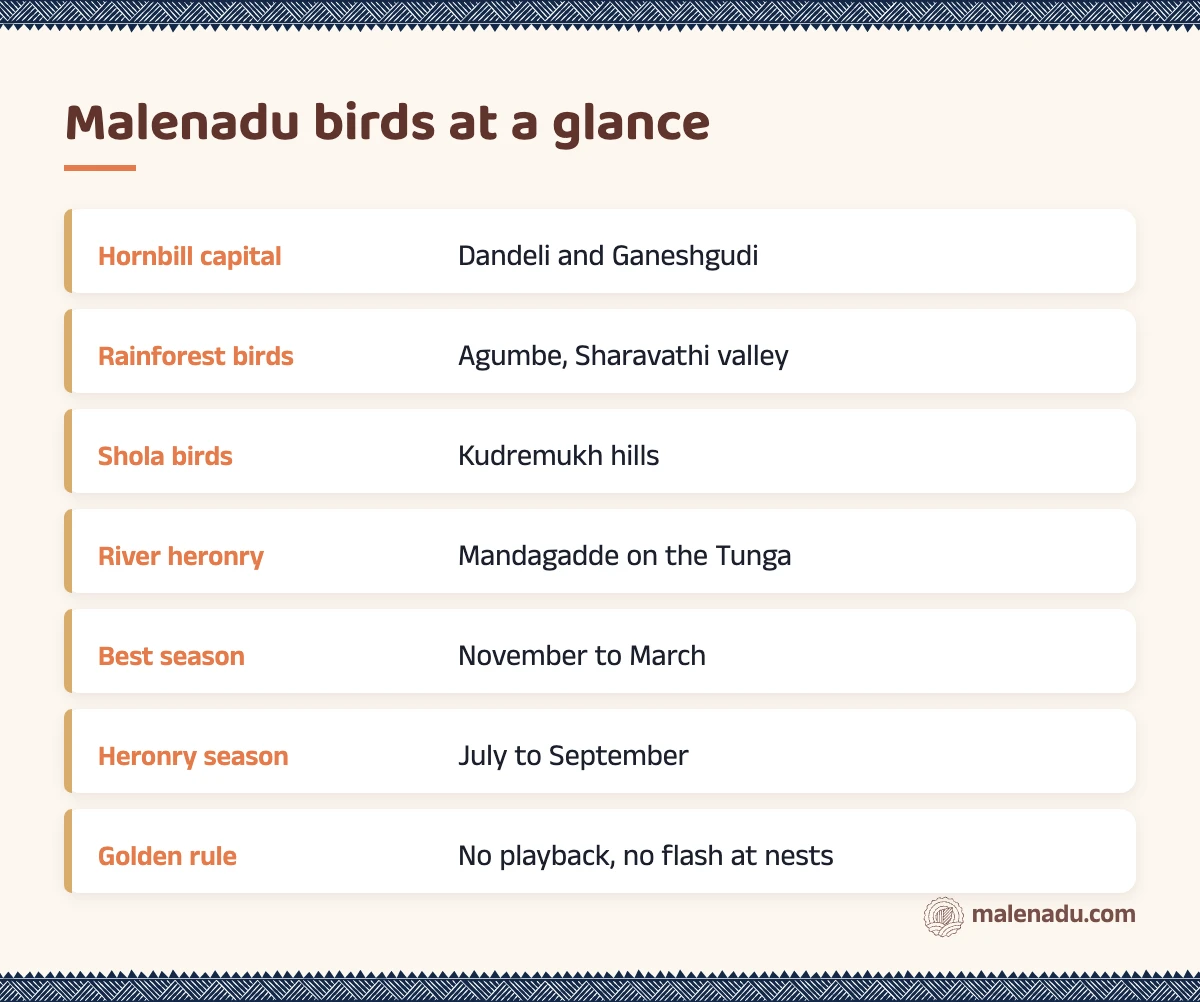
| Dandeli and Ganeshgudi | Uttara Kannada | All four hornbills, river birds on the Kali |
| Sirsi and Yellapur forests | Uttara Kannada | Malabar grey hornbill, woodpeckers, mixed flocks |
| Agumbe and Someshwara | Shivamogga, Udupi | Malabar trogon, treepie, crimson-backed sunbird |
| Sharavathi valley and Jog | Shivamogga | Hornbills, frogmouth, forest birds |
| Mandagadde | Shivamogga | Egrets, cormorants and darters nesting on a Tunga island |
| Gudavi near Sorab | Shivamogga | Waterbirds on a village tank |
| Attiveri near Mundgod | Uttara Kannada | Waterbirds on a small reservoir |
| Kudremukh hills | Chikkamagaluru | Shola birds such as the Nilgiri flycatcher |
| Bhadra backwaters | Chikkamagaluru, Shivamogga | River terns, ospreys, forest edge birds |
| Coffee estates | Chikkamagaluru, Kodagu | Garden and forest birds side by side |
Mandagadde sits on a small island in the Tunga near Shivamogga. Deccan Herald describes how egrets, little cormorants and darters crowd its trees, with July to September the best time and August the peak. Read more about the river in our guide to Malenadu rivers.
For forest birds, our town guides to Agumbe and Sirsi suggest bases and walks. Inside sanctuaries, walks need Forest Department permission and a local guide.
When is the best time to see Malenadu birds?
The best time to see Malenadu birds is November to March, when the rains have ended, winter visitors have arrived and forest trails are open. Each season brings different birds.
| Season | Months | What you will see |
|---|---|---|
| Winter | November to February | Migrant flycatchers, wagtails, warblers, Indian pitta (navaranga), the hornbill festival |
| Summer | March to May | Hornbills and barbets nesting, fruiting figs, birds near water |
| Monsoon | June to September | Heronry at Mandagadde, singing thrushes, fewer forest walks |
| After the rains | October | Returning migrants, green forest, leeches still about |
The first two hours after sunrise are the best time of day for Malenadu birds. Bird activity drops by late morning and picks up again before dusk.
How to watch Malenadu birds without harming them
Watching Malenadu birds kindly means keeping your distance, keeping quiet and leaving no trace. A good birdwatcher should leave the bird exactly as it was found.
- No playback. Do not play recorded calls to pull birds out. It stresses them, especially in the breeding season.
- No flash at nests or roosts. Flash can make parents leave a nest and exposes frogmouths and owls to predators.
- Keep away from nests. Do not cut branches or move leaves to get a clearer photo.
- Do not share nest locations online. Trappers and careless crowds can follow.
- Stay on trails and get permits. Sanctuaries and forest walks need Forest Department permission.
- Respect private land. Ask before entering an areca garden or coffee estate.
- Dress quietly. Wear dull colours and avoid perfume and loud talk.
Local tip
Sit still near a fruiting fig tree for half an hour in the morning. Barbets, hornbills, bulbuls and pigeons will come to you. You will see more Malenadu birds this way than on a long walk.
Why do Malenadu birds need old trees and forests?
Malenadu birds need old trees because many of them nest in tree holes, eat wild fruit and shelter in thick canopy. Hornbills, barbets, woodpeckers, owls and parakeets all depend on old trees with cavities. When big trees are cut, these Malenadu birds lose their homes even if the area still looks green.
Sacred groves, called devara kadu, protect patches of old forest near many villages. They often hold more Malenadu birds than the land around them. Read more in our page on devara kadu.
Bees and birds share the same flowering trees. Sunbirds sip nectar from the flowers that wild bees visit. Fruit-eating Malenadu birds spread the seeds of forest trees that later shade spice gardens.

From the malenadu pantry
Honey from Malenadu comes from bees that forage in the same forests and gardens where these birds live. Buying it supports families who keep trees standing. Do not give honey to babies under one year.
Where to go next
Pair a birding trip with our Malenadu travel guide, which brings together towns, treks and waterfalls. Keep a lookout for snakes on forest walks too. Read our guide to Malenadu snakes before you go. At home, a tin of spices from the same gardens keeps the memory of those mornings alive.
Bring Malenadu home
Grown and made by Malenadu farmer families, packed by malenadu, a farmer owned producer company in Honnavar.






Frequently asked questions about Malenadu birds
Which birds are found only in the Western Ghats?
Western Ghats endemic birds include the Malabar grey hornbill, Malabar parakeet, white-bellied treepie, Malabar barbet, crimson-backed sunbird, grey-headed bulbul, rufous babbler, Nilgiri wood pigeon and Nilgiri flycatcher. Most of them can be seen in Malenadu.
Where can I see hornbills in Karnataka?
Dandeli and Ganeshgudi in Uttara Kannada are the best places, with all four South Indian hornbills. The Sharavathi valley, Sirsi forests and Bhadra also have hornbills.
What is the Malabar whistling thrush?
It is a dark blue-black thrush of forest streams in the Western Ghats. It is called the whistling schoolboy because its song sounds like a boy whistling a tune.
What is the best time for birdwatching in Malenadu?
November to March is best for forest birds and winter migrants. Visit Mandagadde from July to September for the nesting waterbirds.
Is playback allowed while birdwatching?
Playing recorded calls disturbs birds and is discouraged by responsible birders. In protected forests, follow Forest Department rules and your guide’s advice.
What is the Kannada word for hornbill?
Hornbills are called mangatte in Kannada.
Can I see Malenadu birds without going into a forest?
Yes. Areca gardens, coffee estates and village tanks are full of bulbuls, barbets, sunbirds, kingfishers, drongos and often the Malabar grey hornbill.
Explore more of Malenadu
Malenadu TravelMalenadu Travel GuideRoutes, stays and seasons for the rain hills of Karnataka
Malenadu TravelMalenadu Monsoon and RainfallWhy the hills get so much rain and how life bends to it
Malenadu TravelMalenadu Peaks and TreksPeaks, permits and seasons for walking the Western Ghats
Malenadu TravelMalenadu Waterfalls22 falls across the hills, with access and best season
Malenadu TravelMalenadu WildlifeTigers, macaques, king cobras and the forests farms need
Malenadu TravelMalenadu TemplesRiver shrines, hill goddesses and carved stone
Malenadu TravelBangalore to MalenaduDistances, routes and plans for the drive to the hills
Malenadu TravelMalenadu RiversTen rivers that rise in the hills and shape life below
Start hereMalenadu in KarnatakaWhere Malenadu is, what the name means