
Malenadu Farming
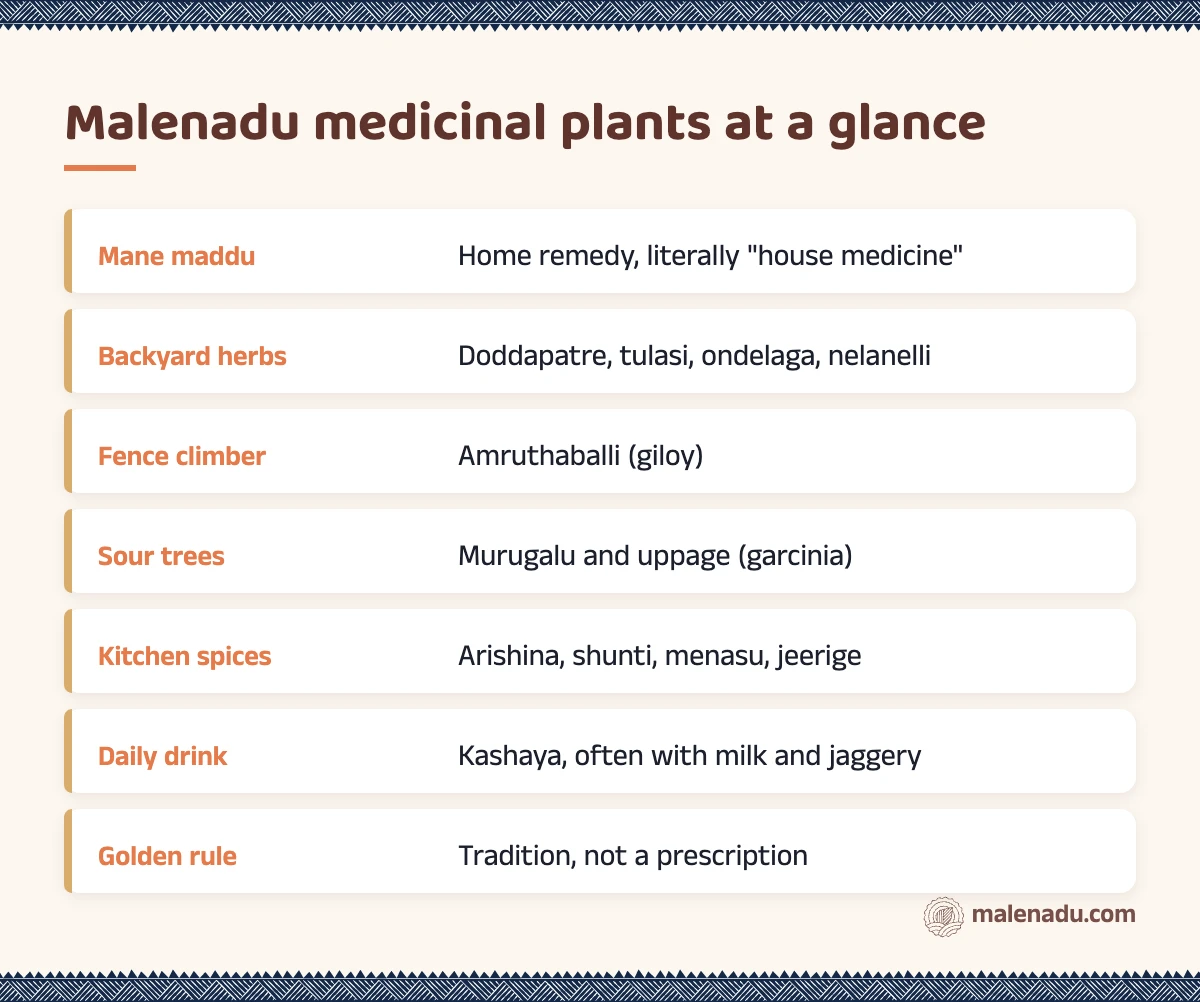
Malenadu medicinal plants grow in almost every backyard of these hills, from doddapatre and tulasi by the well to amruthaballi climbing the fence. This guide explains about 15 of them, how Malenadu homes have traditionally used them in kashaya, tambuli and mane maddu (home remedies), how to grow them and why some forest plants now need protecting.
On this page
What are Malenadu medicinal plants and mane maddu?
Malenadu medicinal plants are the herbs, leaves, roots and fruits that families in these hills have used for generations to look after everyday aches, colds and stomach upsets. Most Malenadu medicinal plants grow within a few steps of the kitchen door. Others come from the forest, the stream bank or the edge of the areca garden.
In Kannada, a home remedy is called mane maddu (ಮನೆ ಮದ್ದು), literally “house medicine”. Grandmothers who knew Malenadu medicinal plants could tell which leaf to crush for a child’s cough and which root to boil in the rains. This knowledge passed from mother to daughter by doing, not by writing, which is why it differs a little from village to village.
This page describes tradition, not treatment. It is not medical advice. Nothing here replaces a doctor. Anyone who is unwell, pregnant, breastfeeding, giving remedies to a child or taking regular medicines should consult a qualified doctor first.
Backyard Malenadu medicinal plants every home knows
The backyard Malenadu medicinal plants are the ones you will find around almost every house: doddapatre, tulasi, ondelaga, nelanelli, amruthaballi, nellikai and the garcinia trees. The table gives their names and how Malenadu homes have traditionally used them.
| Kannada name | English name | Botanical name | Traditional use in Malenadu homes |
|---|---|---|---|
| Doddapatre | Indian borage | Coleus amboinicus | Leaves for colds in children, tambuli, bajji |
| Tulasi | Holy basil | Ocimum tenuiflorum | Worshipped daily, leaves in kashaya for colds |
| Ondelaga | Indian pennywort | Centella asiatica | Tambuli, seen as cooling and good for the mind |
| Nelanelli | Gale of the wind | Phyllanthus amarus | The old village plant given for kamale (jaundice) |
| Amruthaballi | Heart-leaved moonseed | Tinospora cordifolia | Stems and leaves in kashaya during fevers |
| Nellikai | Indian gooseberry, amla | Phyllanthus emblica | Eaten raw or pickled, used in hair oil |
| Murugalu | Kokum | Garcinia indica | Saaru and summer drinks for the body’s heat |
| Uppage | Malabar tamarind | Garcinia gummi-gutta | Souring fish curry, eaten for digestion |
| Lakki soppu | Five-leaved chaste tree | Vitex negundo | Leaves boiled for steam baths for body ache |
| Adusoge | Malabar nut | Justicia adhatoda | Leaves in kashaya for coughs |
| Karibevu | Curry leaf | Murraya koenigii | Daily cooking, chutney powder, hair oil |
| Dasavala | Hibiscus | Hibiscus rosa-sinensis | Leaves as a hair wash, flowers in hair oil |
Our guide to spice and ingredient names in Kannada lists more Kannada names for the leaves and spices of a Malenadu kitchen. The sections below look at the most used Malenadu medicinal plants one by one.
Doddapatre (Indian borage)
Doddapatre is a fleshy, fragrant leaf that smells a little like oregano. In Malenadu homes a few leaves are warmed on a pan and their juice is given to small children with a cold, while adults eat it as tambuli or crisp bajji. Like many Malenadu medicinal plants, it grows easily from a cutting in a pot.
Tulasi (holy basil)
Tulasi grows on the tulasi katte, the raised platform in the front yard that is worshipped every morning. Its leaves go into kashaya and hot water during colds. Of all Malenadu medicinal plants, it is the one most bound up with daily prayer.
Ondelaga and brahmi
Ondelaga is a small creeper with round leaves that loves damp, shady ground near wells and channels. In many Karnataka homes it is also called brahmi, although the plant sold as brahmi elsewhere, Bacopa monnieri, is a different herb. In Malenadu homes ondelaga is made into tambuli and chutney and is traditionally believed to be cooling and good for memory.
Nelanelli (gale of the wind)
Nelanelli is one of the humblest Malenadu medicinal plants, a small weed with tiny leaves and seeds hanging under the leaflets. It pops up everywhere in the monsoon. In many Malenadu villages it was the traditional plant given for kamale (jaundice). Jaundice can have serious causes, so it always needs a doctor’s diagnosis and treatment.
Amruthaballi (giloy)
Amruthaballi is the climber among Malenadu medicinal plants, with heart-shaped leaves that hangs over fences and trees. In Malenadu homes its stem and leaves have long been added to kashaya when someone has a fever. Strong herbs like this are best taken only on a doctor’s advice.
Nellikai and the garcinia trees
Nellikai, the Indian gooseberry, is eaten raw with salt, pickled or dried. The two garcinia trees are just as common: murugalu, whose dried rind makes kokum saaru, plus uppage, a souring fruit for fish curry. An IISc study of medicinal plants in Uttara Kannada records that some communities use a bark infusion of Garcinia indica for stomach acidity.
From the malenadu pantry
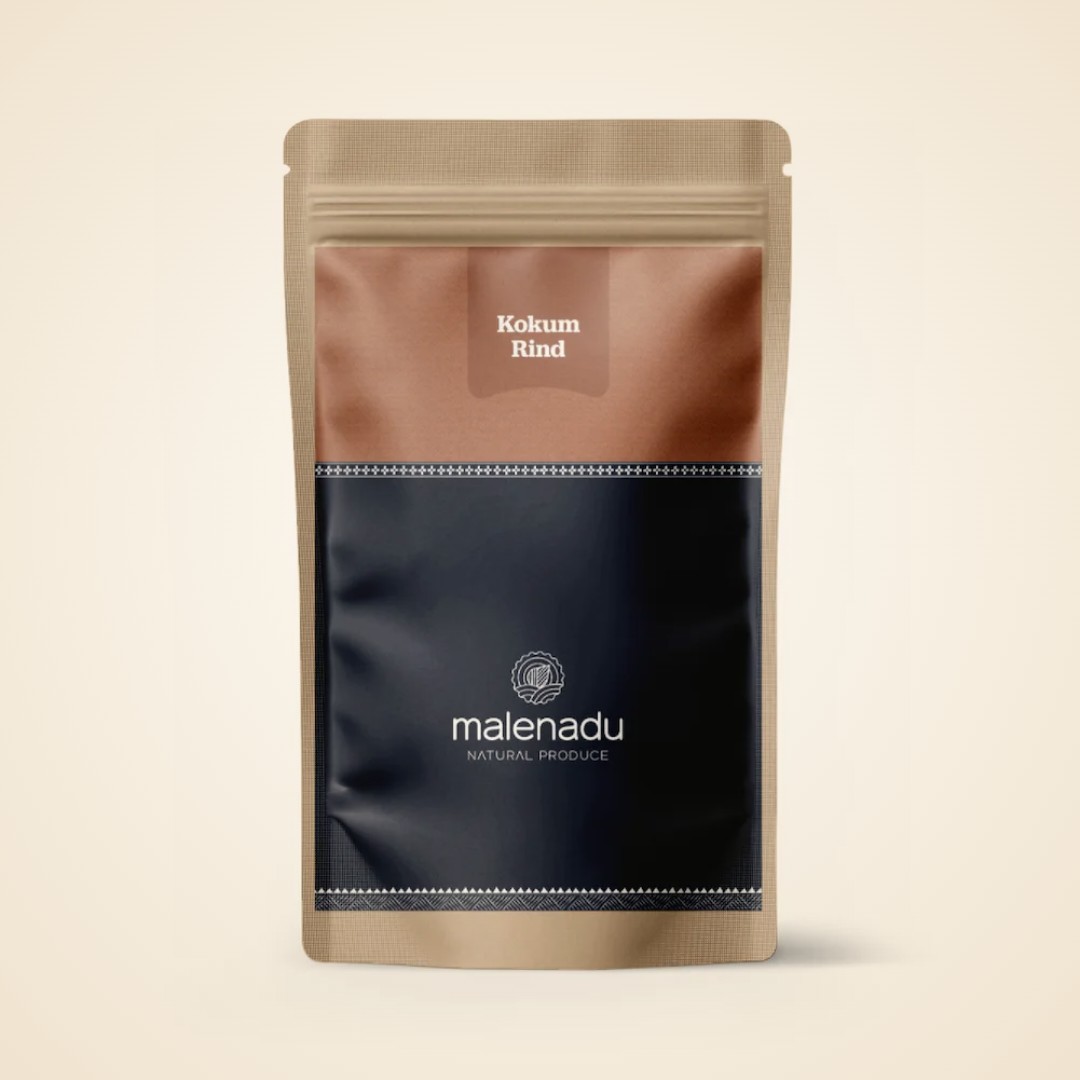
Murugalu trees grow beside many houses on the Uttara Kannada side of Malenadu. Our kokum rind is sun dried from these fruits and is the base of kokum saaru, a sour, peppery rasam made in Malenadu kitchens.
Spices from the kitchen garden
The kitchen spices are also the most used Malenadu medicinal plants, because they go into food every single day. Arishina (turmeric), shunti (dry ginger), menasu (pepper), jeerige (cumin), kottambari (coriander seed) and menthya (fenugreek) all have a place in home remedies.
- Arishina (turmeric): grown in the backyard and dug up after the rains. In Malenadu homes it is traditionally applied on small cuts and added to warm milk at bedtime when someone has a cold.
- Shunti (dry ginger) and fresh ginger: the base of most kashaya. Ginger is given traditionally for a heavy stomach and for colds.
- Menasu (pepper): goes into saaru, kashaya and the rice dishes made when someone is recovering from a fever.
- Jeerige and kottambari: roasted and ground into kashaya powder or boiled in water to drink after a heavy meal.
- Menthya (fenugreek): made into tambuli and eaten in the hot months, as it is believed to be cooling.
From the malenadu pantry
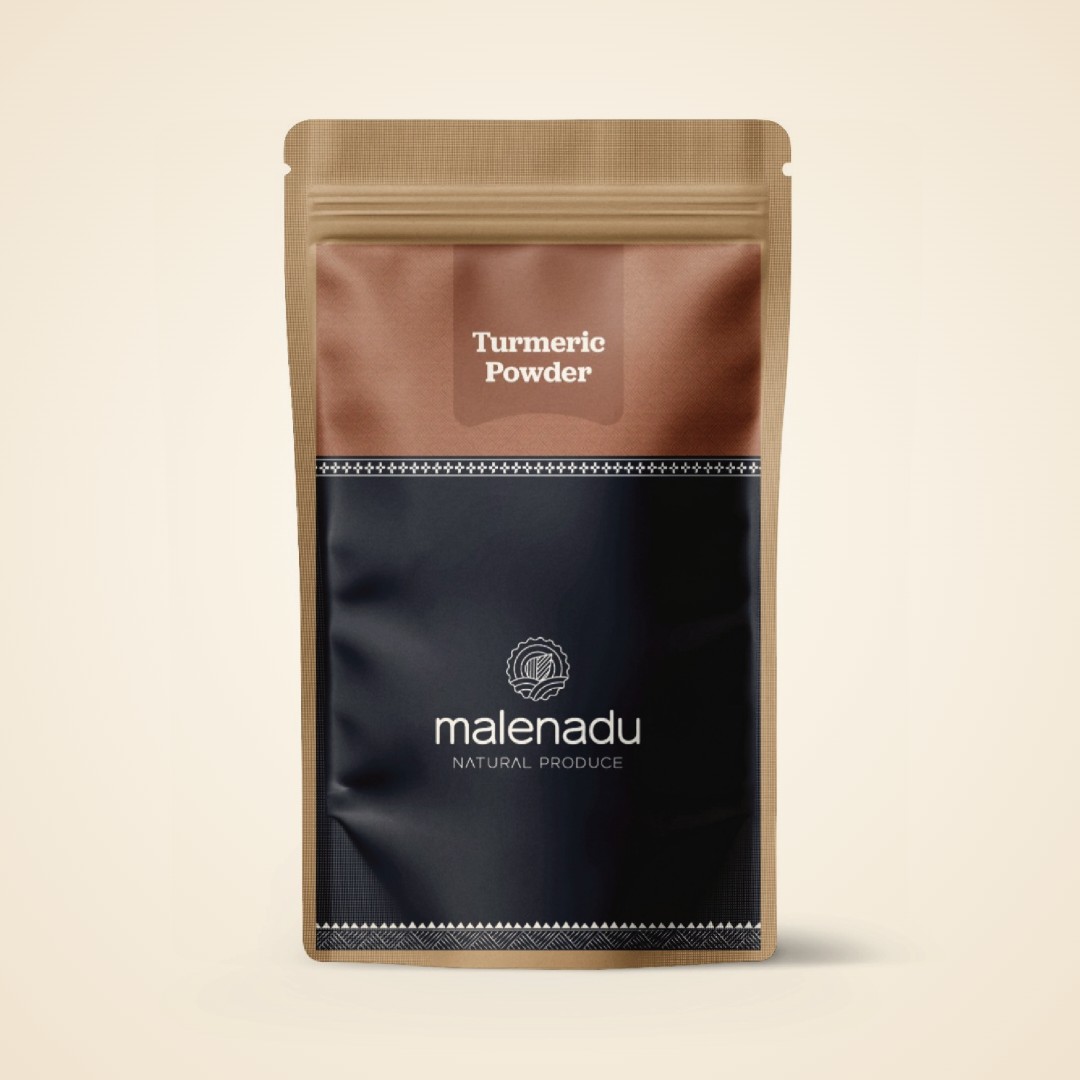
Many Malenadu families still grow and boil their own turmeric each year. Our turmeric powder comes from these hills, ground from dried roots, for the turmeric milk and everyday cooking that most homes rely on.
Kashaya: the Malenadu herbal drink
Kashaya (ಕಷಾಯ) is a hot herbal drink made by boiling spices or leaves in water. In many Malenadu homes it is drunk daily instead of tea or coffee. It is the most common way Malenadu medicinal plants reach the table.
Everyday kashaya
Everyday kashaya is made from a home-ground kashaya pudi (powder) of roasted coriander seeds, cumin, pepper and dry ginger, with fennel or other spices in some families. The powder is boiled in water, then milk and jaggery are added. Many people stir in liquid jaggery, which mixes in easily.
Kashaya for colds in the rains
When someone catches a cold in the monsoon, Malenadu homes boil a stronger kashaya with tulasi, doddapatre, ginger, pepper and sometimes amruthaballi or adusoge leaves. It is drunk hot, often with a little jaggery. This is a comfort drink and a family habit. It does not replace medical care for a fever that lasts. Our guide to the Malenadu monsoon explains why colds are so common in the wet months.
From the malenadu pantry
Crushed pepper is the warm heart of almost every kashaya. Our black pepper is grown on vines in Malenadu gardens and sun dried, so it is easy to crush fresh into the pan.
Tambuli: cooling dishes from Malenadu medicinal plants
Tambuli is a simple, cool dish of ground leaves or spices mixed with buttermilk or curd and tempered in ghee or oil. It is eaten with hot rice. Tambuli is how Malenadu medicinal plants appear in everyday meals.
Almost every backyard leaf becomes tambuli at some point in the year: doddapatre, ondelaga, nelanelli, karibevu and even tender guava or pomegranate shoots in some families. When fresh leaves are not at hand, homes make it from fenugreek or cumin from the spice box. Try our recipe for menthya tambuli, the best known version. Then swap in the leaf of your choice.
Medicinal plants of the Western Ghats forests
The medicinal plants of the Western Ghats forests are a much larger store than any backyard. The IISc team behind the study above notes that the forests of the Western Ghats hold about 700 medicinal plant species, many used in folk and traditional medicine. In the past, traditional healers (naati vaidyas) walked these forests for roots, barks and climbers that families could not grow themselves.
The same IISc study looked at two Medicinal Plants Conservation Areas in the Karnataka Forest Department’s Honnavar division: Jankadkal in Honnavar taluk (close to where we are based) and Shirgunji in Kumta taluk. Such areas protect patches of forest so that rare Malenadu medicinal plants can keep growing and seeding.
Sacred groves, called devara kadu, have protected many Malenadu medicinal plants for centuries without any formal rule. Read more in our page on devara kadu.
Why are some Malenadu medicinal plants disappearing?
Some Malenadu medicinal plants are disappearing because they are dug up or stripped from the wild faster than they can grow back. Demand from the herbal trade turns a few Malenadu medicinal plants a family once needed into sacks for the market.
One example is daruharidra, the tree turmeric (Coscinium fenestratum), a woody climber whose yellow stem is valued in traditional medicine. Deccan Herald reported calls for the Forest Department to stop auctioning it and to conserve a large patch in the Hulikal ghat of Hosanagara taluk. Forest loss, fires and the conversion of forest to plantations add to the pressure on Malenadu medicinal plants.
- Do not collect plants from reserve forests or sanctuaries. Taking forest produce needs Forest Department permission. Protected areas are off limits.
- Never dig up roots or strip bark from wild plants. Grow your own instead.
- Buy only cultivated herbs when you can, from known sources.
- Leave rare plants for seed. If you are unsure whether a plant is rare, leave it.
How to grow the garden herbs Karnataka homes rely on
The easiest way to keep these traditions alive is to grow the garden herbs Karnataka homes have always relied on. Most of them need only a sunny or half-shaded corner and the Malenadu rains.
- Tulasi: grow from seed in a pot or on a tulasi katte. Pinch the flowers to keep it bushy.
- Doddapatre: push a cutting into moist soil. It roots in a couple of weeks.
- Ondelaga: plant runners in a damp, shady spot near a tap or channel.
- Amruthaballi: a piece of stem tied to a fence will root and climb.
- Arishina and shunti (turmeric and ginger): plant rhizomes just before the monsoon and harvest in winter.
- Karibevu and nellikai: plant one tree of each; they last for decades.
- Pepper: a vine planted at the foot of a tree gives a small family harvest. Our guide to pepper and cardamom farming explains how.
Nelanelli usually needs no planting at all. It comes up on its own in the first rains, like several wild Malenadu medicinal plants.
Are home remedies in Malenadu safe?
Home remedies in Malenadu are part of daily life, but they are safe only when used with care and common sense. Herbal does not always mean harmless. The same plant can suit one person and harm another.
- See a doctor for any illness that is severe, lasts more than a few days or affects a baby, an elderly person or a pregnant woman.
- Never stop prescribed medicines in favour of a home remedy.
- Identify plants correctly. Several wild leaves look alike. Some are poisonous.
- Be careful with strong herbs taken daily for long periods. Ask a doctor first, especially if you take other medicines.
- No honey, sugar or jaggery for babies under one year, even in kashaya.
Local tip
If you want to learn these plants, walk around the backyard with the oldest person in the family and ask them to name each leaf. Write the names of these Malenadu medicinal plants down in Kannada, because that knowledge is easily lost.
If a home remedy needs sweetening for an adult, many families use a spoon of honey or jaggery. Remember that honey is not for babies under one year.
Where to go next
To see where these plants grow alongside the region’s crops, read our Malenadu crops guide. For more on how Malenadu medicinal plants appear on the plate, explore Malenadu spices in our shop.
Bring Malenadu home
Grown and made by Malenadu farmer families, packed by malenadu, a farmer owned producer company in Honnavar.
-
13% OFF
Turmeric Powder
Price range: ₹70 through ₹120 -
8% OFF
Black Pepper
Price range: ₹165 through ₹299 -
17% OFF
Kokum Rind
Original price was: ₹240.₹200Current price is: ₹200. -
29% OFF
Honey
Price range: ₹249 through ₹449 -
14% OFF
Liquid Jaggery
Original price was: ₹349.₹299Current price is: ₹299. -
40% OFF
Desi Cow Ghee
Original price was: ₹1,500.₹899Current price is: ₹899.
Frequently asked questions about Malenadu medicinal plants
What is mane maddu?
Mane maddu means home remedy in Kannada, literally “house medicine”. It refers to the leaves, roots and spices that families traditionally use for everyday complaints such as colds and stomach upsets.
What is doddapatre used for?
In Malenadu homes doddapatre leaves are traditionally used for children’s colds and coughs and are also cooked into tambuli and bajji. This is tradition, not medical advice.
What is kashaya made of?
Everyday kashaya is made from roasted coriander seeds, cumin, pepper and dry ginger boiled in water, usually with milk and jaggery. Families add leaves such as tulasi or doddapatre during colds.
Is ondelaga the same as brahmi?
In many Karnataka homes ondelaga (Centella asiatica) is called brahmi, but the herb sold as brahmi elsewhere is usually Bacopa monnieri, a different plant.
Which medicinal plants grow in the Western Ghats?
The Western Ghats forests hold hundreds of medicinal plants. Common ones around Malenadu homes include doddapatre, tulasi, ondelaga, nelanelli, amruthaballi, nellikai, kokum, turmeric, ginger and pepper.
Can I collect medicinal plants from Malenadu forests?
Collecting from reserve forests and sanctuaries needs Forest Department permission and is often not allowed. It is better to grow common herbs at home or buy cultivated ones.
Can home remedies replace a doctor?
No. Home remedies are a family tradition, not a replacement for medical care. Always consult a doctor for illness, especially for children, elders and pregnant women.
Explore more of Malenadu
Malenadu FarmingMalenadu CropsWhat grows in Karnataka’s rain hills and why it grows
Malenadu FarmingAreca Nut Farming in MalenaduAdike, the palm that shapes every Malenadu village
Malenadu FarmingMalenadu Crop CalendarWhat grows, ripens and cooks in the hills, month by month
Malenadu FarmingMalenadu GiddaThe small, tough hill cow of Karnataka’s Western Ghats
Malenadu FarmingPepper and Cardamom FarmingHow the two great spices of the hills are grown
Malenadu FarmingMalenadu CoffeeShade grown, hand picked and sun dried in the hills
Malenadu FarmingBeekeeping in MalenaduBee boxes, wild hives and the people who tend them
Malenadu CultureMalenadu CulturePeople, arts and old ways of Karnataka’s rain hills
Start hereMalenadu in KarnatakaWhere Malenadu is, what the name means