
Malenadu Farming
Malenadu crops are the crops of Karnataka’s rain-fed hill country: areca nut, black pepper, cardamom, coffee, paddy, sugarcane, coconut and a whole garden of spices. This guide explains why each of these Malenadu crops grows here, where it grows, when it is harvested and what makes farming in these hills hard today.
On this page
Why do Malenadu crops grow so well here?
Malenadu crops grow well because the hills give them four things at once: heavy monsoon rain, deep red laterite soil, slopes that drain fast and shade from tall forest trees. Malenadu (ಮಲೆನಾಡು, “the hill country”) is the Western Ghats belt of Karnataka, running through Shivamogga, Chikkamagaluru, Kodagu, Hassan and the hill taluks of Uttara Kannada.
Our page on Malenadu in Karnataka explains the region itself. The list of Malenadu districts and taluks shows where it begins and ends. Here we stay in the fields and gardens.
Rain
The southwest monsoon reaches these hills in early June and stays till September, often longer. Crops that love water and damp air, like areca, pepper and cardamom, do very well. Our guide to Malenadu monsoon and rainfall explains how the rain moves across the hills.
The dry months matter too. From December to May there is little rain, so the areca garden needs channels or sprinklers while pepper and coffee wait for the first summer showers to flower. The timing of those showers decides the size of many Malenadu crops more than anything a farmer does.
Laterite soil
Most Malenadu soil is red laterite or lateritic loam, rich in iron and on the acidic side. Heavy rain washes nutrients out of it every year, so farmers keep feeding it with leaves, compost and cow dung. The soil is easy to dig, drains well and holds roots firmly on a slope.
Slopes and valleys
The shape of the land decides where Malenadu crops go. Flat valley floors that hold water become paddy fields, called gadde (ಗದ್ದೆ). Lower slopes near a stream become the areca garden, the thota (ತೋಟ), watered by small channels. Higher and cooler slopes under forest shade are left for coffee and cardamom.
Shade
Many Malenadu crops are forest plants at heart. Black pepper is a climber native to these very hills, cardamom grows wild in Western Ghats forests and coffee here is always grown under shade trees. Farmers do not so much clear the forest as thin it and fill the gaps.
How do areca and pepper gardens work?
Areca and pepper gardens work in layers, with each crop using a different height, a different amount of light and a different season. The thota is the heart of Malenadu farming in Shivamogga, Uttara Kannada and Chikkamagaluru. Walking into one on a hot April afternoon feels like stepping into a cool green room.
A typical thota holds these Malenadu crops in layers:
- Top layer, areca palms. Tall, straight adike (ಅಡಿಕೆ) palms in neat rows bring the main income.
- Climbing layer, pepper. Black pepper vines are trained up the areca trunks, so each palm carries a second crop.
- Middle layer, banana, nutmeg and clove. Banana shades young palms and feeds the house. In some gardens toward Dakshina Kannada cocoa also grows under the palms.
- Low layer, cardamom and betel leaf. In cooler gardens cardamom clumps grow in deep shade. Betel leaf (veelyadele) vines climb a few palms.
- Ground layer, mulch. Fallen areca fronds and green leaves from the forest cover the soil to keep in moisture.
This is why areca and pepper gardens are so hard to copy on flat land. One acre gives several harvests through the year. When areca prices fall, pepper or nutmeg can carry the family through.
Pepper deserves a special word. Of all the Malenadu crops in the thota it is the most loved, because it costs little to grow, uses empty space on the palm and stores well for years once dried. Karnataka grew about 45 percent of India’s black pepper by volume in 2021, according to a Spices Board note on Karnataka spices.
From the malenadu pantry
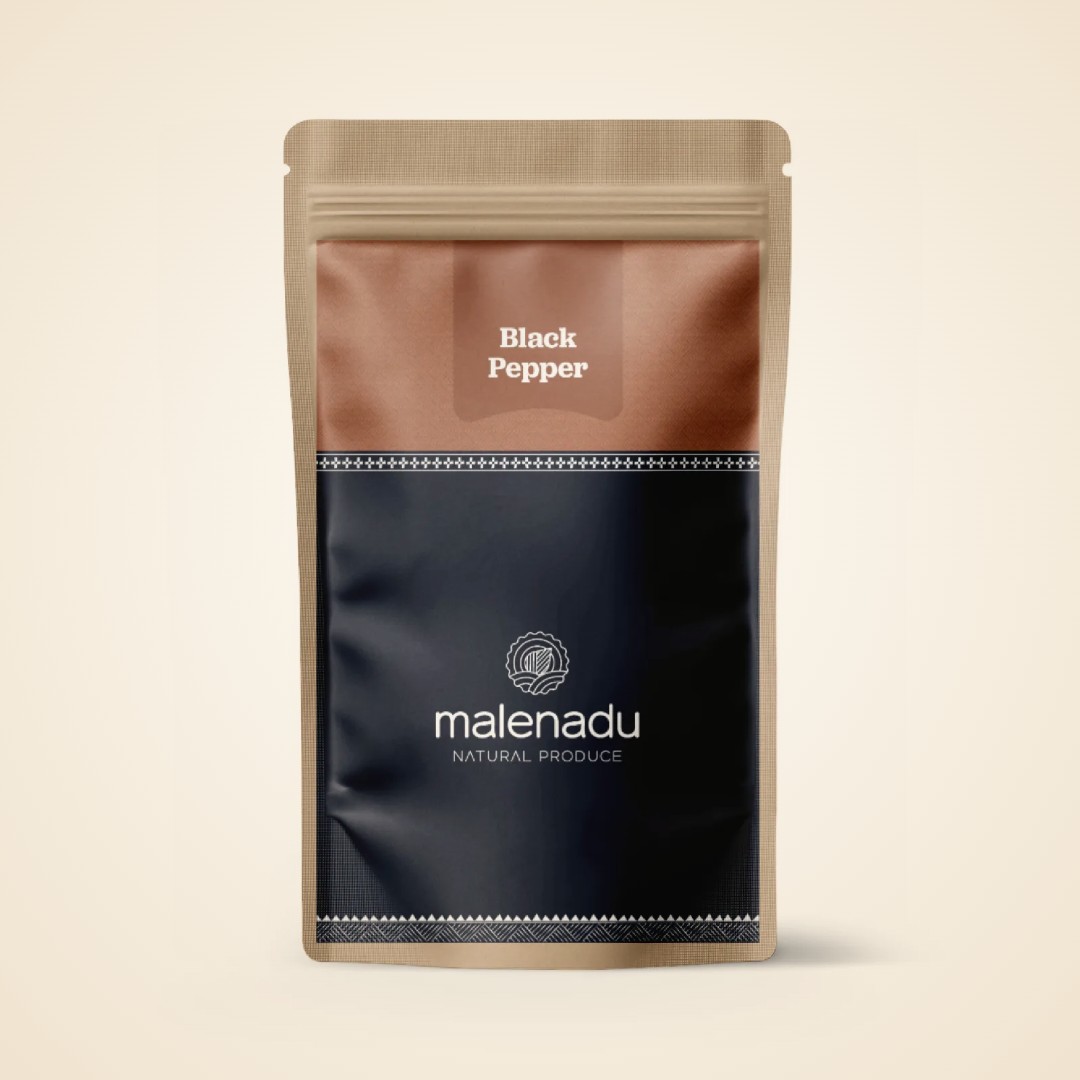
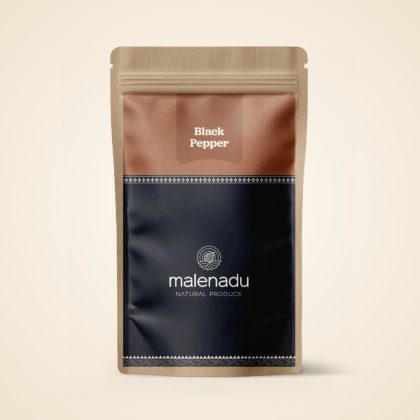
Our Black Pepper comes from vines like these, climbing areca palms and shade trees in Malenadu gardens. It is picked when the spikes start to turn, threshed and sun dried on mats.
Coffee estates of Chikkamagaluru, Kodagu and Hassan
Coffee is the big estate crop among Malenadu crops, grown mainly in Chikkamagaluru, Kodagu and Hassan under a canopy of shade trees. Where the thota is a family garden of a few acres, a coffee estate can run into hundreds of acres with its own workers’ lines and drying yards.
The Baba Budan legend
India’s coffee story begins in Malenadu. Legend says that around 1600 AD the Sufi saint Baba Budan brought seven coffee seeds from the port of Mocha in Yemen and planted them in the Chikkamagaluru hills that now carry his name. The Government of India’s note on Indian coffee tells the same story and names Karnataka as the top coffee state.
How a coffee estate is planted
Indian coffee grows under two layers of shade: tall forest trees above and planted trees such as silver oak below. Pepper vines climb many of these shade trees, so an estate harvests pepper after its coffee. Coffee flowers after the blossom showers of March and April. Arabica is picked from about November to January and robusta from about December to February.
Coffee and other plantation crops Karnataka is known for
Coffee, areca, pepper and cardamom are the main plantation crops Karnataka grows in its western hills, with rubber and cocoa in smaller pockets. Three coffees from these hills hold a GI tag: Coorg Arabica, Chikmagalur Arabica and Bababudangiris Arabica. Coffee and pepper on one estate is one of the most useful pairings of all Malenadu crops. Our guide to Malenadu coffee covers the estates, the blossom and the harvest in full.
Paddy, sugarcane and jaggery in the valley
Paddy (bhatta, ಭತ್ತ) is grown in the gadde fields on almost every valley floor, planted with the monsoon and harvested from around October. For centuries every Malenadu home grew its own rice for the year, with the paddy field right below the house and the thota.
That is changing. Many gadde fields have been turned into areca gardens because areca pays more. Some families now buy their rice.
Sugarcane and the aale mane
Sugarcane (kabbu, ಕಬ್ಬು) is grown in some valley fields and crushed in the village aale mane (ಆಲೆಮನೆ), the jaggery shed. The juice is boiled for hours in a wide iron pan and stirred till it thickens into bella (jaggery). Neighbours gather on aale mane nights while children wait for a cup of hot fresh juice.
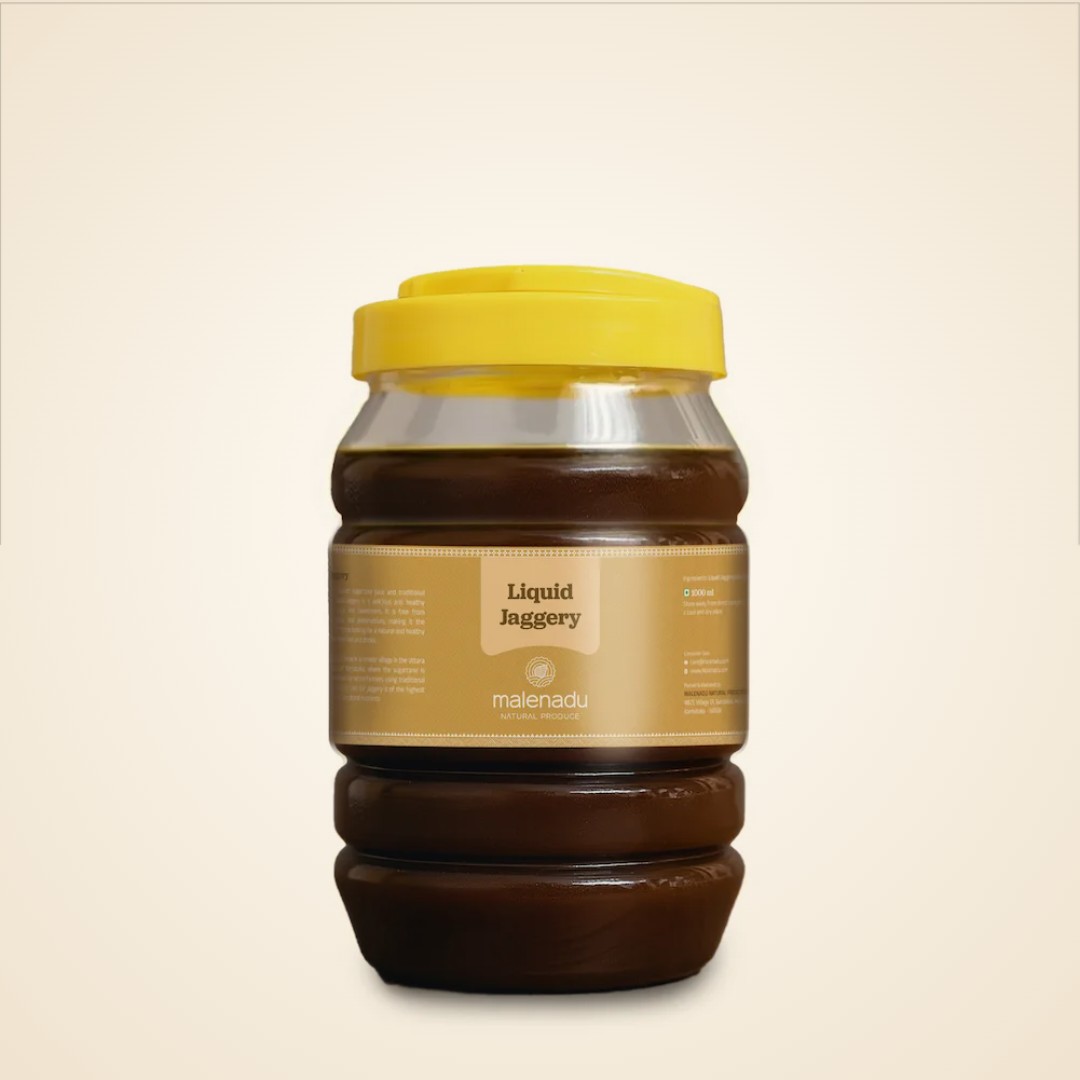
Some of the boiling juice is taken off early, before it sets, to make joni bella. This runny liquid jaggery is poured over dosa, rotti and kadubu. A jar of it sits on most Malenadu breakfast tables in winter.
From the malenadu pantry
Our Liquid Jaggery is joni bella made the Malenadu way, from sugarcane juice boiled down slowly till it pours like thick honey. It goes on dosa, rotti or a bowl of hot rice with ghee.
Coconut, kokum and spices toward the coast
As the hills drop toward the Arabian Sea in Uttara Kannada, Udupi and Dakshina Kannada, coconut takes over from areca as the main palm. In taluks like Honnavar and Kumta gardens mix both palms. Coconut gives tender nuts, copra for oil and leaves for thatch.
Kokum (murugalu, ಮುರುಗಲು) trees grow around homes on these western slopes. The ripe red fruit is picked in summer and its rind is sun dried for saaru, juice and fish curry. Small spice plants fill the gaps: bird eye chilli (gandhari menasu) by the kitchen door, a few turmeric plants and the odd nutmeg or clove tree by the well.
These coastal Malenadu crops are what make the cooking of Uttara Kannada taste the way it does. Our Malenadu food guide shows where each one ends up on the plate.
What keeps Malenadu farming going: bees, cattle and manure
Malenadu farming runs on bees for pollination and cattle for manure, two helpers that cost little and give back every year. Without them the soil would tire and many flowers would not set fruit.
Bees in the garden
Many families keep wooden boxes of the Indian hive bee (Apis cerana) at the edge of the thota. Bees work the flowers of the garden all year. Cardamom in particular needs insect visitors, mostly bees, to set its capsules. Honey is a small second income. Our guide to beekeeping in Malenadu explains the native bees and how the boxes are kept.
Cattle and manure
Malenadu Gidda is the small, hardy hill cow of these forests. It walks steep slopes and grazes on forest edges. It gives little milk, but its dung is the backbone of the areca garden. In the cowshed (kottige, ಕೊಟ್ಟಿಗೆ) the bedding is made of dry leaves, which turns into rich compost once mixed with dung.
In parts of Uttara Kannada and Shivamogga, areca gardens traditionally had a patch of forest attached, called soppina betta, from which leaves were cut for mulch. This link between forest, cattle and garden keeps Malenadu crops going on poor laterite soil without heavy fertiliser.
From the malenadu pantry
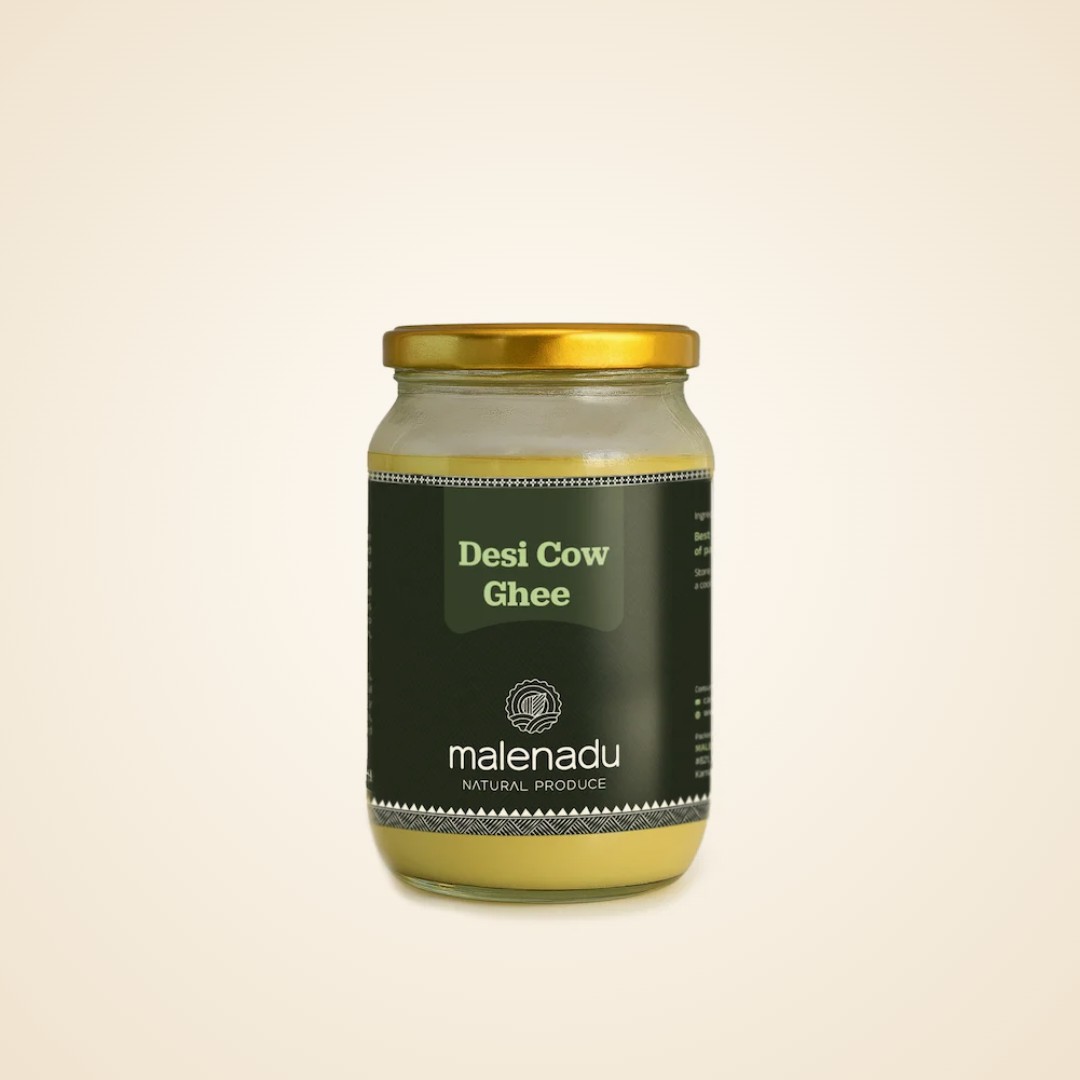
Our Desi Cow Ghee is hand churned by farmer families from the milk of desi breeds, Malenadu Gidda and other Indian breeds. Desi cattle like these feed the gardens with manure and the kitchen with ghee.
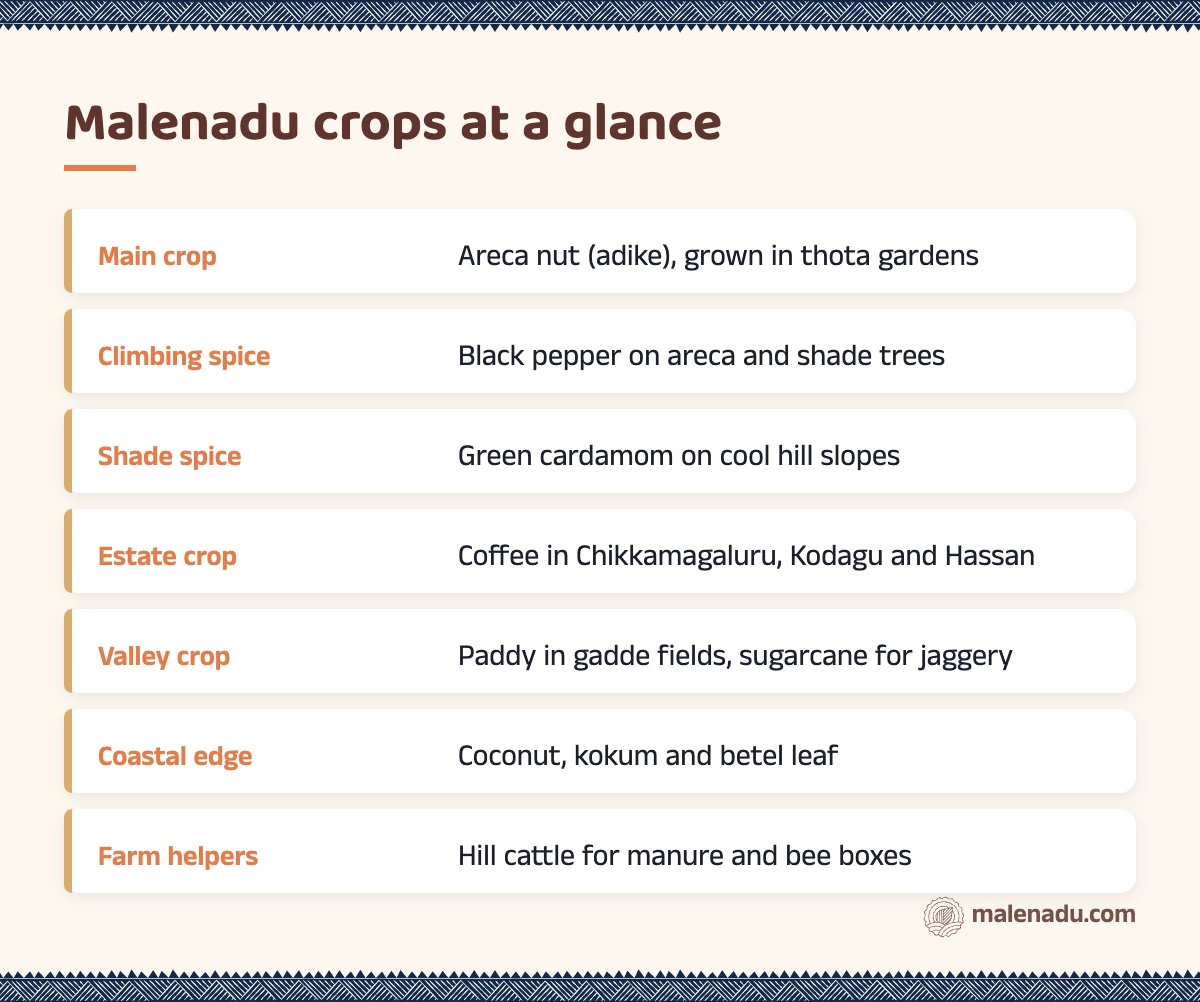
Malenadu crops at a glance: what grows where and when
Here are 12 main Malenadu crops with their Kannada names, where each grows and when it is harvested. Months are a rough guide and shift with altitude and rain.
| Crop | Kannada name | Where it grows | Harvest months | From malenadu |
|---|---|---|---|---|
| Areca nut | adike (ಅಡಿಕೆ) | Shivamogga, Uttara Kannada, Chikkamagaluru | About November to February | None |
| Black pepper | kaalu menasu (ಕಾಳು ಮೆಣಸು) | On areca and shade trees | December to February | Black Pepper |
| Cardamom | elakki (ಏಲಕ್ಕಿ) | Sakleshpur, Kodagu, Chikkamagaluru | August to January | Cardamom |
| Coffee | kaafi (ಕಾಫಿ) | Chikkamagaluru, Kodagu, Hassan | November to February | None |
| Paddy | bhatta (ಭತ್ತ) | Valley floors (gadde) | October to December | None |
| Sugarcane | kabbu (ಕಬ್ಬು) | Valley fields | Cool months, for jaggery | Liquid Jaggery |
| Coconut | tengu (ತೆಂಗು) | Coastal side | All year | Wood Pressed Coconut Oil |
| Banana | baale (ಬಾಳೆ) | Inside areca gardens | All year | None |
| Betel leaf | veelyadele (ವೀಳ್ಯದೆಲೆ) | On areca palms | All year | None |
| Clove | lavanga (ಲವಂಗ) | Areca gardens | Cool dry months | Clove |
| Nutmeg | jaayikaayi (ಜಾಯಿಕಾಯಿ) | Areca gardens | Peak in June and July | Nutmeg and mace |
| Kokum | murugalu (ಮುರುಗಲು) | Western slopes | Summer | Kokum Rind |
Two things stand out. Most harvests fall in the cool dry months from November to February, the busiest season in a Malenadu village. And almost all Malenadu crops grow with another crop around them, never alone.
Local tip
If you want to see Malenadu crops being harvested, visit between November and February. Areca is being cut and boiled, pepper is drying on mats in every courtyard and the coffee estates smell of ripe cherries.
What challenges do Malenadu crops face today?
Malenadu crops face five big problems today: disease, price swings, labour shortage, wildlife and less predictable rain. None of these is new. Together they make farming in the hills harder than it was a generation ago.
- Yellow leaf disease in areca. Leaves turn yellow from the tips, nuts fall early and the palm slowly declines. It is worst around Sringeri and Koppa in Chikkamagaluru district. Scientists link it to a tiny bacteria-like organism called a phytoplasma and there is still no cure.
- Koleroga in areca. This fruit rot spreads in the wettest monsoon weeks. Farmers spray Bordeaux mixture (copper sulphate and lime) to protect the young nuts.
- Price swings. Areca prices can rise or crash within a season. Pepper prices follow world markets.
- Labour. Climbing a wet areca palm is skilled and risky work that fewer young people want to do. Many farms now depend on workers from the drier districts of north Karnataka.
- Wildlife. Elephants, gaur (kaati), wild boar and monkeys raid gardens near forest edges.
- Climate. A dry spell in May or June can ruin pepper flowering. Rain out of season spoils drying coffee and areca.
How Malenadu agriculture is changing
Malenadu agriculture is slowly moving from many crops to one. Paddy fields are becoming areca gardens and areca has spread out of the hills into the plains of Chitradurga and Davanagere. Karnataka now grows about 79 percent of India’s areca, according to the Directorate of Arecanut and Spices Development.
The careful farmers are going the other way. They are adding pepper, nutmeg and cardamom back into their gardens and keeping a few cows for manure. Mixed Malenadu crops spread the risk that one crop alone cannot.
How does a farmer producer company help?
A farmer producer company helps by giving small farmers a steady, fair buyer for the small lots of Malenadu crops that traders often ignore. malenadu is one such company, Malenadu Natural Producer Company Limited, owned by its farmer members and based in Honnavar, Uttara Kannada.
We cannot stop yellow leaf disease or bring the rain on time. What we can do is buy pepper, cardamom, kokum, ghee and jaggery from Malenadu farmers, clean and pack them carefully and sell them straight to homes across India. More of the price then reaches the family that grew it.
Guides to Malenadu crops, one by one
Each of these guides goes deeper into one part of farming in the hills:
- Areca nut farming in Malenadu: the thota, koleroga, yellow leaf disease, harvest and how kempu and chali adike are made.
- Pepper and cardamom farming: how the two great spices of the hills are grown, dried and graded.
- Malenadu Gidda cattle: the small hill cow that keeps the gardens fed with manure.
- The Malenadu crop calendar: what happens in the fields month by month.
Where to go next
If you want to taste Malenadu crops at home, start with the spices from Malenadu farms and work outward to jaggery, ghee and kokum. For the people and the land behind them, the farming guides above are the best next stop.
Bring Malenadu home
Grown and made by Malenadu farmer families, packed by malenadu, a farmer owned producer company in Honnavar.
-
8% OFF
Black Pepper
Price range: ₹165 through ₹299 -
19% OFF
Cardamom
Price range: ₹130 through ₹330 -
14% OFF

Liquid Jaggery
Original price was: ₹349.₹299Current price is: ₹299. -
24% OFF

Wood Pressed Coconut Oil
Original price was: ₹899.₹679Current price is: ₹679. -
40% OFF

Desi Cow Ghee
Original price was: ₹1,500.₹899Current price is: ₹899. -
17% OFF
Kokum Rind
Original price was: ₹240.₹200Current price is: ₹200.
Frequently asked questions about Malenadu crops
What are the main Malenadu crops?
The main Malenadu crops are areca nut, black pepper, cardamom, coffee and paddy. Sugarcane, coconut, banana, betel leaf, clove, nutmeg and kokum are also grown, usually mixed together in one garden.
Which crop is Malenadu most famous for?
Areca nut is the biggest earner in most villages, while coffee is the best known outside Karnataka. Black pepper grown on areca palms is the crop farmers are proudest of.
Why is pepper grown on areca palms?
Pepper is a climber and needs a support. The areca palm is already standing there and pepper uses the same water and manure, giving a second income from the same land.
When is the harvest season for Malenadu crops?
Most Malenadu crops are harvested in the cool dry months from about November to February. Cardamom starts earlier, in August.
Where is coffee grown in Malenadu?
Coffee is grown mainly in Chikkamagaluru, Kodagu and Hassan districts, always under shade trees. The Baba Budan Giri hills are where Indian coffee is said to have begun.
What type of soil do Malenadu crops grow in?
Most Malenadu crops grow in red laterite or lateritic soil that is rich in iron, acidic and well drained. Farmers add leaf mulch and cow dung every year because heavy rain washes out nutrients.
Is cardamom one of the Malenadu crops?
Yes. Cardamom grows in the cool shaded hills of Sakleshpur, Kodagu and Chikkamagaluru. It also grows in some cooler areca gardens.
Explore more of Malenadu
Malenadu FarmingAreca Nut Farming in MalenaduAdike, the palm that shapes every Malenadu village
Malenadu FarmingMalenadu Crop CalendarWhat grows, ripens and cooks in the hills, month by month
Malenadu FarmingMalenadu GiddaThe small, tough hill cow of Karnataka’s Western Ghats
Malenadu FarmingPepper and Cardamom FarmingHow the two great spices of the hills are grown
Malenadu FarmingMalenadu CoffeeShade grown, hand picked and sun dried in the hills
Malenadu FarmingBeekeeping in MalenaduBee boxes, wild hives and the people who tend them
Malenadu FarmingMalenadu Medicinal PlantsThe backyard and forest herbs behind every mane maddu
Malenadu CultureMalenadu CulturePeople, arts and old ways of Karnataka’s rain hills
Malenadu FoodMalenadu FoodRice, kokum, pepper and joni bella from the hills
Malenadu TravelMalenadu Travel GuideRoutes, stays and seasons for the rain hills of Karnataka
Start hereMalenadu in KarnatakaWhere Malenadu is, what the name means