
Malenadu Food
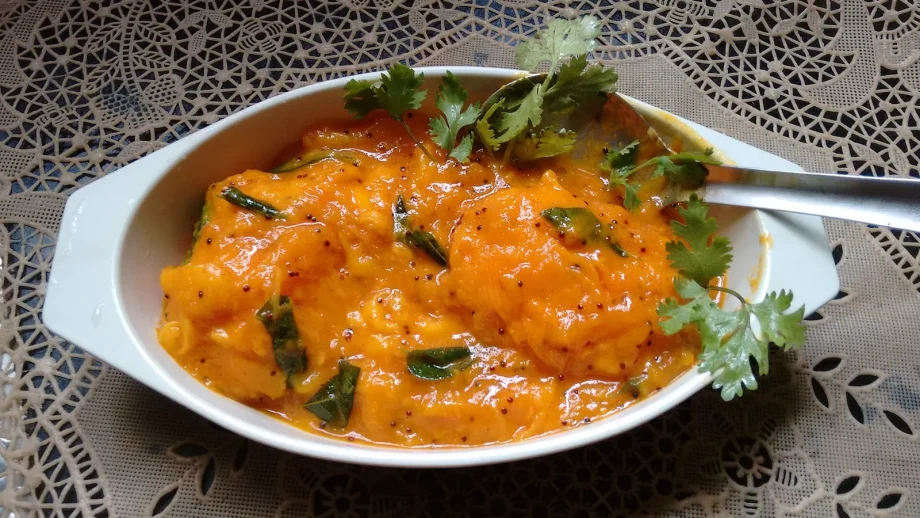
Mavina gojju is a sweet, sour and spicy relish of small ripe mangoes simmered in a thin gravy with jaggery, roasted red chilli and a coconut oil tempering. It is summer food in Malenadu and on the Karnataka coast. This page explains which mangoes to use, gives an eight step recipe and shares five variations, including the raw mango version.
On this page
What is mavina gojju?
Mavina gojju (ಮಾವಿನ ಗೊಜ್ಜು) is a mango gojju: a thin to medium thick relish of mango pieces cooked with jaggery, salt and red chilli, then finished with mustard, curry leaves and hing in coconut oil. Mavu (ಮಾವು) is the Kannada word for mango and mavina means “of mango”. Gojju is a family of sweet, sour and spicy relishes eaten with rice.
Mavina hannina gojju or mavinakayi gojju?
When people say mavina gojju they usually mean the ripe mango version, called mavina hannina gojju (ಮಾವಿನ ಹಣ್ಣಿನ ಗೊಜ್ಜು). Hannu means ripe fruit. The raw mango version is mavinakayi gojju, from mavinakayi, a green mango. Both are loved, but they taste quite different.
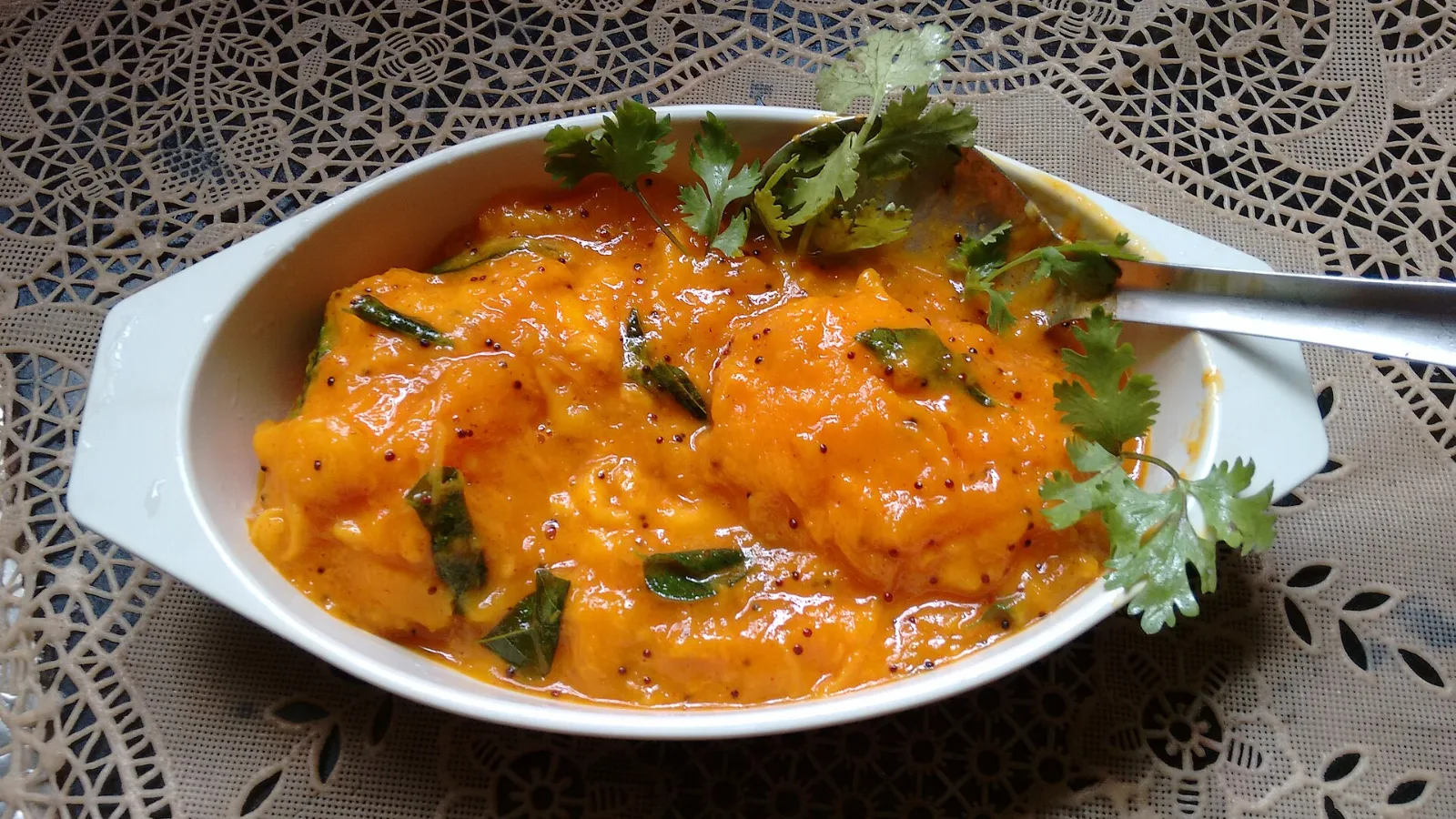
A good mavina gojju tastes of fruit first, then sour, then the chilli. The gravy is orange and glossy, with soft pieces of mango that still hold their shape. The seeds go into the pot too. The best part for many people is sucking the gravy off the seed at the end of lunch.
Is mavina gojju from Malenadu or the coast?
Mavina gojju is made all along the Western Ghats and the Karnataka coast, in Malenadu homes and in Udupi and Mangaluru kitchens alike. No single town owns it. Karnataka Tourism notes that gojju comes in many regional versions using vegetables or fruits. Ripe mango is one of the fruit versions made most often in summer.
Which mangoes are best for mavina gojju?
The best mangoes for mavina gojju are small, fibrous, sour sweet local mangoes, the kind that grow on old trees beside streams, in backyards and at the edge of the forest. In Kannada they are often called kaadu mavu, “forest mango”. They are too fibrous to slice neatly, which is exactly why they are cooked or squeezed.
These little mangoes are very different from market mangoes. A 2023 study in the journal of ICAR’s Indian Institute of Horticultural Research recorded 45 local mango types from coastal Karnataka. The authors note that the Western Ghats are home to wild mangoes with distinctive flavours, tastes and scents. Even the heaviest fruit in their sample weighed only about 110 g.
Each old tree has its own taste and families know which tree gives the best gojju. If you are buying in a market, this table will help you choose.
| Mango | Good for mavina gojju? | Why |
|---|---|---|
| Small local ripe mangoes | Best | sour sweet, fibrous, strong smell |
| Medium sour ripe mangoes | Good | use 2 or 3, add a little tamarind if needed |
| Very sweet table mangoes | Not ideal | too sweet, the gojju turns flat |
| Raw green mangoes | Yes, for mavinakayi gojju | firm and sour, needs more jaggery |
| Appe midi | No | tender wild mangoes kept for pickle |
Appe midi are the tiny tender wild mangoes of the Uttara Kannada and Shivamogga hills. They are picked green, long before they ripen, for the famous appe midi pickle. They are not used for mango gojju.
Local tip
Smell the stalk end before you buy. A small ripe local mango with a strong, sharp mango smell will make a far better gojju than a big, perfect looking one with little smell.
When is mango season in Malenadu?
Ripe local mangoes come in mostly in April and May, in the hot weeks before the monsoon, with a few trees running into early June. Raw mangoes for mavinakayi gojju appear earlier, from March. Mavina gojju is made almost every week in this season, when the trees drop more fruit than a family can eat.
In the Malenadu year, mango season overlaps with jackfruit, kokum and jamun. Our guide to fruits of the Malenadu hills has the full calendar. To see where these hill taluks lie, our page on Malenadu districts has the map.
Ingredients for mango gojju, explained
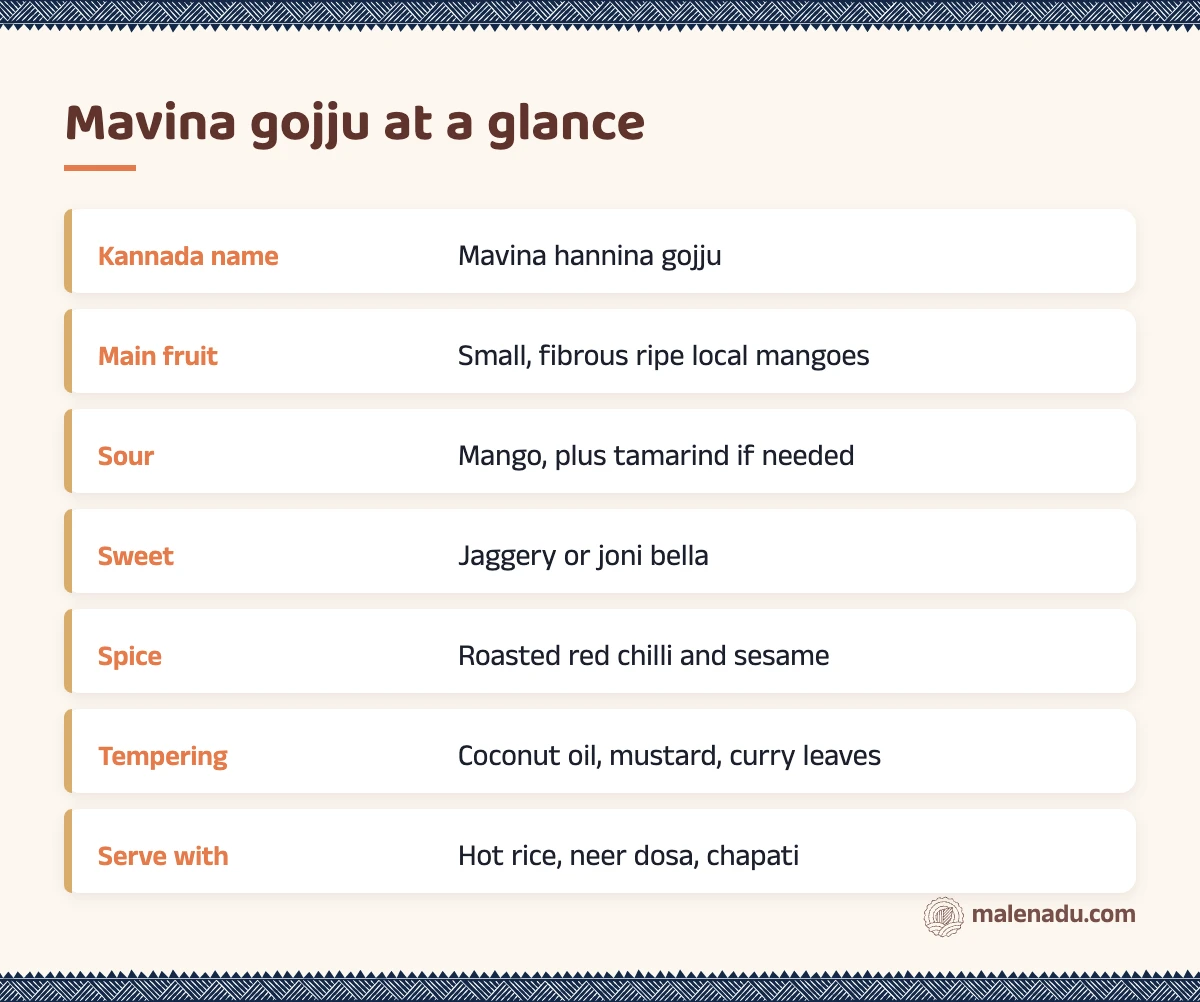
Mango gojju needs only a handful of ingredients. What changes from house to house is the balance of sweet, sour and hot.
- Ripe mangoes: 6 to 8 small local mangoes (about 500 g) or 2 to 3 medium sour ones. Keep the seeds.
- Jaggery: balances the sour. How much depends entirely on the mangoes, from 1 to 4 tablespoons.
- Tamarind: only if the mangoes are sweet. A teaspoon of thick tamarind water brings back the tang.
- Red chilli and sesame powder: dry red chillies and white sesame, roasted in a few drops of oil and ground. This gives colour and gentle heat.
- Rice flour: one teaspoon, mixed in water, to give the gravy a little body. Optional.
- Turmeric and salt.
- Tempering: coconut oil, mustard seeds, a dry red chilli, curry leaves and hing.
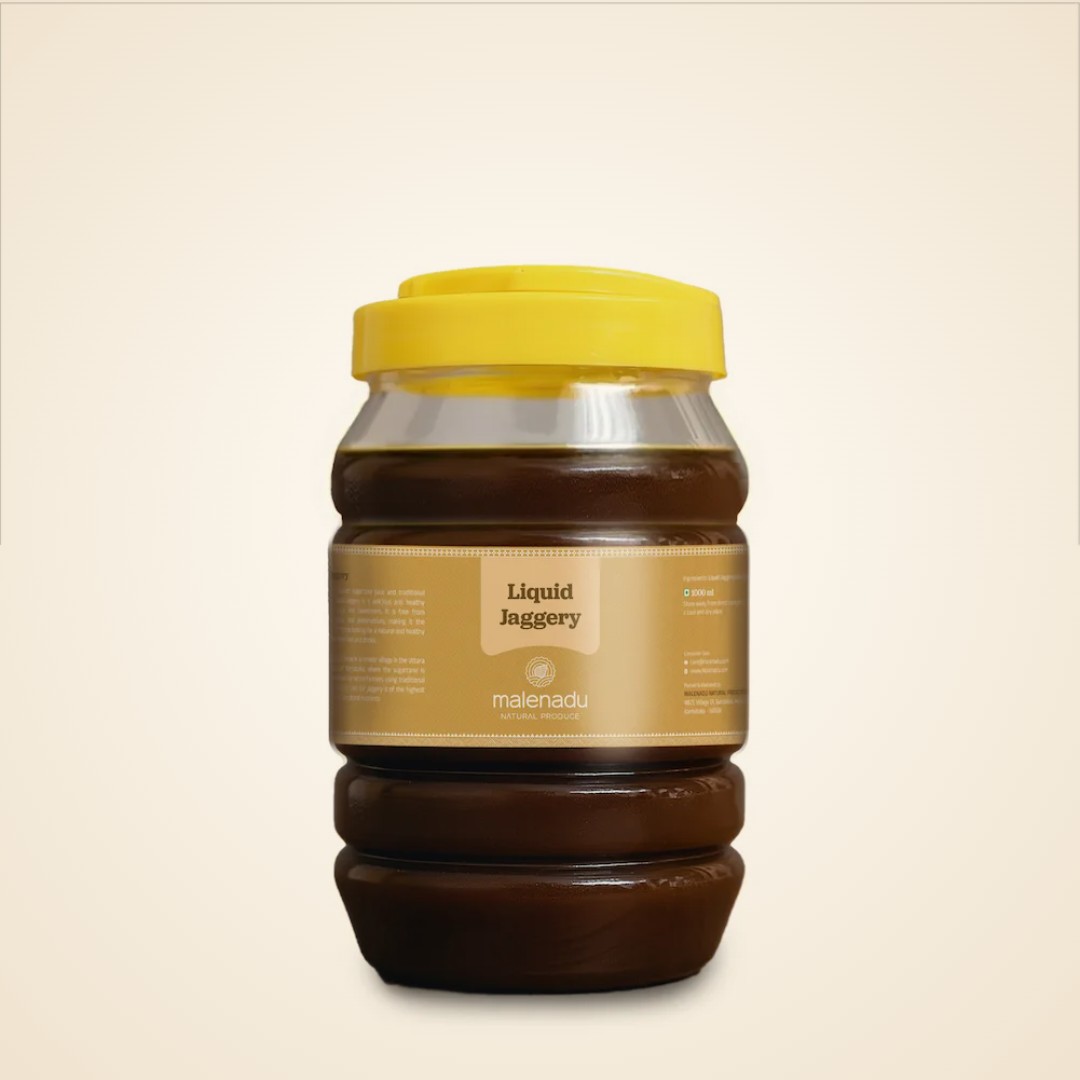
Jaggery is the ingredient you will adjust most. Liquid jaggery is the easiest, because you can add it a spoon at a time while tasting the gravy.
From the malenadu pantry
Our Liquid Jaggery, joni bella in Kannada, melts at once into hot mavina gojju. Start with one tablespoon for sour local mangoes and add more only after tasting.
For heat, many Malenadu homes crush one gandhari menasu, the tiny backyard chilli, into the gravy along with the dry chillies. It gives a sharp, fresh heat that cuts through the sweetness of ripe mango.

From the malenadu pantry
Our Bird Eye Chilli is the small, fiery gandhari menasu of Malenadu gardens. Crush one into mavina gojju for a bright heat. It is very hot, so start with one.
How to make mavina gojju at home
This mavina gojju recipe takes about 35 minutes and serves four with rice. Ripe mango cooks fast, so most of the time goes into peeling and cutting.
Recipe card
Mavina Gojju
Pieces of small ripe local mango simmered with jaggery, a roasted red chilli and sesame powder and a little rice flour, finished with a coconut oil tempering.
Ingredients
- 6 to 8 small ripe local mangoes, about 500 g (or 2 to 3 medium sour ripe mangoes)
- 1 1/2 cups water
- 1/4 teaspoon turmeric powder
- 3/4 teaspoon salt (adjust to taste)
- 1 to 4 tablespoons liquid jaggery (or grated jaggery), depending on the mangoes
- 1 teaspoon thick tamarind water, only if the mangoes are sweet
- a few drops of coconut oil, for roasting
- 4 to 5 dry red chillies (Byadgi for colour)
- 2 teaspoons white sesame seeds
- 1 teaspoon rice flour mixed in 3 tablespoons water
- 2 tablespoons wood pressed coconut oil, for tempering
- 1 teaspoon mustard seeds
- 1 dry red chilli, broken
- 10 to 12 curry leaves
- a pinch of hing (asafoetida)
Method
- Wash the mangoes and peel them with your fingers or a small knife. Cut the two cheeks off each mango into large pieces and keep the seeds with the pulp still on them.
- Roast the red chillies in a few drops of oil on low heat until crisp. Add the sesame and roast for 30 seconds until it pops. Cool and grind to a fine powder.
- Put the mango pieces and seeds in a pan with the water, turmeric and salt. Bring to a boil and simmer on medium heat for 5 to 6 minutes, until the pieces are soft but not falling apart.
- Squeeze the seeds lightly with a spoon against the side of the pan so their pulp goes into the gravy.
- Taste the gravy. Add jaggery a tablespoon at a time until it is sweet and sour in balance. Add the tamarind water now if it tastes too sweet.
- Stir in the chilli and sesame powder and simmer for 3 to 4 minutes on low heat.
- Stir the rice flour mix and pour it in, stirring all the time. Simmer for 2 minutes until the gravy turns glossy and coats the back of a spoon.
- Heat the coconut oil for tempering. Add the mustard seeds and let them splutter, then add the broken chilli, curry leaves and hing. Pour over the gojju, cover and rest for 10 minutes before serving.
How should mavina gojju look when done?
Mavina gojju is done when the gravy is orange, glossy and just thick enough to coat a spoon, with soft mango pieces that still hold their shape. It should be pourable, not as thick as a jam. The smell of raw chilli powder should be gone.
The tempering is not optional. The smell of coconut oil, mustard and hing poured hot over the mango is what makes this dish.
From the malenadu pantry
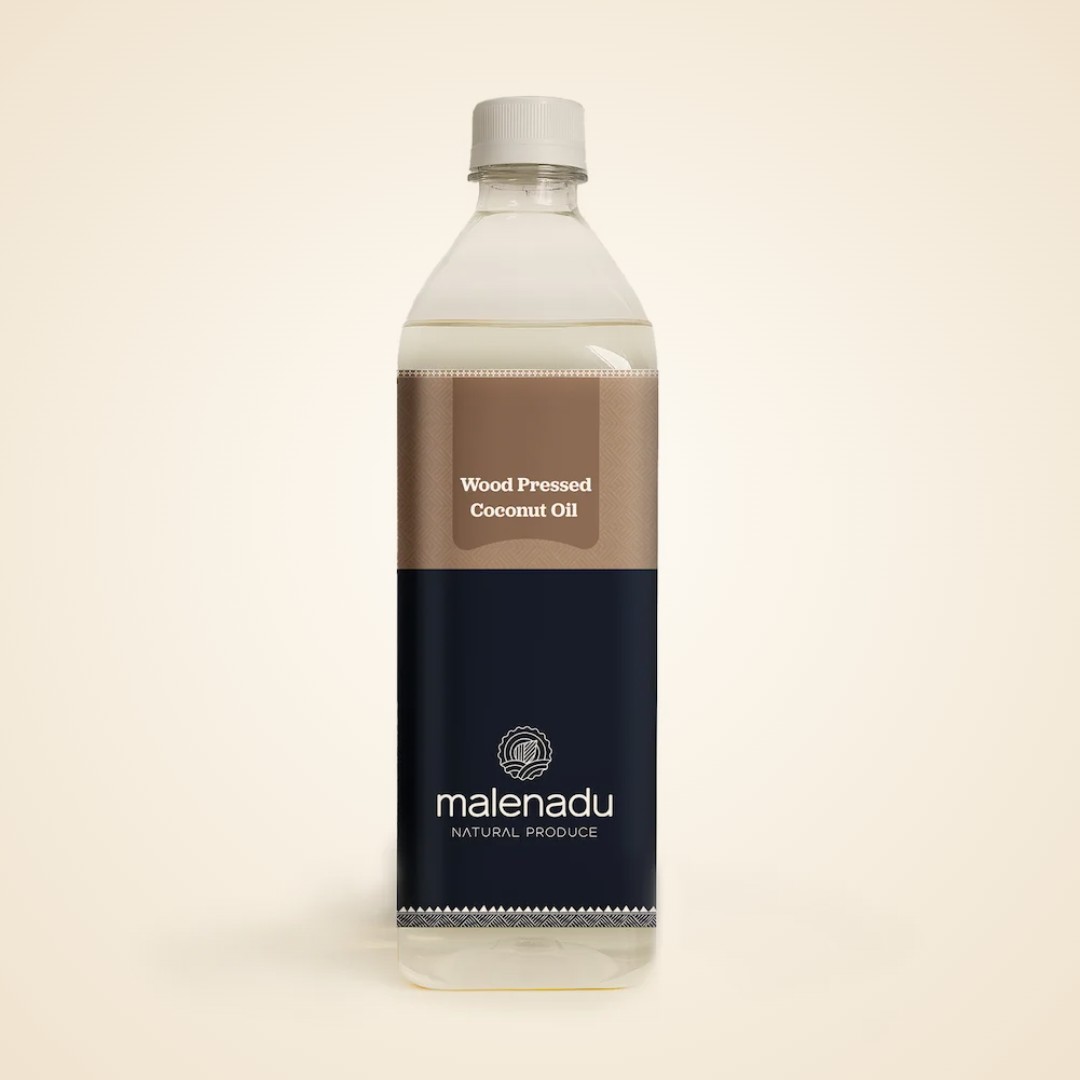
Our Wood Pressed Coconut Oil is pressed from sun dried copra in a wooden ghani. Two tablespoons in the tempering carry the smell of mustard and curry leaves into mavina gojju.
Mavinakayi gojju and other mango gojju variations
Mavina gojju changes with the mango, the season and the family. These five variations are the ones you will meet most often.
Mavinakayi gojju (raw mango gojju)
Mavinakayi gojju is made with sour green mangoes in March and April, before the ripe ones come in. Peel and dice 2 medium raw mangoes and cook them in 1 cup water with turmeric, salt and 1/4 cup jaggery until just soft. Roast 1 tablespoon urad dal, 1 teaspoon chana dal, 1/4 teaspoon fenugreek, 1/2 teaspoon cumin, 2 teaspoons sesame and 5 red chillies, grind them with 1/2 cup grated coconut and simmer the paste with the mango for 8 to 10 minutes. Finish with the same tempering.
This version is thicker, darker and much more sour than the ripe mango gojju. It keeps a day longer too.
Whole small mangoes, squeezed by hand
On the coast and in many Malenadu homes, tiny ripe mangoes are boiled whole with a few shallow cuts for 6 to 8 minutes, peeled by hand and squeezed into the water. Crushed green chillies, jaggery and salt go in, followed by the tempering. There is no spice powder. It is thinner, fresher and very fruity.
With ground coconut and mustard (sasive)
Grind 1/2 cup grated coconut with 1/2 teaspoon mustard seeds and 2 red chillies to a smooth paste and stir it into the cooked mango pulp. This is the coastal mavina hannina sasive. It is milder and creamy.
With garlic
In homes that use garlic, fry 4 to 5 crushed cloves in the tempering until golden. Many traditional homes skip garlic, so leave it out when cooking for them.
Thin mango saaru
Add an extra cup of water and skip the rice flour. Mavina gojju then turns into a thin, sweet and sour mango saaru. Some families drink it from a cup like rasam.
What to serve with mavina gojju
Mavina gojju is best with plain hot rice, as part of a simple summer lunch. It also goes with soft breakfast dishes.
- Rice: the classic. Pour a ladle of gravy and a piece of mango over hot rice.
- Neer dosa: thin neer dosa with mango gojju is a summer favourite on the coast.
- Chapati and akki rotti: use the gojju as a dip.
- With tambuli: start the meal with a cool menthya tambuli, then rice with mavina gojju. The sweet gojju and the cool curd sit well together.
- With happala: a fried papad on the side gives crunch.
On hot days many families keep lunch simple: rice, mavina gojju, a pickle and buttermilk. That is a complete Malenadu summer meal.
How long does mavina gojju keep?
Mavina gojju keeps for a day at room temperature and two to three days in the fridge in a clean, closed glass container. Ripe mango spoils faster than amla or tamarind, so it does not keep as long as other gojjus.
- Cool it fully before you put it in the fridge.
- Warm it gently before serving and add a spoon of water if it has thickened.
- The coconut versions keep only a day in the fridge.
- Throw it out if it smells sour in a fermented way or starts to bubble.
Common mistakes when making mango gojju
Most problems with mango gojju come from using the wrong mango or getting the sweet and sour balance wrong. Here is what to watch for.
| Problem | Cause | Fix |
|---|---|---|
| Too sweet and flat | very sweet table mangoes | add tamarind water and a pinch more salt |
| Too sour | raw or very sour mangoes | add jaggery a spoon at a time |
| Mushy pieces | cooked too long | simmer only until just soft |
| Lumpy gravy | rice flour added dry | always mix it in water first |
| Bitter | chillies or sesame burnt | roast on low and stop when crisp |
| No smell | tempering skipped or oil not hot | heat oil until mustard splutters |
One more habit helps. Taste mavina gojju only once the jaggery has dissolved fully, because jaggery takes a minute to show its sweetness.
Local tip
Do not throw away the peels straight away. Squeeze them over the pan with your hand. A good amount of pulp clings to the skin of small local mangoes.
What to cook next
Mavina gojju is the summer partner of the winter amla relish on our nellikai gojju page and of the monsoon kesuvina gojju. Explore more hill recipes in our Malenadu food guide. The jaggery, chillies and oil used on this page are in our natural sweeteners and spices sections.
Bring Malenadu home
Grown and made by Malenadu farmer families, packed by malenadu, a farmer owned producer company in Honnavar.
-
14% OFF
Liquid Jaggery
Original price was: ₹349.₹299Current price is: ₹299. -

Bird Eye Chilli
₹200 -
24% OFF
Wood Pressed Coconut Oil
Original price was: ₹899.₹679Current price is: ₹679. -
13% OFF
Turmeric Powder
Price range: ₹70 through ₹120 -
17% OFF
Kokum Rind
Original price was: ₹240.₹200Current price is: ₹200. -
8% OFF
Black Pepper
Price range: ₹165 through ₹299
Frequently asked questions about mavina gojju
What is mavina gojju?
Mavina gojju is a Karnataka relish of mango cooked with jaggery, salt and red chilli, then tempered with mustard and curry leaves in coconut oil. It is sweet, sour and spicy at once.
What is the difference between mavina hannina gojju and mavinakayi gojju?
Mavina hannina gojju is made with ripe mangoes and is fruity and sweet sour. Mavinakayi gojju is made with raw green mangoes and a roasted coconut paste and is thicker and more sour.
Which mango is best for mavina gojju?
Small, fibrous, sour sweet local mangoes are best. Very sweet table mangoes make a flat gojju unless you add tamarind.
Can I use appe midi for mango gojju?
No. Appe midi are tiny tender wild mangoes picked green for pickle. They are not left to ripen for gojju.
Do you add tamarind to mavina gojju?
Only when the mangoes are sweet. Sour local mangoes need no tamarind at all.
How long does mavina gojju last?
It keeps for a day outside and two to three days in the fridge in a clean, closed container.
What do you eat mango gojju with?
Hot rice is the classic pairing. It also goes well with neer dosa, chapati and akki rotti.
Explore more of Malenadu
Malenadu FoodMalenadu FoodRice, kokum, pepper and joni bella from the hills
Malenadu FoodHalasina KadubuSweet jackfruit dumplings steamed in leaves
Malenadu FoodSpices Names in KannadaEnglish, Kannada and Hindi names for a Malenadu kitchen
Malenadu FoodKara KadubuSpicy steamed rice dumplings from Malenadu kitchens
Malenadu FoodKokum SaaruThe sour, peppery everyday rasam of Malenadu homes
Malenadu FoodMenthya TambuliA cool fenugreek and curd side for the first rice course
Malenadu FoodMalenadu FruitsJackfruit, kokum, wild mango and the fruits of the forest
Malenadu FoodKesuvina GojjuThe sweet and sour colocasia leaf relish of the monsoon
Start hereMalenadu in KarnatakaWhere Malenadu is, what the name means