
Malenadu Food
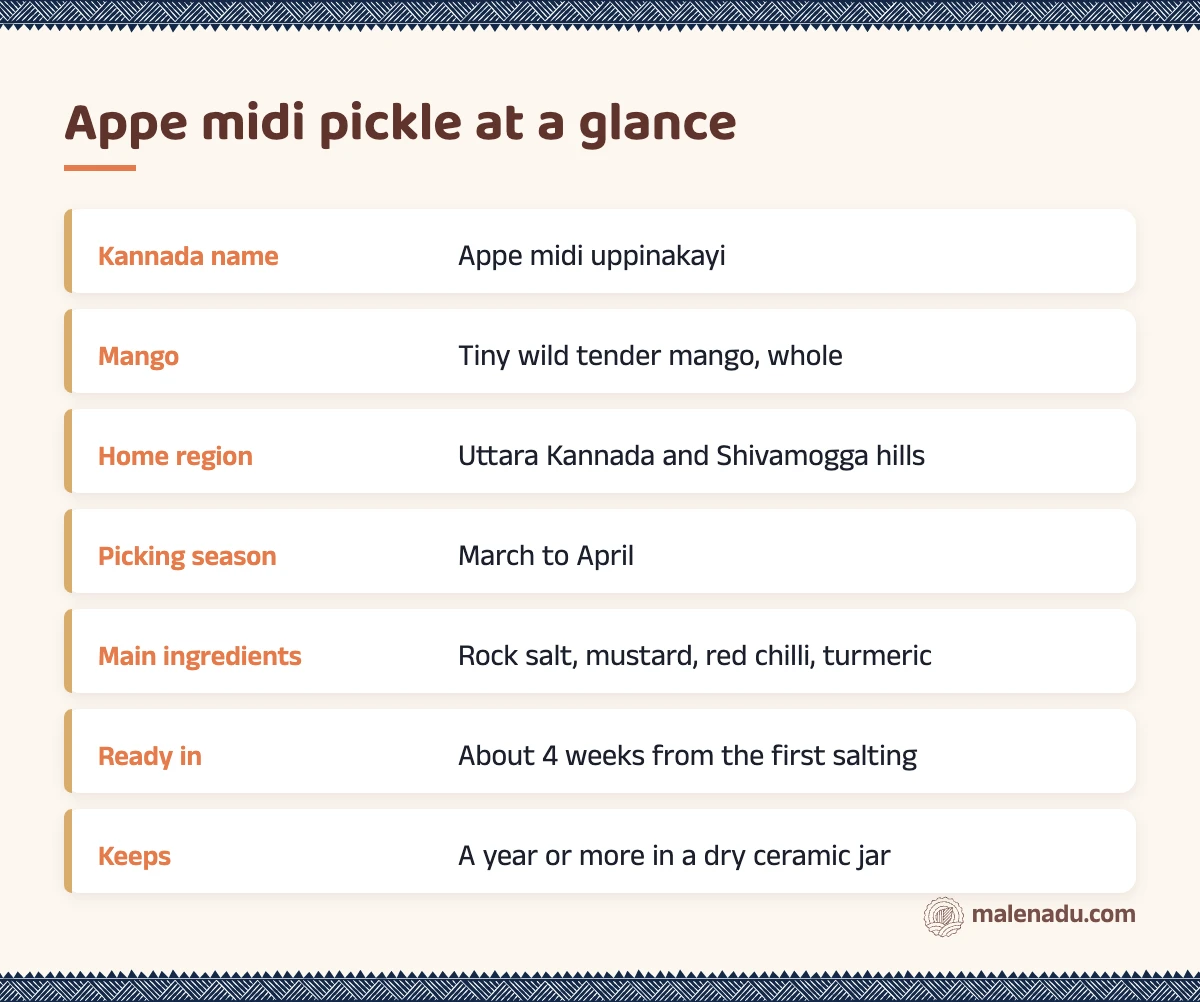
Appe midi pickle is a pickle of whole, thumb-sized tender mangoes cured in salt and coated in a fiery paste of mustard, red chilli and turmeric. It is the most prized pickle of the Malenadu hills. This page explains the special appe midi mango and its GI tag, gives a home recipe in nine steps and covers the season, storage, mistakes and variations.
On this page
What is appe midi pickle (appe midi uppinakayi)?
Appe midi pickle is a Malenadu pickle made from whole tender mangoes of a special wild type, picked long before the stone hardens and pickled stalk and all. In Kannada it is called appe midi uppinakayi (ಅಪ್ಪೆ ಮಿಡಿ ಉಪ್ಪಿನಕಾಯಿ). Uppinakayi means pickle and midi means a very young, tender mango.
The mangoes are first buried in rock salt until they shrivel and give out their own brine. That brine is then ground with mustard, chilli and turmeric into a thick red paste that coats every mango. There is no vinegar and, in the old method, no oil. Salt and mustard do the keeping.
What sets appe midi pickle apart is the smell. Open a good jar and a sharp, almost resinous mango aroma reaches you before you see the mangoes.
Where is appe midi pickle made?
Appe midi pickle is made mostly in the hill taluks of Uttara Kannada and Shivamogga, around Sirsi, Siddapur, Yellapur, Sagara and Thirthahalli. Havyaka homes there are especially known for it. For the map of these taluks, see our page on Malenadu districts.
What is the appe midi mango and why is it prized?
The appe midi mango is a group of wild and semi-wild mango types of the Western Ghats whose tender fruits are picked only for pickling. The trees grow mostly in forest and along streams and river banks, in valleys such as the Aghanashini, Bedthi, Kali, Sharavathi and Varada.
Three things make the appe midi mango special:
- Aroma. The milky sap (sone) that drips from the cut stalk carries a strong, sharp mango smell. That smell goes into the pickle.
- Small, firm fruit. The fruits are picked tiny and green, with a soft white seed inside. They stay crisp in salt.
- Clean sourness. The flesh is sour and low in fibre, so it soaks up salt and masala evenly.
Scientists at ICAR’s Indian Institute of Horticultural Research (IIHR) in Bengaluru collected 33 distinct appe midi types from Uttara Kannada and kept them in their field gene bank, because forest loss was putting old trees at risk. Eight of them stood out for whole-fruit pickling.
Appe midi mango varieties
Each old appe midi tree has its own smell and taste. Families name trees after their smell, village or owner.
| Name | What it is known for |
|---|---|
| Jeerige midi | A smell that reminds people of cumin (jeerige) |
| Karpoora midi | A smell close to camphor (karpoora) |
| Ananthabhatta appe | A named type sought by pickle makers |
| Malange (Malanji) appe | Traced to an old tree near Sirsi |
| Isagoor appe | Rated well for whole-fruit pickle |
| Kashimidi | Rated well for whole-fruit pickle |
| Dodderi jeerige | A jeerige type rated well for pickle |
An earlier IIHR trial tested 19 mango types as tender whole-fruit pickle and picked Kashimidi, Isagoor Appe, Malange, Appemidi, Dantimamidi and Jeerige as the best. The panel liked their sharp sourness and strong raw mango flavour.
Is there a GI tag for the appe midi mango?
Yes. Appemidi Mango is a registered Geographical Indication of Karnataka. The GI registry record shows application number 132, filed in September 2008 by the Department of Horticulture, Government of Karnataka, with certificate number 114 issued in 2009. The tag protects the name for mangoes from Karnataka.
When is appe midi season?
Appe midi season is short: the tender mangoes are picked mostly in March and April, just after the trees flower and set fruit. Pickers wait until the fruit is the right size but still tender inside, with a soft seed you can cut with a thumbnail.
The mangoes are picked by hand with a long stalk attached. The milky sap that drips from the stalk is the sign of a true appe midi.
Many trees are tall and old with no low branches, so picking is skilled work. Cutting whole branches to reach the fruit harms the tree. Older pickers say many trees have been lost this way.
In the Malenadu year this falls in the hot, dry months before the monsoon, when kokum, jackfruit and mango are all in season. Our Malenadu crop calendar shows where appe midi picking sits among the other summer jobs. For other fruits of these hills, read our guide to Malenadu fruits.
Local tip
Buy appe midi the day it is picked and start salting the same evening. Squeeze the stalk end gently: if a bead of milky sap comes out and the smell hits you, the mangoes are fresh.
Ingredients for appe midi pickle, explained
Appe midi pickle needs only six ingredients, but each one has to be right. Buy them before the mangoes arrive.
- Tender mangoes: firm, green, with no cuts, bruises or black spots. Keep a short stalk on each one.
- Rock salt (kallu uppu): the main preservative. It draws water out of the mangoes and makes the brine.
- Mustard seeds (sasive): ground fine, they give the paste its sharp bite and help the pickle keep.
- Dry red chilli: Byadgi chilli gives a deep red colour without too much heat.
- Turmeric: for colour and an earthy note.
- Hing (asafoetida): a pinch rounds off the masala.
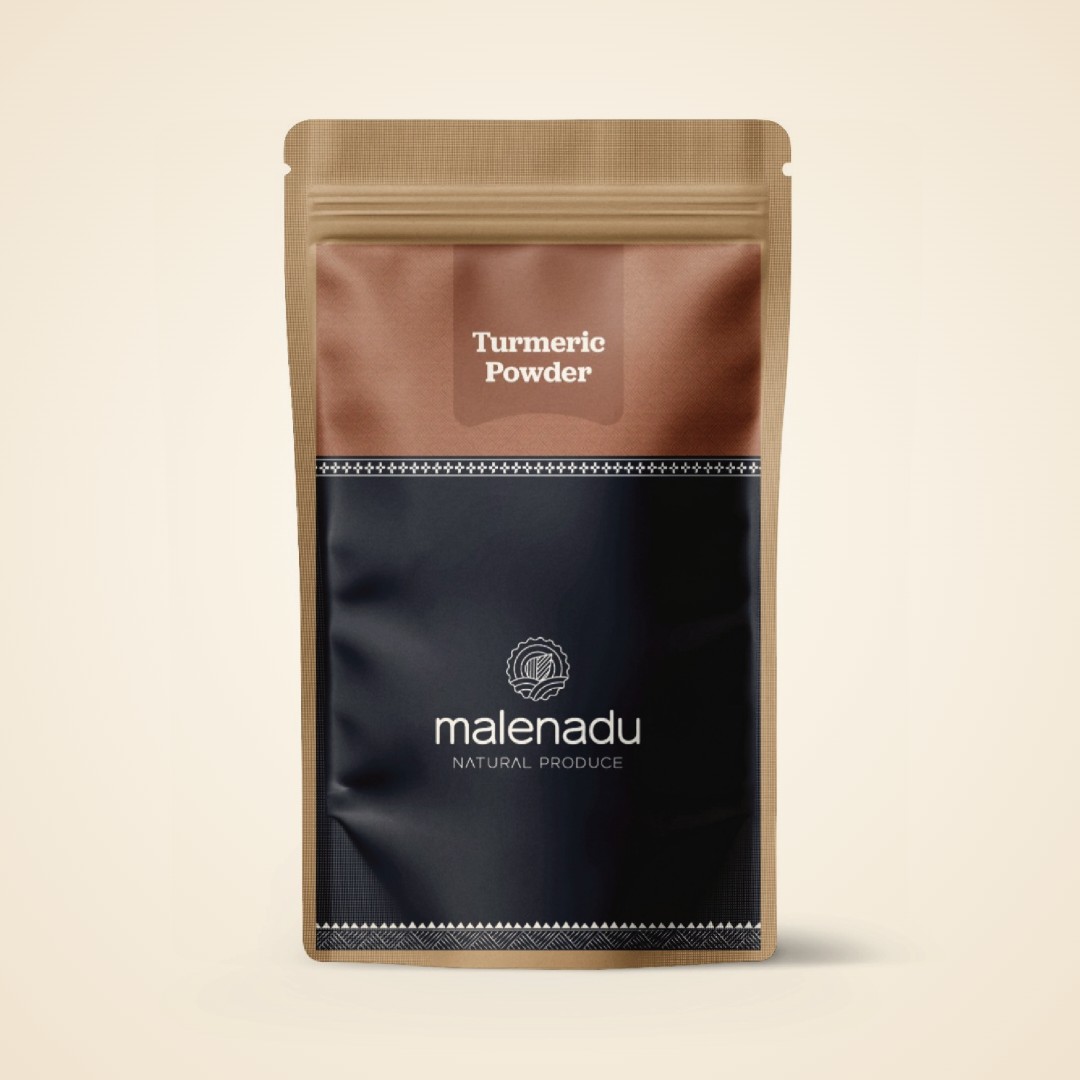
Turmeric gives appe midi pickle its warm orange-red colour. Use a fresh, bright powder, because old turmeric turns the paste dull. Our turmeric powder suits this well.
From the malenadu pantry
Our turmeric powder has a deep yellow colour and a fresh, earthy smell. One tablespoon is enough for a kilo of appe midi pickle and it keeps the masala bright in the jar.
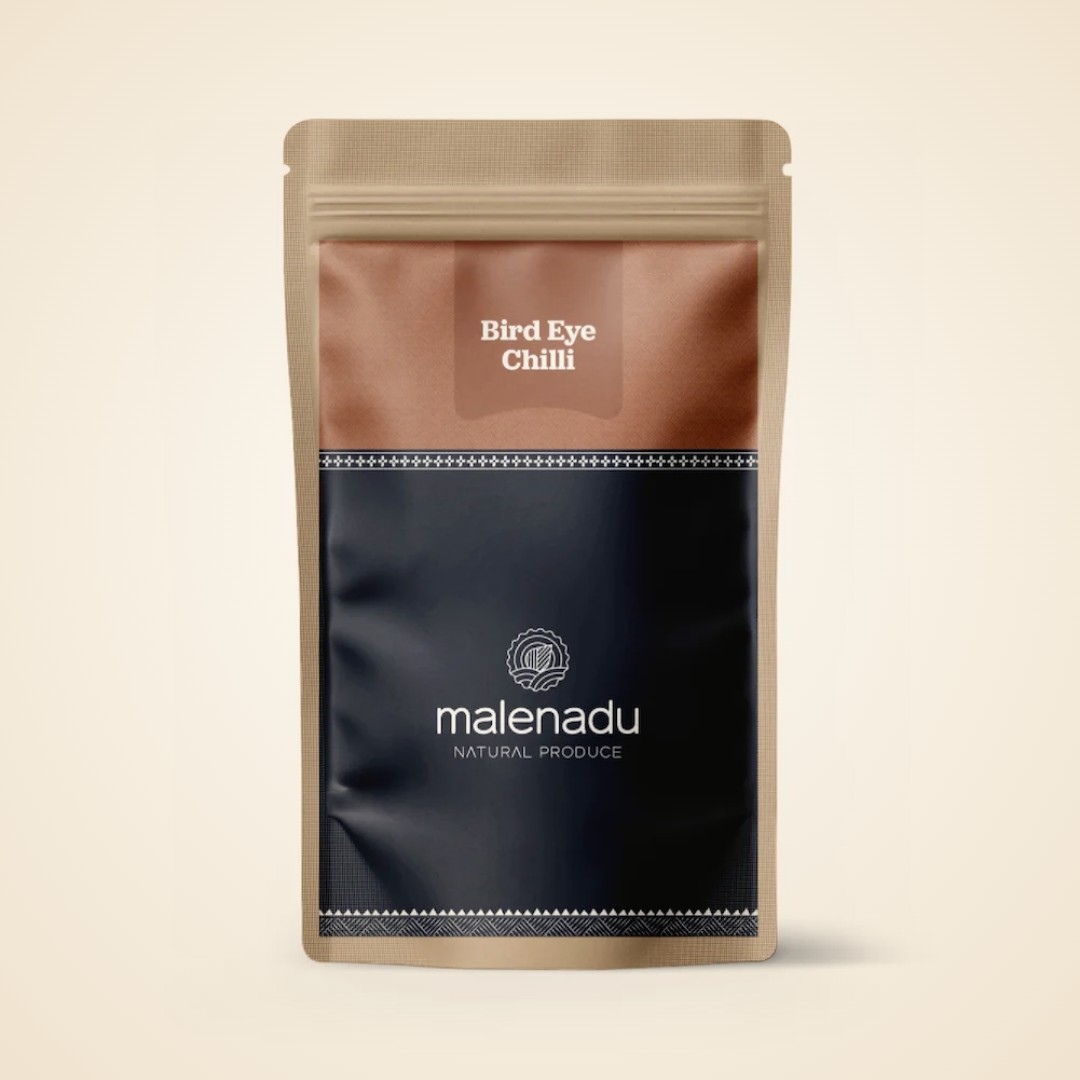
Some Malenadu homes add a few gandhari menasu, the tiny fiery bird eye chillies from the backyard, for a sharper heat. Our bird eye chilli works well here, but start with four or five.
From the malenadu pantry
Our bird eye chilli is the gandhari menasu of Malenadu backyards, small and very hot. A handful dropped into the jar gives appe midi pickle a fresh, sharp heat on top of the mild Byadgi chilli.
How to make appe midi pickle at home (midi uppinakai recipe)
Making appe midi pickle takes about four weeks from start to first taste, but less than two hours of actual work. This midi uppinakai recipe is the traditional no-oil method and makes one large jar.
Recipe card
Appe Midi Pickle
Whole tender appe midi mangoes cured in rock salt for about 10 days, then coated in a paste of mustard, Byadgi chilli and turmeric ground with their own brine. Makes one large jar.
Ingredients
- 1 kg appe midi tender mangoes, with short stalks
- 1 1/4 cups rock salt, for salting the mangoes
- 1/2 cup rock salt, for the brine
- 2 cups water
- 100 g mustard seeds (about 2/3 cup)
- 150 g Byadgi chilli powder (about 1 1/4 cups) or whole dry Byadgi chillies
- 1 tablespoon turmeric powder
- 1 teaspoon hing (asafoetida)
- 4 to 6 bird eye chillies, optional
Method
- Sort the mangoes and throw out any that are soft, cut or spotted. Wipe each one with a damp cloth, then spread them on a dry cotton cloth in the shade for 1 to 2 hours until there is no trace of water.
- Take a clean, completely dry ceramic jar or glass jar. Spread 2 tablespoons of salt at the bottom, then add the mangoes in layers with a little salt between each layer. Finish with a layer of salt on top.
- Close the jar, cover the mouth with a cloth and keep it in a cool, dry place. Once a day, shake the jar or turn the mangoes gently with a dry spoon. In 8 to 10 days the salt will melt into brine and the mangoes will shrivel. Give them 3 to 4 more days if they are still plump.
- Lift the mangoes out of the jar and keep the brine. Spread the mangoes on a dry cotton cloth for 2 to 3 hours.
- Pour the brine into a steel pan, add 1/2 cup salt and 2 cups water and boil for 4 to 5 minutes. Let it cool completely.
- Warm the mustard seeds in a dry pan on low heat for a minute, without letting them pop. If using whole chillies, warm them until crisp. Cool both, then grind them to a fine powder. Mix in the turmeric and hing.
- Grind the masala powder with about 1 cup of the cooled brine into a thick, smooth paste. Keep 2 tablespoons of the paste aside.
- Mix the mangoes into the paste and add more brine until the paste coats them thickly and just covers them. Add the bird eye chillies if using. Taste a little paste and add salt if needed.
- Spread the reserved paste at the bottom of a dry jar, pack in the pickle and press it down. Wipe the rim dry, close the lid, tie a cloth over it and rest the jar for 2 to 3 weeks before eating, turning the pickle with a dry spoon every few days.
When appe midi pickle is ready, the mangoes are wrinkled, firm and dark green under a thick red coat. The paste smells of mustard and mango, not of raw chilli.
How is appe midi pickle different from other tender mango pickle?
Appe midi pickle differs from an ordinary tender mango pickle in its mango, its smell and how long it keeps. The method is almost the same.
| Appe midi pickle | Ordinary tender mango pickle | |
|---|---|---|
| Mango | Wild appe midi types | Tender fruit of any grafted mango |
| Size | Very small, picked whole | Often larger, sometimes cut |
| Aroma | Strong, resinous mango smell from the sap | Milder raw mango smell |
| Texture | Stays crisp for months | Can soften with time |
| Season | Short, about March to April | Longer, wherever mango trees set fruit |
| Keeps | A year or more | Usually less |
| Price | High, because fruit is scarce | Lower |
You can make a good tender mango pickle with the same recipe using small fruits of any local mango tree (maavina midi). It will be tasty, just not as fragrant. Many families mix a few appe midi into a jar of ordinary midi to lift the smell.
How should you store appe midi pickle?
Store appe midi pickle in a dry ceramic jar or glass jar with a tight lid, in a cool, dark place. In Malenadu homes the pickle is kept in tall glazed ceramic jars called bharani (ಭರಣಿ), with a cloth tied over the mouth. Our page on the traditional Malenadu house shows where these jars sit in the old home.
- Use a dry spoon every time. One drop of water can spoil the top layer.
- Keep the mangoes under the paste. Press them down after each use so none stick out dry.
- Avoid steel and plastic for long storage. Salt and sour mango can react with metal over months.
A well made jar keeps for a year or more without a fridge. Many families keep old jars for several years. If you see white mould, a slimy layer or a bad smell, throw away the top layer at once.
Common mistakes when making appe midi pickle
Most failed batches of appe midi pickle come from water, soft fruit or too little salt. Here is what to watch for.
- Washing the mangoes and not drying them. Water left on the skin spoils the pickle. Wipe, then dry fully.
- Using soft or bruised mangoes. They turn mushy and can ruin the whole jar.
- Removing the stalk. Pulling the stalk off opens the fruit. Cut it short instead.
- Too little salt. Salt is the only preservative. Do not cut it.
- Burning the mustard. Burnt mustard tastes bitter. Warm it gently instead.
- Mixing in warm brine. Hot brine cooks the mangoes and dulls the smell.
- Eating it too soon. Appe midi pickle needs at least two weeks after mixing to settle.
Appe midi pickle variations
The basic appe midi pickle stays the same in most homes. Small changes give each family its own jar.
With gandhari menasu
Add a handful of whole bird eye chillies with the mangoes in step 8. Over a few weeks they soften and soak up the brine.
Plain salted midi in brine
Some homes keep a few salted tender mangoes in plain brine, with no masala. These are used through the year in chutneys and in appe huli, a thin, sour saaru made with tender mango.
Other Malenadu pickle traditions
Appe midi is the king, but it is not the only Malenadu pickle. Homes in the hills also put up lime, herale kai (a large wild citron), ambate (hog plum) and nellikai (Indian gooseberry) pickles, mostly with the same salt, mustard and chilli method. The Kannada names of these fruits and spices are in our guide to spice and ingredient names in Kannada.
How do Malenadu homes eat appe midi pickle?
In Malenadu homes appe midi pickle is eaten in small bites with rice, never in big spoonfuls. One mango can last a whole meal.
- With hot rice and ghee. The classic first bite: a little rice, a spoon of ghee and a nibble of appe midi.
- With curd rice. The cool curd and sharp pickle are a natural pair at the end of lunch.
- With saaru and tambuli. A mango sits at the edge of the banana leaf through the whole meal, next to a kokum saaru or tambuli.
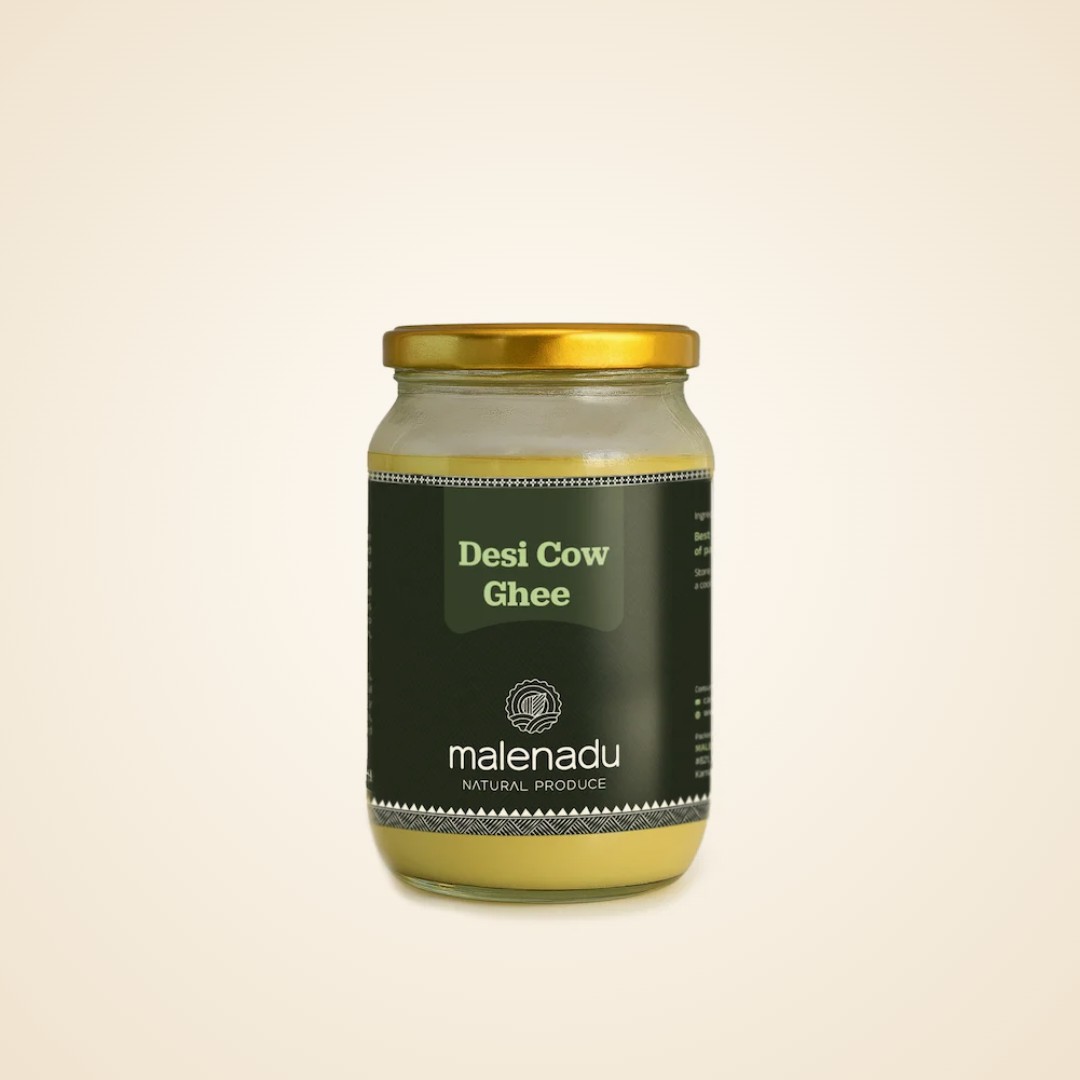
Ghee and appe midi pickle belong together, because the ghee softens the salt and heat. Our desi cow ghee is the one we reach for.
From the malenadu pantry
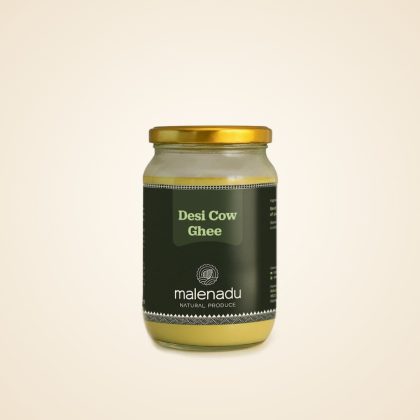
Our desi cow ghee is hand churned by farmer families from the milk of desi breeds such as Malenadu Gidda. A spoon on hot rice with a bite of appe midi is the simplest Malenadu meal there is.
Local tip
Never throw away the leftover red paste at the bottom of the jar. Mix it with a little curd for a quick chutney or stir it into plain rice.
Where to go next
Appe midi pickle is one part of a bigger Malenadu kitchen. Our Malenadu food guide shows the rest of the meal around it, from tambuli to payasa. For chilli, turmeric and pepper from the same hills, browse our spices section.
Bring Malenadu home
Grown and made by Malenadu farmer families, packed by malenadu, a farmer owned producer company in Honnavar.
-
Bird Eye Chilli
₹200 -
13% OFF
Turmeric Powder
Price range: ₹70 through ₹120 -
40% OFF
Desi Cow Ghee
Original price was: ₹1,500.₹899Current price is: ₹899. -
8% OFF
Black Pepper
Price range: ₹165 through ₹299 -
17% OFF
Kokum Rind
Original price was: ₹240.₹200Current price is: ₹200. -
24% OFF
Wood Pressed Coconut Oil
Original price was: ₹899.₹679Current price is: ₹679.
Frequently asked questions about appe midi pickle
What is appe midi in English?
Appe midi is a type of wild tender mango from the Western Ghats of Karnataka, picked very young for pickling. There is no common English name, so it is usually called appe midi or appemidi mango.
What is appe midi pickle called in Kannada?
It is called appe midi uppinakayi (ಅಪ್ಪೆ ಮಿಡಿ ಉಪ್ಪಿನಕಾಯಿ). Uppinakayi means pickle and midi means tender mango.
Does the appe midi mango have a GI tag?
Yes. Appemidi Mango is a registered Geographical Indication of Karnataka, filed by the state Department of Horticulture in 2008 and registered with certificate number 114 in 2009.
When is appe midi season?
The tender mangoes are picked mostly in March and April. The season is short, so families buy and salt them the same day.
How long does appe midi pickle last?
Made with enough salt and kept dry in a ceramic or glass jar, it keeps for a year or more without a fridge. Many Malenadu families keep jars for several years.
Is there oil in appe midi pickle?
The traditional recipe uses no oil. Salt, mustard and the mango’s own brine preserve it.
Can I make appe midi pickle with ordinary tender mangoes?
Yes, the same method works with small tender mangoes of any tree. The pickle will taste good but will not have the strong appe midi aroma.
Explore more of Malenadu
Malenadu FoodMalenadu FoodRice, kokum, pepper and joni bella from the hills
Malenadu FoodHalasina KadubuSweet jackfruit dumplings steamed in leaves
Malenadu FoodSpices Names in KannadaEnglish, Kannada and Hindi names for a Malenadu kitchen
Malenadu FoodKara KadubuSpicy steamed rice dumplings from Malenadu kitchens
Malenadu FoodKokum SaaruThe sour, peppery everyday rasam of Malenadu homes
Malenadu FoodMenthya TambuliA cool fenugreek and curd side for the first rice course
Malenadu FoodMalenadu FruitsJackfruit, kokum, wild mango and the fruits of the forest
Malenadu FoodKesuvina GojjuThe sweet and sour colocasia leaf relish of the monsoon
Start hereMalenadu in KarnatakaWhere Malenadu is, what the name means