
Malenadu Food
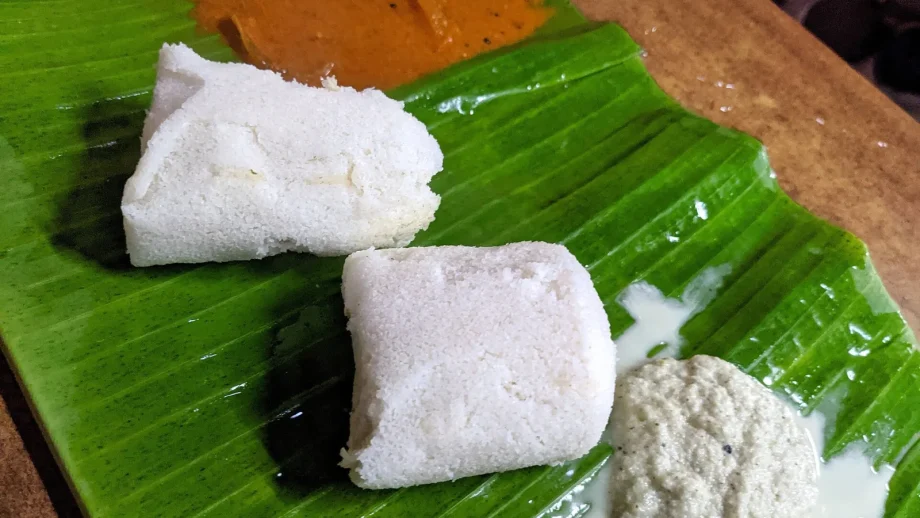
Kotte kadubu (ಕೊಟ್ಟೆ ಕಡುಬು) is fermented rice and urad dal batter poured into small cups pinned from four jackfruit leaves and steamed until soft. The leaves give it a square shape and a light green smell. This page shows how to make the leaf cups step by step, gives a home recipe and explains how it differs from moode.
On this page
What is kotte kadubu, the jackfruit leaf idli?
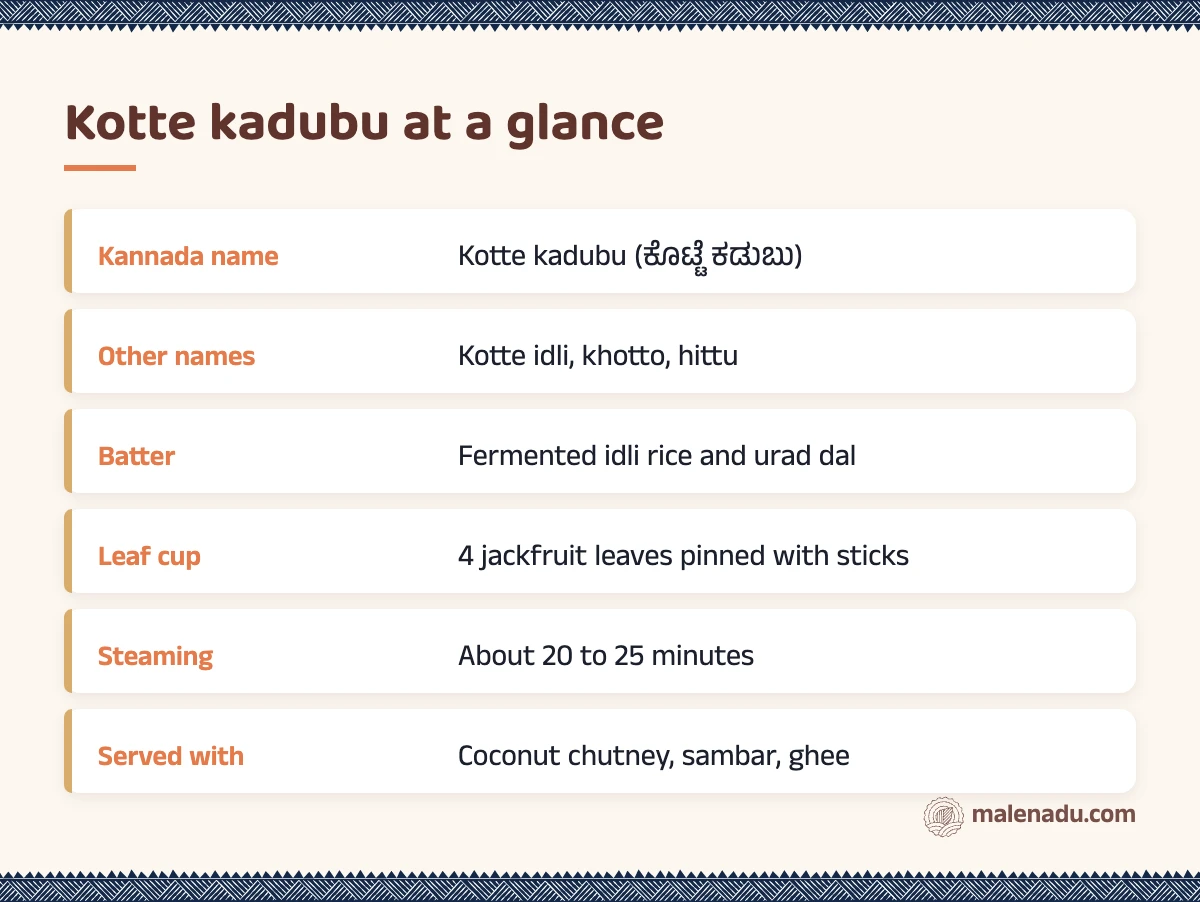
Kotte kadubu is an idli steamed in a cup made of jackfruit leaves instead of an idli plate. “Kotte” (ಕೊಟ್ಟೆ) is the leaf cup and “kadubu” is the Kannada word for a steamed rice cake. So the name simply means a kadubu cooked in a leaf cup.
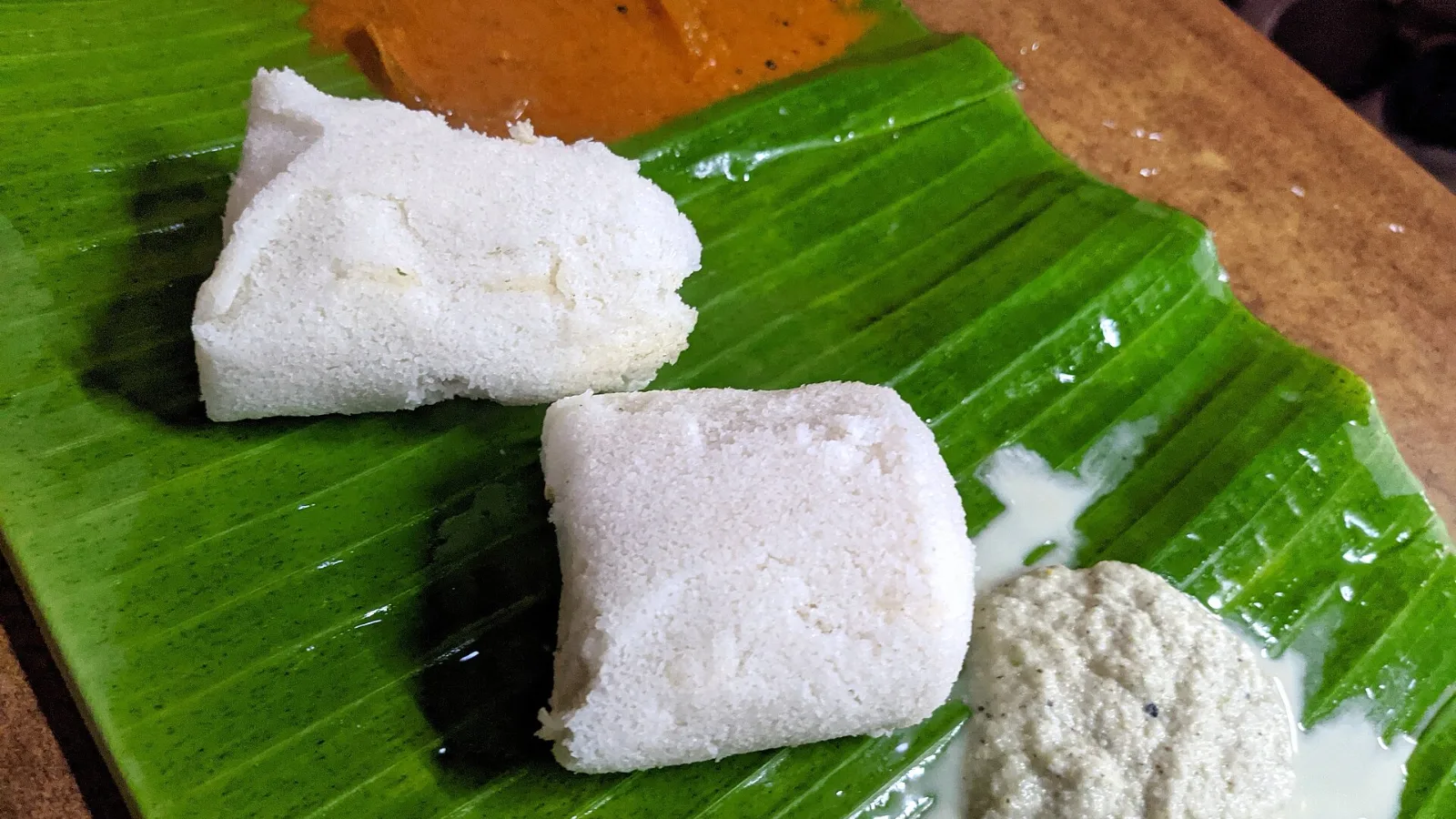
The batter is the same fermented rice and urad dal batter used for idli. What changes is the shape and the smell. Each kotte kadubu comes out as a tall, soft square block, with faint lines from the leaves on its sides. Steaming in the leaf gives it a mild green, slightly woody smell that a steel plate cannot.
Many people call it jackfruit leaf idli. Because each cup holds much more batter than an idli mould, one kotte kadubu is a big piece. Two make a good breakfast for most adults.
Kotte idli, khotto and other names
The dish has a different name in almost every language of the coast and the hills.
- Kotte kadubu or kotte idli in Kannada.
- Khotto (plural khotte) or hittu in Konkani speaking homes.
- Jackfruit leaf idli in English menus and recipe books.
Karnataka Tourism describes kadubu cooked in cubical cups made by stitching jackfruit leaves together, with steamed batter served with coconut chutney and sambar. The same page notes that it is commonly sold in the eateries of coastal Karnataka and Malenadu. It is a dish shared by the hills and the coast, not the dish of one town.
Where and when is kotte kadubu made?
Kotte kadubu is made wherever jackfruit trees grow near the house, which in Malenadu and on the coast means almost everywhere. Most old homes in these hills have a jackfruit tree in the backyard or the thota (home plantation), so fresh leaves are never far away. Our guide to Malenadu fruits shows how every part of the jackfruit tree gets used.
Because the leaves are there all year, it can be made in any season. Still, it is most often a dish for a special morning: festival days such as Ganesha Chaturthi and Deepavali, family functions and the day relatives come to stay. Our page on Malenadu festivals lists the other kadubu that come out on those days.
A Deccan Herald feature on the food of South Canara counts jackfruit leaf kadubu among the region’s leaf cooked dishes, noting the aroma the leaves give. To see which taluks make up the hills, see our page of Malenadu districts and taluks.
Is kotte kadubu the same as moode?
No. Both are idli batter steamed in leaves, but moode uses long screwpine leaves woven into tall cylinders, while kotte kadubu uses jackfruit leaves pinned into square cups.
| Point | Kotte kadubu | Moode |
|---|---|---|
| Leaf | jackfruit leaf | screwpine (kedage, pandanus) leaf |
| Shape | short square cup | tall cylinder |
| How the cup is made | 4 leaves pinned with sticks | long leaf strips woven into a tube |
| Smell | mild and green | stronger and sweeter |
| Where | hills and coast | mostly Udupi, Mangaluru and the coast |
Moode is mostly a coastal dish and is closely tied to Krishna Janmashtami in Udupi and around. Screwpine leaves have thorns along their edges that must be stripped off. The leaves are wilted over a flame so they bend without cracking and then woven into tubes, which is skilled work. On the coast the same screwpine kind is also called kottige.
Kotte kadubu is far easier at home. Jackfruit leaves have no thorns and need no wilting, so it is the leaf idli you will find in most Malenadu homes.
How to make kotte, the jackfruit leaf cups
A kotte is made by pinning four jackfruit leaves together at the base and then folding them up into a square cup, pinned at each corner. It sounds hard, but after three or four cups your hands learn it.
What you need
- Leaves. Fresh, unbroken jackfruit leaves of the same size, dark green but not old and hard. You need 4 for each cup, so 40 to 48 for a full batch.
- Sticks. Thin, sharp slivers of the midrib of a coconut leaf (the same ribs used in a broom) or thin bamboo slivers, cut to about 1 inch. Toothpicks are thicker and tend to split the leaves.
- A clean cloth to wipe the leaves dry.
Step by step
- Wash and dry. Wash the leaves and wipe them dry with the cloth. Cut the stalks short. Leaves picked the same day bend best. Old, dry leaves crack when folded.
- Pin the first pair. Lay two leaves flat with their tips overlapping in the middle and pin them together where they overlap.
- Add the second pair. Lay two more leaves across the first pair, again with their tips meeting in the middle, so the four leaves form a plus sign. Pin through the centre to hold all four together. The square in the middle is the base of your cup.
- Fold up the sides. Lift two neighbouring leaves up from the base and fold their edges together into an L at the corner. Pin along the fold from the bottom upwards.
- Close all four corners. Repeat with each pair of neighbouring leaves until you have a square cup with four pinned corners.
- Check for gaps. Hold the cup up to the light. If you see a gap at the base or a corner, add another stick. Batter finds every hole.
- Trim. Snip off any stalks or tips that stick up too high, so the cups fit under the lid of your steamer.
Make the cups while the batter ferments and keep them under a damp cloth. Make two extra, because one or two always leak.
Local tip
If this is your first time, ask someone who makes kotte to show you once. What takes a page to write takes a minute to watch.
Kotte kadubu recipe: how to make it at home
This kotte kadubu recipe makes 10 to 12 kadubu, enough for a breakfast for five or six people. It uses the same batter as idli but a little thicker, so it holds well in the leaf cups.
Recipe card
Kotte Kadubu
Fermented rice and urad dal batter steamed in cups of jackfruit leaves, the soft leaf idli of Malenadu and coastal Karnataka.
Ingredients
- 2 cups idli rice (parboiled rice), about 400 g
- 1 cup urad dal (white, split or whole), about 200 g
- 1/2 teaspoon fenugreek (menthya) seeds
- 1 1/2 teaspoons salt
- about 1 1/2 to 2 cups cold water, for grinding
- 10 to 12 kotte (jackfruit leaf cups), made from 40 to 48 leaves
- coconut oil or ghee, to serve
Method
- Wash the rice and soak it in plenty of water for 5 to 6 hours. Wash the urad dal with the fenugreek seeds and soak them together in a separate bowl for 4 hours.
- Drain the dal. Grind it with cold water, a little at a time, until the batter is very smooth, light and fluffy. In a wet grinder this takes 15 to 20 minutes. In a mixer, grind in two batches.
- Drain the rice and grind it with a little water to a slightly grainy paste, like fine rava. Mix it well into the dal batter with your hand.
- Cover the bowl and leave it in a warm place for 8 to 12 hours or overnight, until it has risen and nearly doubled. In hot weather add the salt before fermenting. In cool weather add it after.
- Add the salt if you have not yet and stir gently once or twice. The batter should be thick and fall from a ladle in a slow ribbon. Do not add water.
- Pour about 2 inches of water into a large steamer or idli cooker and bring it to a boil.
- Stand the leaf cups upright on the steamer plate, close together so they support each other. Fill each cup about three quarters full, since the batter rises.
- Cover and steam on a medium high flame for 20 to 25 minutes. Push a thin skewer into the centre of one kadubu. If it comes out clean, they are done. If it is sticky, steam for 5 minutes more.
- Switch off the heat and rest for 5 minutes. Pull out the sticks, peel away the leaves and serve hot with chutney, sambar and a spoon of ghee or coconut oil.
A well made kotte kadubu is white, soft and spongy, with small even holes inside when you break it. The sides carry the faint print of the leaf and the outside may have a pale green tinge. It should spring back when pressed, not stay dented.
In many homes the kadubu are served still in their cups so each person opens their own. The smell that comes out when you pull the leaves apart is half the reason people make kotte kadubu at all.
What to serve with kotte kadubu
Kotte kadubu is served hot with coconut chutney, sambar and a spoon of ghee or coconut oil poured over the top. These are the usual partners.
- Coconut chutney. A coarse chutney of fresh coconut, green or red chilli, a little tamarind and a tempering of mustard and curry leaves.
- Sambar. A Karnataka style sambar with a little jaggery in it. A spoon of liquid jaggery is the easy way to add it.
- Chutney powder. For travel or a quick breakfast, a spoon of chutney pudi mixed with oil or ghee.
- Majjige huli. A mild buttermilk curry with coconut and a pinch of turmeric powder, common at festival meals.
- Chicken curry. In homes that eat meat, kadubu with a peppery chicken curry is a Sunday treat.
From the malenadu pantry
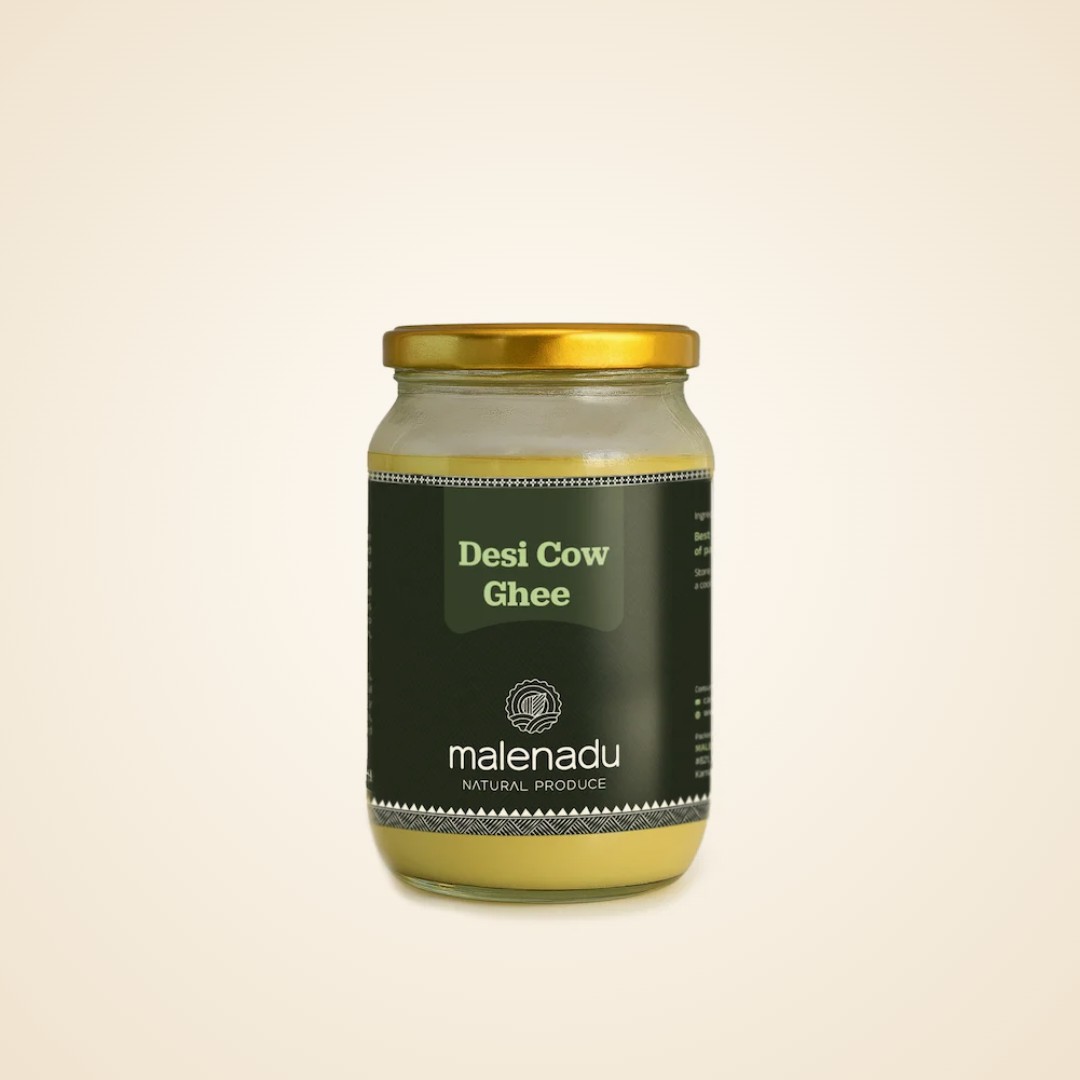
malenadu Desi Cow Ghee is hand churned by farmer families from the milk of desi breeds such as Malenadu Gidda. A spoon melting into a hot, freshly opened kotte kadubu is the way most hill families like it.
Some families prefer a few drops of raw coconut oil instead of ghee, especially with a hot chutney. Both are traditional and both bring out the leaf smell.
From the malenadu pantry
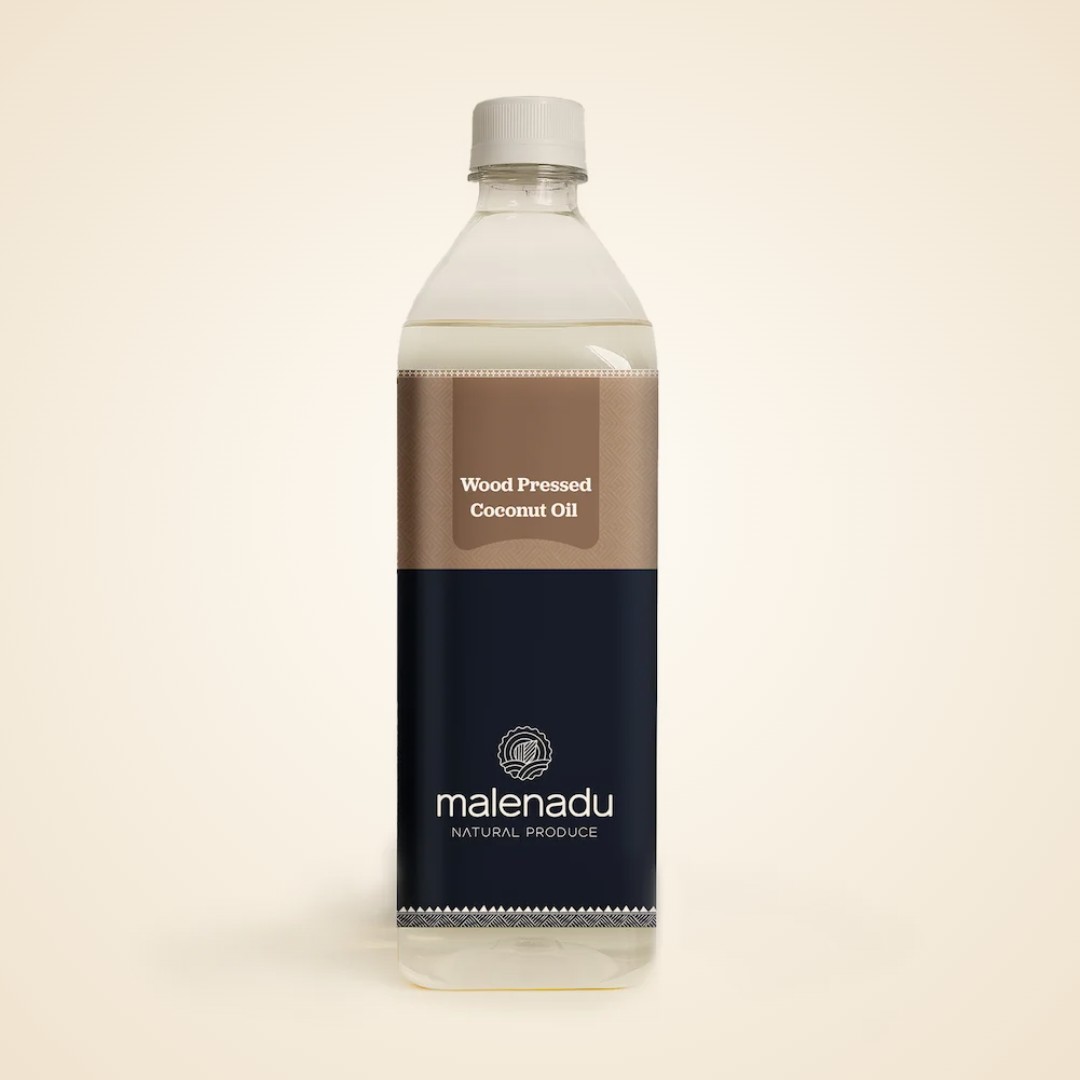
malenadu Wood Pressed Coconut Oil is pressed from sun dried copra in a wooden ghani. Poured raw over hot kadubu, it adds the coconut smell that goes with the jackfruit leaf. It is also the oil for the chutney tempering.
A hotter chutney for kadubu
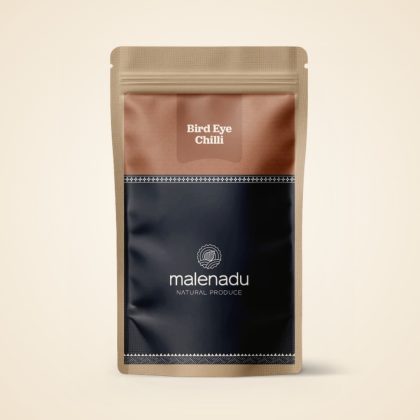
Many Malenadu homes like their kadubu chutney sharp. Grind 1 cup of fresh coconut with a small piece of tamarind, salt and one or two gandhari menasu, the tiny bird eye chillies of hill backyards, instead of green chilli. A pinch of crushed black pepper gives a warmer heat that children find easier.
From the malenadu pantry
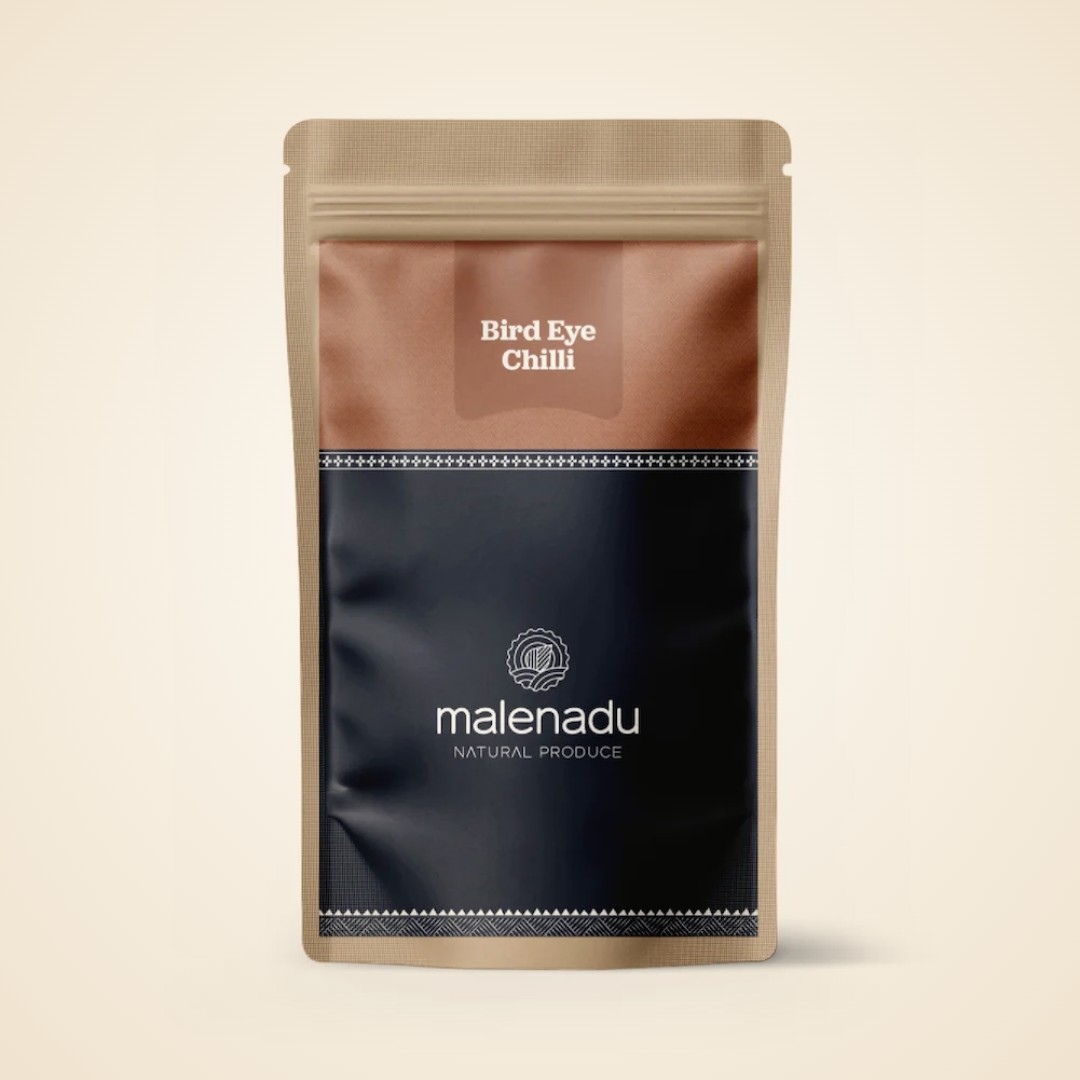
malenadu Bird Eye Chilli is gandhari menasu, the small fiery chilli of Malenadu backyards. One or two ground into coconut chutney give a sharp, fresh heat that suits soft, plain kadubu.
What if you have no jackfruit leaves?
If you cannot get jackfruit leaves, you can still make kotte kadubu style idli with banana leaf cones, steel cups or plain idli plates. Each gives a slightly different shape and smell.
| Instead of kotte | How to do it | What you get |
|---|---|---|
| Banana leaf cones | cut leaf into squares, wilt over a flame, roll into a cone and pin | a mild leaf smell, a cone shape |
| Banana leaf lined cups | line greased steel cups or tumblers with wilted banana leaf | a neat shape, a little leaf smell |
| Steel cups or tumblers | grease well and fill three quarters full | the same shape and texture, no leaf smell |
| Idli plates | grease and fill as for idli, steam 12 to 15 minutes | ordinary idli from the same batter |
Karnataka Tourism notes that steel cups are used where leaves are not available. Banana leaves are the closest substitute in cities and are sold in most markets. Wave each piece over a low flame for a few seconds until it turns bright green and soft. Otherwise it cracks when you roll it.
Kotte kadubu variations
Most homes make their own changes to the batter, not the cups.
With idli rava
Many homes skip grinding the rice and use rice rava (idli rava) instead. Soak 1 cup urad dal for 3 to 4 hours and grind it fluffy. Wash 2 cups idli rava, squeeze out the water and mix it into the dal batter. Ferment overnight and steam as above.
Kara kotte kadubu
For a spicy version, temper mustard seeds, chana dal, curry leaves, green chilli and grated ginger in coconut oil. Stir this into the fermented batter with a handful of grated coconut just before filling the cups. For other steamed dishes of the hills, see our kara kadubu and the sweet jackfruit halasina kadubu, which also steams well in these cups.
Common kotte kadubu mistakes and how to fix them
Most problems come from leaky cups, a batter that did not rise or too little steaming time. This table shows what went wrong and what to do next time.
| Problem | Likely cause | Fix |
|---|---|---|
| Batter leaks out | gaps at the base or corners | check cups against the light, add sticks |
| Leaves crack when folded | old or dry leaves | use fresh leaves picked the same day |
| Hard and flat | batter did not ferment | keep it warm, ferment until nearly doubled |
| Sticky in the middle | too little steaming | steam 5 minutes more, test with a skewer |
| Overflows the cup | cup filled too full | fill only three quarters |
| Sour taste | batter fermented too long | ferment for less time in hot weather |
Cooked kotte kadubu keep for a day in the fridge, still in their leaves. Steam them for 5 to 7 minutes to warm them through. Leftover batter keeps in the fridge for 2 to 3 days, though it turns more sour each day.
Where to go next after kotte kadubu
For another rice breakfast from the same kitchens, try thin, lacy neer dosa, which needs no fermenting at all. Our Malenadu food guide brings all the recipes together. Ghee and coconut oil to pour over your kadubu are in the oil and ghee section of our shop.
Bring Malenadu home
Grown and made by Malenadu farmer families, packed by malenadu, a farmer owned producer company in Honnavar.
-
40% OFF
Desi Cow Ghee
Original price was: ₹1,500.₹899Current price is: ₹899. -
24% OFF
Wood Pressed Coconut Oil
Original price was: ₹899.₹679Current price is: ₹679. -
Bird Eye Chilli
₹200 -
8% OFF
Black Pepper
Price range: ₹165 through ₹299 -
14% OFF
Liquid Jaggery
Original price was: ₹349.₹299Current price is: ₹299. -
13% OFF
Turmeric Powder
Price range: ₹70 through ₹120
Frequently asked questions about kotte kadubu
What is kotte kadubu?
Kotte kadubu is idli batter of fermented rice and urad dal steamed in cups made of four jackfruit leaves. The leaves give it a square shape and a light green smell.
What is the difference between kotte kadubu and moode?
Kotte kadubu is steamed in square cups of jackfruit leaves. Moode is steamed in tall cylinders woven from screwpine leaves and is mostly made on the coast.
How long should kotte kadubu be steamed?
Steam it for 20 to 25 minutes on a medium high flame. It is done when a skewer pushed into the centre comes out clean.
What is khotto?
Khotto is the Konkani name for idli steamed in jackfruit leaf cups. It is the same dish as kotte kadubu.
Can I make kotte kadubu without jackfruit leaves?
Yes. Use banana leaf cones or greased steel cups lined with banana leaf. The taste is close, but you lose the special smell of jackfruit leaves.
What do you use to pin the jackfruit leaves?
Thin sharp slivers from the midrib of a coconut leaf or thin bamboo slivers. Toothpicks are thicker and tend to split the leaves.
Is kotte kadubu the same as idli?
It uses the same batter, but it is steamed in a leaf cup instead of an idli plate. That makes it bigger and gives it the smell of the leaf.
Explore more of Malenadu
Malenadu FoodMalenadu FoodRice, kokum, pepper and joni bella from the hills
Malenadu FoodHalasina KadubuSweet jackfruit dumplings steamed in leaves
Malenadu FoodSpices Names in KannadaEnglish, Kannada and Hindi names for a Malenadu kitchen
Malenadu FoodKara KadubuSpicy steamed rice dumplings from Malenadu kitchens
Malenadu FoodKokum SaaruThe sour, peppery everyday rasam of Malenadu homes
Malenadu FoodMenthya TambuliA cool fenugreek and curd side for the first rice course
Malenadu FoodMalenadu FruitsJackfruit, kokum, wild mango and the fruits of the forest
Malenadu FoodKesuvina GojjuThe sweet and sour colocasia leaf relish of the monsoon
Start hereMalenadu in KarnatakaWhere Malenadu is, what the name means