
Malenadu Culture
The main Malenadu language is Kannada, but walk from one valley to the next and you will hear Havyaka Kannada, Arebhashe, Kodava takk, Konkani, Tulu, Urdu and Marathi too. This guide explains who speaks what, where and why. It also gives you a table of everyday farm and food words that you will meet in kitchens, gardens and in our product names.
On this page
What is the Malenadu language?
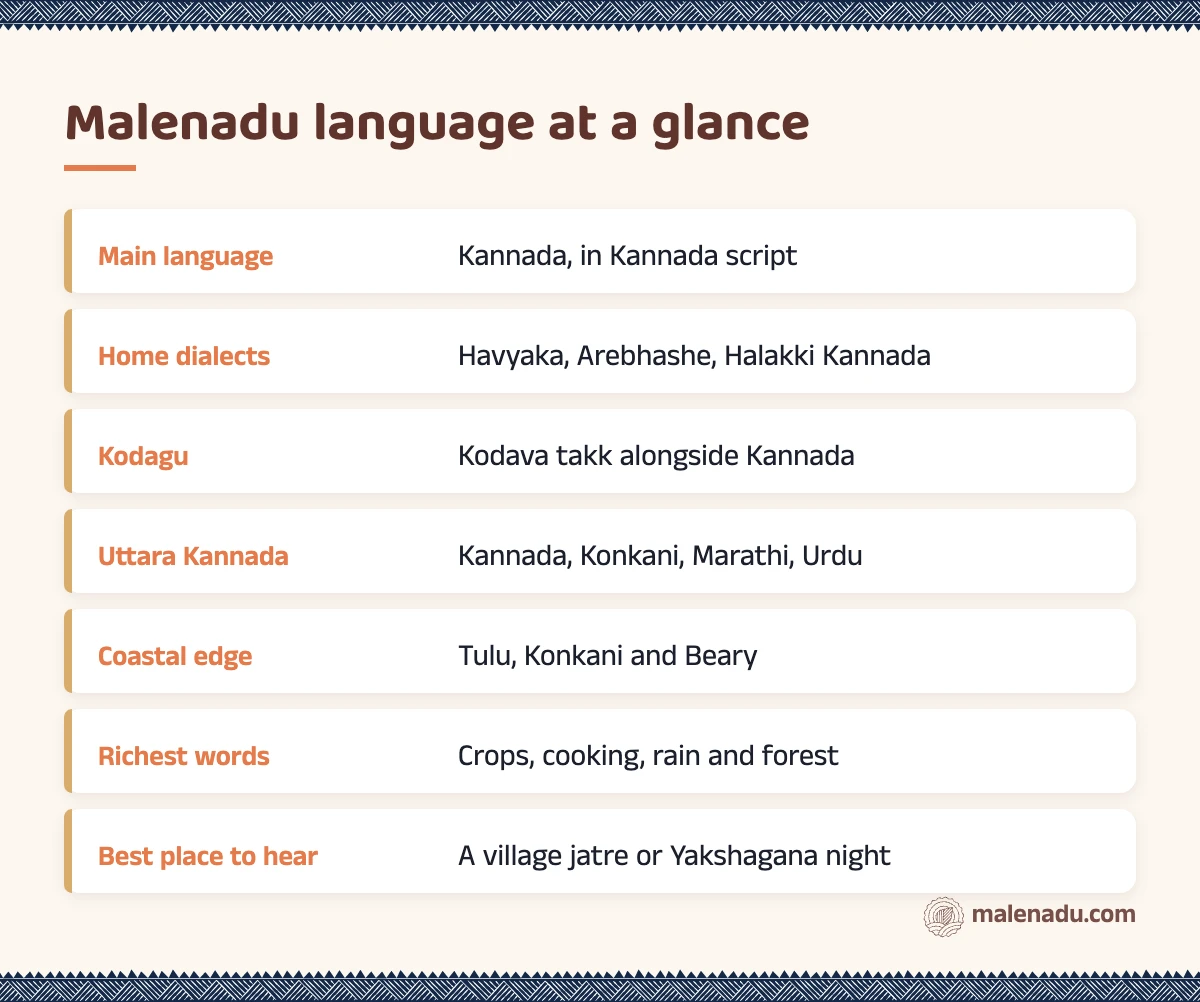
The Malenadu language for almost everyone is Kannada (ಕನ್ನಡ), the official language of Karnataka, spoken in homes, markets, schools and temples across the hills. But “Malenadu language” really means a family of speech: the Kannada of the hills with its own words, the community dialects inside it and several separate languages spoken alongside it.
There are three layers to the Malenadu language picture:
- Kannada as the shared language. Everyone from a Sirsi areca farmer to a Mudigere coffee planter uses it to talk across communities.
- Community dialects of Kannada. Havyaka Kannada, Arebhashe (Gowda Kannada), Halakki Kannada and others, each spoken at home by one community.
- Separate languages. Kodava takk, Tulu, Konkani, Urdu and Marathi, spoken by communities at the edges of the hills or living among Kannada speakers.
So when someone asks what the Malenadu language is, the short answer is Kannada. The long answer is this page. For where these hills are, see our pages on Malenadu in Karnataka and the Malenadu districts and taluks.
Is Malenadu Kannada different from Bengaluru Kannada?
Malenadu Kannada is the same language as Bengaluru Kannada, but it carries many words for plants, crops, dishes and farm work that a city speaker may never have heard. A Bengaluru friend will understand you in Sirsi or Thirthahalli, though they may stop you to ask what murugalu or vate huli is.
The differences are mostly in vocabulary and in the local accent, which changes from taluk to taluk. Farm words are the richest part of Malenadu language: there are separate words for each stage of areca, for kinds of paddy land and for every leaf that goes into a tambuli. English words like “bus”, “tractor” and “phone” come into everyday Malenadu Kannada just as they do in the city.
Scholars of Kannada have long noted that the language has many regional and social dialects. The 9th century work Kavirajamarga already speaks of differences in Kannada speech. Linguists such as D.N. Shankara Bhat have argued that some community dialects of the west, including Havyaka and Gowda Kannada, kept older verbs and grammar that standard Kannada has lost.
What is Havyaka Kannada?
Havyaka Kannada (also called Havigannada) is the home dialect of the Havyaka Brahmin community, who live mainly in Uttara Kannada, the Sagara and Hosanagara side of Shivamogga and parts of Dakshina Kannada around Puttur. It is spoken at home and among family, while the same speakers use standard Kannada at school, work and in town.
Because Havyaka families are spread over a long belt of hills, their speech is not the same everywhere. Researchers have written separately about northern Havyaka of the Sirsi and Kumta side and the southern speech of the Puttur side. Within the wider Malenadu language picture, Havyaka Kannada is one of the dialects scholars point to when they talk about old Kannada features surviving in the west.
For a visitor, the easiest way to hear Havyaka Kannada is at a Havyaka wedding, a temple festival in Sirsi or Siddapur or simply at a homestay run by an areca farming family. The language is full of food and garden words, which is natural in homes built around the thota. Listen for it and you hear one of the oldest layers of Malenadu language.
Arebhashe and Kodava takk: the speech of Kodagu and Sullia
Arebhashe and Kodava takk are the two home languages you will hear most in the southern hills, alongside Kannada. Both are part of the Malenadu language story, but they belong to different communities and should not be mixed up.
Arebhashe (Gowda Kannada)
Arebhashe, also called Gowda Kannada or Arebhase, is spoken by the Gowda community of the Sullia side of Dakshina Kannada and of Madikeri and Somwarpet in Kodagu. It is a form of Kannada with its own sounds and words, shaped by long contact with neighbouring languages of the coast and Kodagu.
The Karnataka government set up the Arebhashe Samskruthi mattu Sahitya Academy to protect this speech. The academy has worked on an Arebhashe glossary and encyclopedia. That is a big step for one of the smallest Malenadu languages. It helps keep the speech alive for children who now grow up in cities.
Kodava takk
Kodava takk is the language of the Kodava people of Kodagu. It is a separate Dravidian language, not a dialect of Kannada. It has traditionally been written in the Kannada script. Kodavas use it at home, at clan gatherings in the ainmane (ancestral house) and in songs at festivals like Huttari. They also speak Kannada and English.
Other communities in Kodagu, such as the Yerava and Jenu Kuruba, have their own speech too. This makes Kodagu one of the most varied corners of the Malenadu language map.
Where is Konkani in Uttara Kannada spoken?
Konkani in Uttara Kannada is spoken mainly along the coast and in the northern forests, from Karwar and the Goa border down through Ankola, Kumta, Honnavar and Bhatkal and up into Joida and Haliyal. It is not one single speech: each community has its own Konkani variety.
- Saraswat Konkani. Spoken by Gowda Saraswat and other Saraswat families in coastal and hill towns.
- Catholic Konkani. Spoken by Konkani Christian families along the coast and in some hill towns.
- Kunbi. The Konkani-based speech of the Kunbi community of Joida and the northern forests.
- Siddi speech. Hindu and Christian Siddis around Yellapur and Haliyal speak a variety of Konkani, while Muslim Siddis speak Dakhni.
- Nawayathi. The speech of the Nawayath Muslims of Bhatkal, built on a Konkani base with many Arabic and Persian words.
If you travel from Sirsi down the ghats to Kumta or Honnavar, you will hear Konkani in Uttara Kannada markets mixed freely with Kannada, often in the same sentence. Many families here speak both from childhood, so for them the Malenadu language is really two languages at once.
Local tip
In Uttara Kannada, do not assume a Konkani speaker is from Goa. Many Konkani-speaking families have lived on this coast and in these hills for centuries and are as Kannadiga as anyone else. For them Konkani is a Malenadu language too.
Tulu, Urdu, Marathi and other neighbours
Several other languages touch the edges of the Malenadu language map. They are spoken where the hills meet other regions and by communities who live among Kannada speakers.
- Tulu. The language of the Tulu coast of Dakshina Kannada and Udupi. You hear it on the hill edges of these districts and among families who have moved up the ghats.
- Beary. The language of the Beary Muslim community of the Dakshina Kannada coast, heard in some hill towns too.
- Urdu and Dakhni. Spoken by many Muslim families in towns across Shivamogga, Chikkamagaluru, Hassan and Uttara Kannada.
- Marathi. Heard in the north of Uttara Kannada near Joida and Haliyal and across the Belagavi border.
- Halakki Kannada. The home Kannada of the Halakki Vokkaliga community of coastal Uttara Kannada, rich in folk songs.
Most people in these communities speak Kannada as well. Hearing three or four languages in one market lane is the everyday Malenadu language experience.
Malenadu Kannada words for farm and food
Malenadu Kannada words for the farm and the kitchen are the part of the language most visitors meet first. Here are 25 everyday words you will hear in a farming home, with their meaning. These words are the heart of the Malenadu language. Spellings in English vary, so we have used the most common forms.
| Word | Kannada | Meaning |
|---|---|---|
| thota | ತೋಟ | Garden or plantation, usually areca with spices |
| gadde | ಗದ್ದೆ | Paddy field |
| betta | ಬೆಟ್ಟ | Hill; in Uttara Kannada also leaf manure land |
| adike | ಅಡಿಕೆ | Areca nut |
| menasu | ಮೆಣಸು | Pepper (kari menasu is black pepper) |
| gandhari menasu | ಗಾಂಧಾರಿ ಮೆಣಸು | Bird’s eye chilli |
| elakki | ಏಲಕ್ಕಿ | Cardamom |
| arishina | ಅರಿಶಿನ | Turmeric |
| murugalu | ಮುರುಗಲು | Kokum fruit and its dried rind |
| vate huli | ವಾಟೆ ಹುಳಿ | Monkey jack, a souring fruit |
| bella | ಬೆಲ್ಲ | Jaggery |
| joni bella | ಜೋನಿ ಬೆಲ್ಲ | Liquid jaggery |
| jenu | ಜೇನು | Honey |
| tuppa | ತುಪ್ಪ | Ghee |
| kobbari enne | ಕೊಬ್ಬರಿ ಎಣ್ಣೆ | Coconut oil |
| hittu | ಹಿಟ್ಟು | Flour or batter |
| saaru | ಸಾರು | Thin, peppery soup like rasam |
| huli | ಹುಳಿ | Sour; also a thick lentil and vegetable curry |
| gojju | ಗೊಜ್ಜು | Thick sweet, sour and spicy relish |
| tambuli | ತಂಬುಳಿ | Cool curd dish with herbs or leaves |
| kadubu | ಕಡುಬು | Steamed rice cake or dumpling |
| kotte | ಕೊಟ್ಟೆ | Leaf cup, often of jackfruit leaves, for steaming |
| appe midi | ಅಪ್ಪೆ ಮಿಡಿ | Tender wild mango for pickle |
| jagali | ಜಗಲಿ | Front veranda of the house |
| senabina cheela | ಸೆಣಬಿನ ಚೀಲ | Jute bag |
Many of these words go together in one breath. A farmer might say the menasu in the thota is ready, the adike needs drying and there is murugalu saaru for lunch. For the full list of spice names, see our guide to Kannada names of spices and ingredients. For a house tour in the same words, read about the traditional Malenadu house.
How Malenadu language travels into our product names
At malenadu we name several products with the Malenadu word next to the English one, the word the family who grew it would use. That keeps the food tied to the place and makes it easier for a grandmother in Bengaluru to know exactly what is in the jar.
| Product | Malenadu word | Why the word matters |
|---|---|---|
| Kokum Rind | murugalu | The name used in hill kitchens for saaru and drinks |
| Liquid Jaggery | joni bella | The runny jaggery poured over dose and kadubu |
| Monkey Jack Powder | vate huli | The forest souring fruit, dried and powdered |
| Bird Eye Chilli | gandhari menasu | The tiny fiery chilli grown at the garden edge |
| Black Pepper | kari menasu | The pepper of the thota |
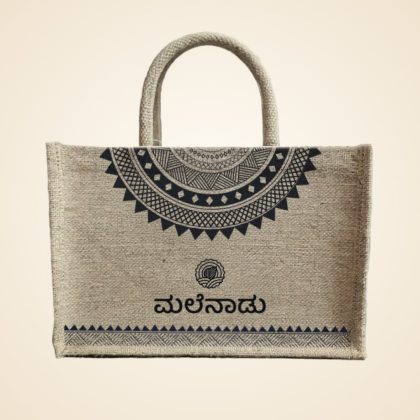
| Small Jute Bag | senabina cheela | Printed in Kannada letters |
Murugalu is the best example of Malenadu language in a product name. On the coast the same fruit may be called punarpuli and in Marathi and Konkani areas amsul. In the hills it is murugalu. Our kokum rind page carries the names people actually search for in their own language.
From the malenadu pantry
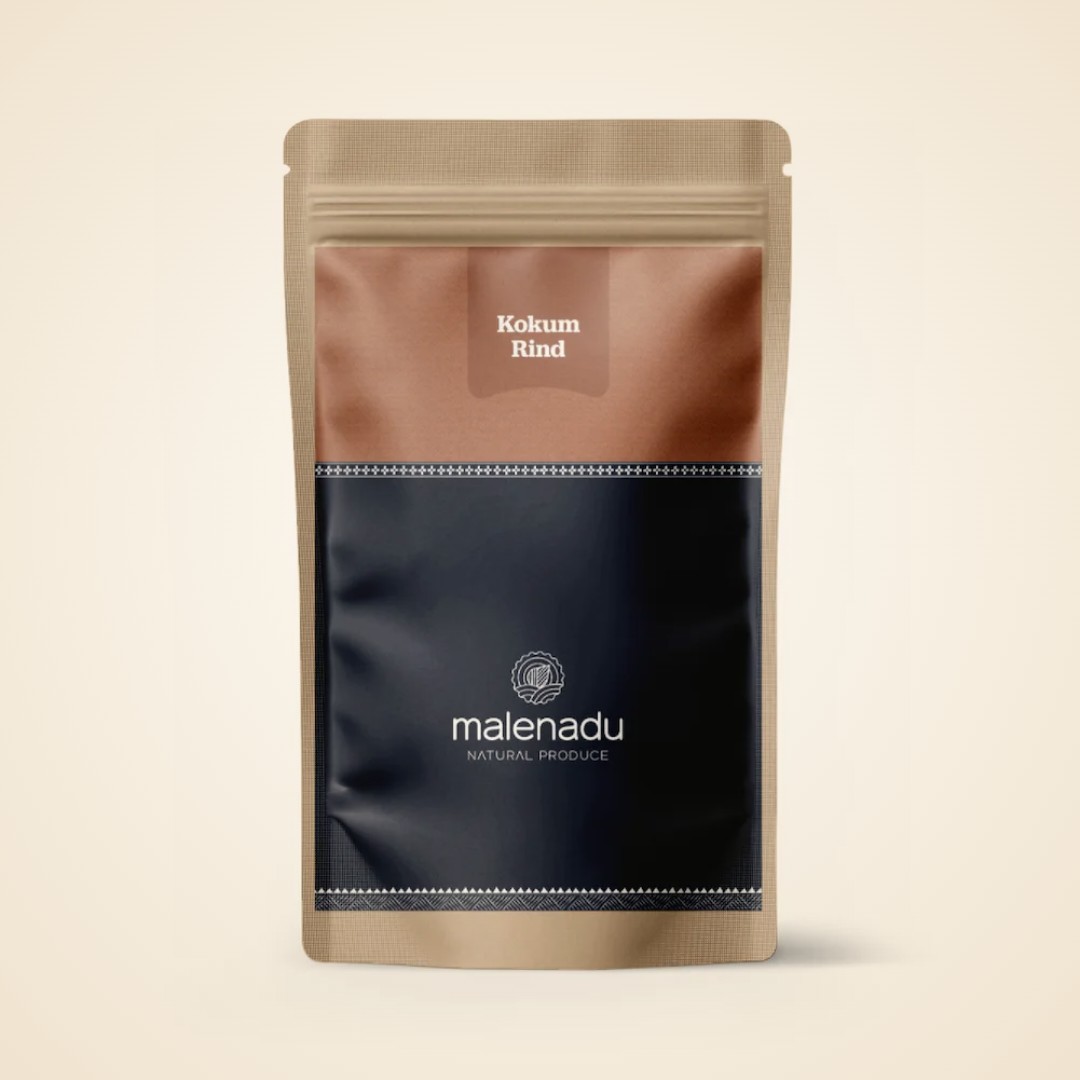
Sun dried kokum rind from Malenadu, sold under its English name but known in every hill kitchen as murugalu. Two or three pieces make a pot of sour, peppery murugalu saaru.
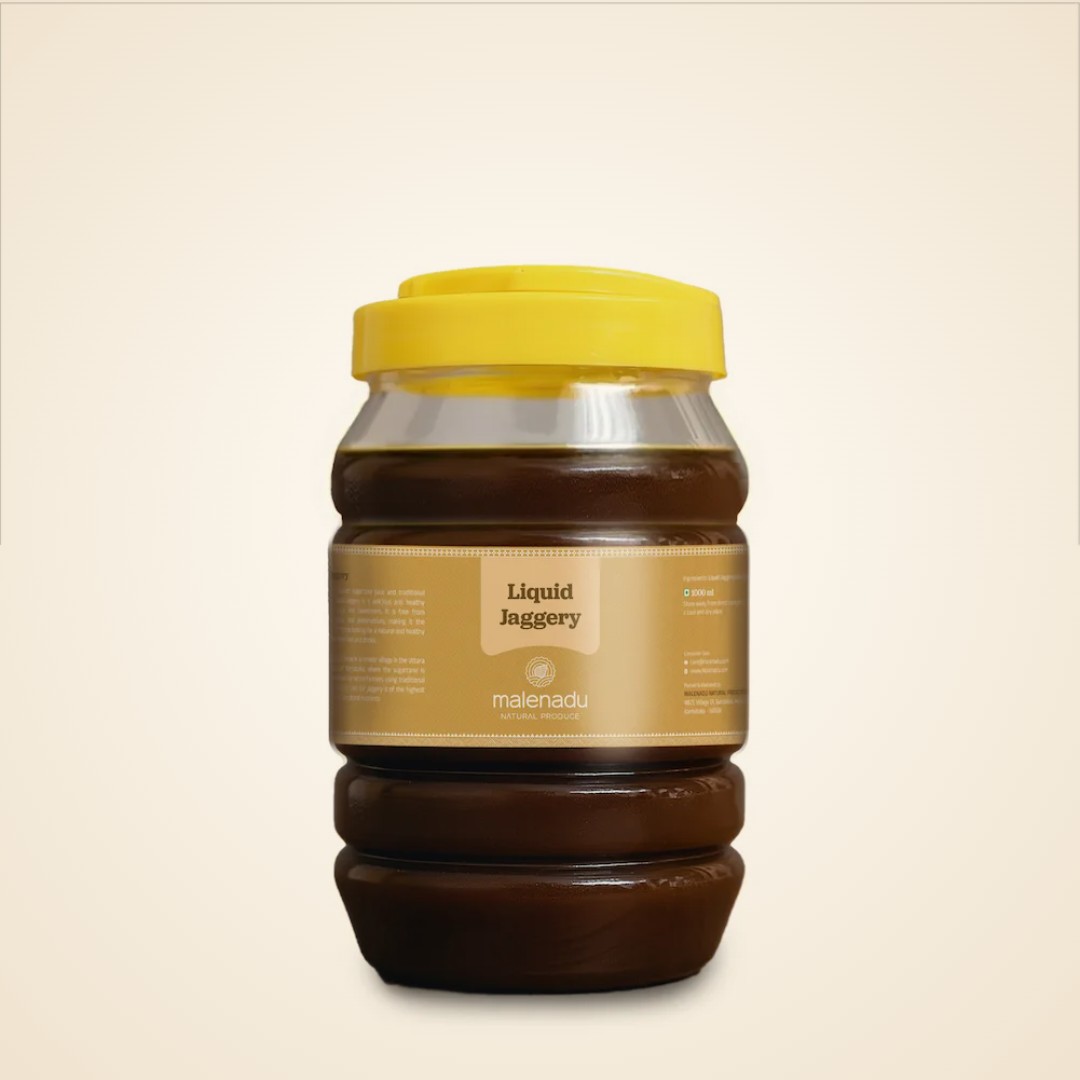
Joni bella is another word that never needed translating at home. It is the soft, pourable jaggery that hill families eat with dose and kadubu in the cool months. Our liquid jaggery is the same thing.
From the malenadu pantry
Liquid jaggery, joni bella, poured straight from the jar over hot dose, kadubu or a bowl of rice with ghee. It is the sweet that every Malenadu child learns the name of first.
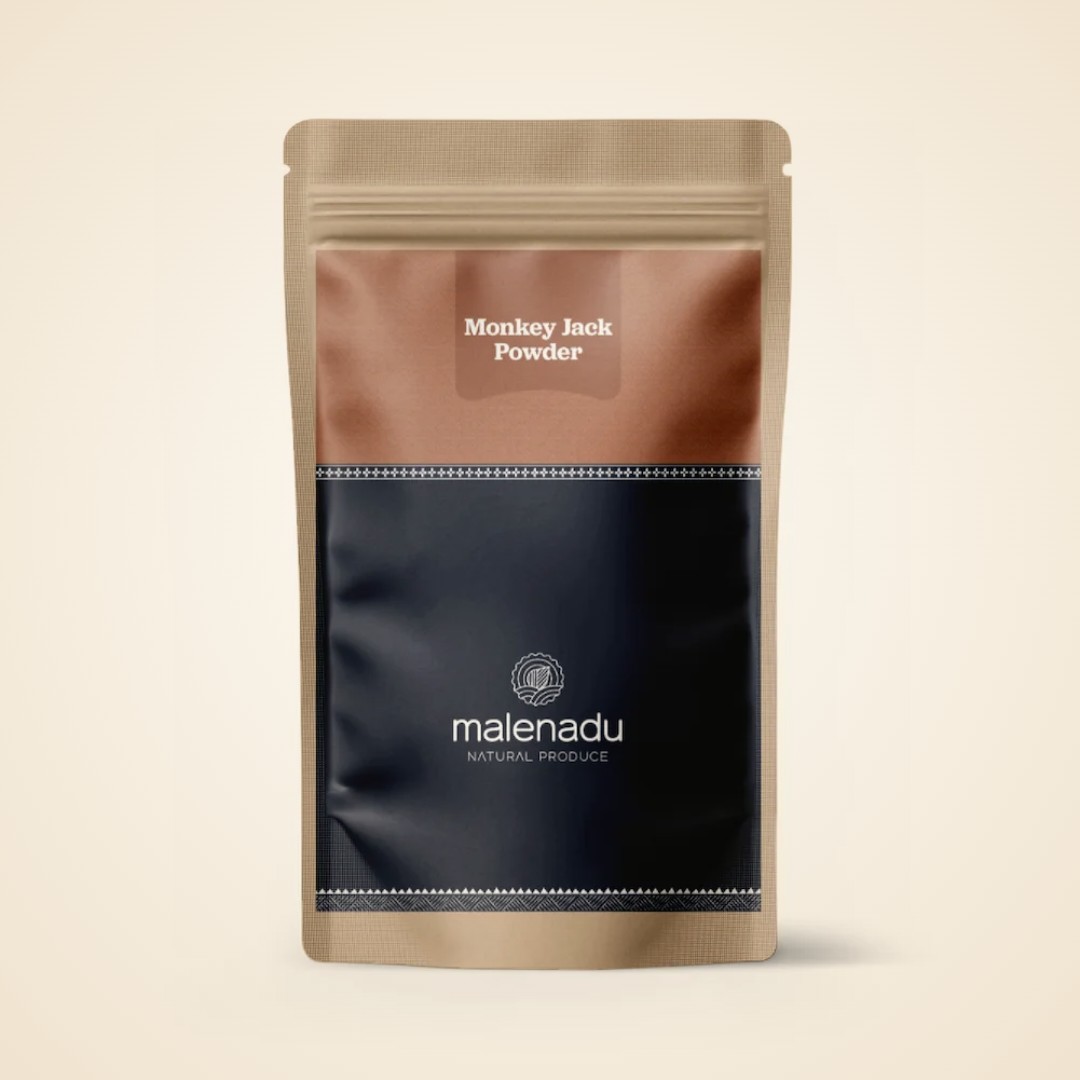
Vate huli is a word most city cooks have never heard, yet in Malenadu homes it sours fish curry and saaru the way tamarind does elsewhere. Our monkey jack powder brings that tang to kitchens far from the forest.
From the malenadu pantry
Monkey jack (vate huli) dried and powdered, a tangy forest souring agent that replaces tamarind in many hill recipes. A teaspoon is enough for a pot of saaru or a small fish curry.
A few Kannada phrases for your Malenadu trip
You do not need to learn the Malenadu language to visit, but a few Kannada phrases make hosts smile. These are standard Kannada, understood everywhere in the hills.
- Namaskara. Hello, with folded hands.
- Oota aaytha? Have you eaten? A common, friendly greeting.
- Banni. Please come.
- Neeru beku. I need water.
- Chennagide. It is good (say it about the food).
- Saaku. Enough, used when your host keeps serving.
- Dhanyavaada. Thank you.
Say saaku early and firmly. In the Malenadu language of hospitality, a polite “only a little” is usually heard as a request for more.
Where to go next
The Malenadu language is the doorway to everything else in these hills. Read our hub on Malenadu culture for the people behind these languages. You can also see how many of these words turn up in the festivals of Malenadu. When you are ready to taste them, our farm products carry the same names.
Bring Malenadu home
Grown and made by Malenadu farmer families, packed by malenadu, a farmer owned producer company in Honnavar.
-
17% OFF
Kokum Rind
Original price was: ₹240.₹200Current price is: ₹200. -
14% OFF
Liquid Jaggery
Original price was: ₹349.₹299Current price is: ₹299. -
6% OFF
Monkey Jack Powder
Original price was: ₹399.₹375Current price is: ₹375. -
8% OFF
Black Pepper
Price range: ₹165 through ₹299 -
Bird Eye Chilli
₹200 -
51% OFF
Small Jute Bag
Original price was: ₹200.₹99Current price is: ₹99.
Frequently asked questions about the Malenadu language
What is the language of Malenadu?
The main Malenadu language is Kannada. Community dialects such as Havyaka Kannada and Arebhashe are spoken at home. Kodava takk, Konkani, Tulu, Urdu and Marathi are spoken in parts of the region.
Is Havyaka a separate language?
No. Havyaka Kannada is a Malenadu language variety, a dialect of Kannada spoken at home by the Havyaka Brahmin community of Uttara Kannada, Shivamogga and Dakshina Kannada. Speakers also use standard Kannada.
Where is Arebhashe spoken?
Arebhashe (Gowda Kannada) is spoken by the Gowda community on the Sullia side of Dakshina Kannada and in Madikeri and Somwarpet in Kodagu.
Is Kodava takk a dialect of Kannada?
No. Kodava takk is a separate Dravidian language spoken by the Kodava people of Kodagu, traditionally written in the Kannada script. It is the main Malenadu language of Kodava homes.
Which languages are spoken in Uttara Kannada?
Kannada is the main language. Konkani is widely spoken on the coast and in the north, with Marathi near Joida and Haliyal and Urdu or Dakhni among many Muslim families.
What is murugalu called in English?
Murugalu is kokum, the sour purple fruit of the Western Ghats. Its dried rind is used in Malenadu kitchens for saaru and summer drinks.
What does joni bella mean?
Joni bella means liquid jaggery, a soft and pourable jaggery that Malenadu families eat with dose, kadubu and rice.
Explore more of Malenadu
Malenadu CultureMalenadu CulturePeople, arts and old ways of Karnataka’s rain hills
Malenadu CultureFestivals of MalenaduA year of harvests, jatres and sweets in the rain hills
Malenadu CultureThe Malenadu HouseCourtyards, verandas and attics built for the rain
Malenadu FarmingMalenadu CropsWhat grows in Karnataka’s rain hills and why it grows
Malenadu FoodMalenadu FoodRice, kokum, pepper and joni bella from the hills
Start hereMalenadu in KarnatakaWhere Malenadu is, what the name means