
Malenadu Farming
Beekeeping in Malenadu is the old habit of keeping a few wooden bee boxes at the edge of the areca garden, the coffee estate or the backyard. This guide explains beekeeping in Malenadu from the four native bees and how a box works to the harvest, the Thai sacbrood disaster and how farmers are building their colonies back.
On this page
What is beekeeping in Malenadu?
Beekeeping in Malenadu means keeping colonies of native bees in wooden boxes near the house and garden. In some villages it also means gathering from wild hives in the forest. In Kannada the bee and what it makes share one word, jenu (ಜೇನು). Most families do it as a side job next to areca, pepper, coffee or paddy.
A typical beekeeper in Uttara Kannada keeps about 14 boxes, according to a survey by the Indian Institute of Science. For most families, beekeeping in Malenadu is about two things: a little income and better crops, because bees pollinate the garden.
The habit runs across the hill districts, from Uttara Kannada and Shivamogga to Chikkamagaluru, Hassan and Kodagu. Our list of Malenadu districts and taluks shows where each one sits. Our page on Malenadu in Karnataka explains the region itself.
Why the hills suit bees
The hills suit bees because something is nearly always flowering between the forest and the garden. Evergreen forest, areca and coconut gardens, coffee estates, paddy bunds and backyard fruit trees all sit within a bee’s flying range. Beekeeping in Malenadu works best where the forest is still close to the village.
The heavy monsoon is the hard part. From June to September bees can barely fly for days at a time, so beekeepers watch their boxes closely and sometimes feed weak colonies with sugar syrup. Bees build up again once the rain eases.
Which bees of the Western Ghats live in Malenadu?
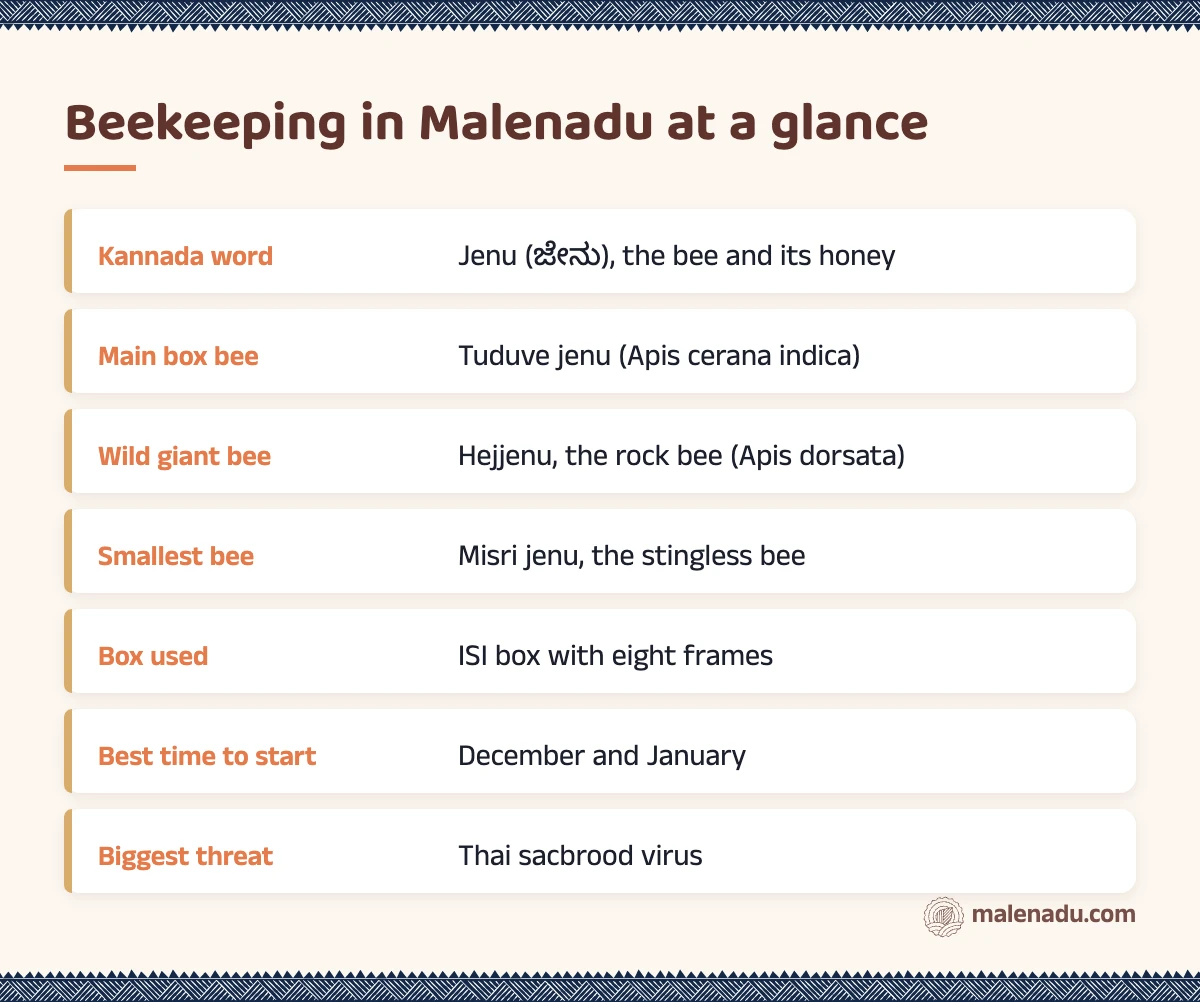
Four kinds of bees of the Western Ghats live in Malenadu: the Indian hive bee, the rock bee, the little bee and the tiny stingless bee. The IISc report on beekeeping in Uttara Kannada records three Apis species plus the stingless bee in the district. Only two of them can be kept in boxes.
| Kannada name | Common name | Scientific name | Where it nests | Kept in a box? |
|---|---|---|---|---|
| Tuduve jenu | Indian hive bee | Apis cerana indica | Tree hollows, pots, walls | Yes, the main box bee |
| Hejjenu | Rock bee, giant bee | Apis dorsata | Big trees, cliffs, buildings | No, wild only |
| Kolu jenu | Little bee, dwarf bee | Apis florea | One small comb on a twig | No |
| Misri jenu | Stingless bee, dammer bee | Tetragonula (Trigona) | Tree trunks, logs, wall cracks | Yes, in small boxes |
Tuduve jenu, the Indian hive bee
Tuduve jenu (ತುಡುವೆ ಜೇನು, also written thuduve jenu) is the bee that beekeeping in Malenadu is built on. It is a medium-sized, yellowish-brown bee that is fairly calm. In the wild it nests in dark, sheltered places such as tree hollows, earthen pots and gaps in walls, building seven or eight combs side by side.
Because it likes the dark, the tuduve jenu settles happily into a wooden box. It does not migrate like the rock bee. The IISc report gives about 5 to 15 kg of honey a year from one colony, though survey yields in Uttara Kannada were lower. In Kodagu the same bee is called potti then, the box bee, in Kodava.
Hejjenu, the rock bee
Hejjenu (ಹೆಜ್ಜೇನು), also called kadu jenu or forest bee, is the giant rock bee. It builds a single huge open comb, often 1.5 to 2 m across, hanging from a cliff or the high branches of a tall forest tree. In Uttara Kannada it nests on the Yana rocks in Kumta taluk and on very large Tetrameles nudiflora trees.
Hejjenu is the fiercest of the bees of the Western Ghats. When disturbed, thousands of bees attack together, which is why it is never kept in boxes. It also migrates about 100 to 200 km in a year, following the flowering season.
Kolu jenu, the little bee
Kolu jenu is the little bee or dwarf bee. It builds one palm-sized comb on a thin twig, often in bamboo clumps or hedges. It gives very little honey but is a busy pollinator of crops and wild plants.
Misri jenu, the stingless bee
The stingless bee, called misri jenu in Uttara Kannada and mooli then in Kodagu, is the smallest of all. It cannot sting, so it bites when it defends its nest. It lives in tree trunks, logs, wall cracks and under roofs, sealing the entrance with resin.
A stingless bee colony gives only about half a kilo a year, according to Kodagu beekeepers. Some families keep the stingless bee in small wooden boxes near the house because it is gentle and easy to handle.
How does a bee box work in beekeeping in Malenadu?
A bee box works by giving the colony a dark, dry home with movable wooden frames, so the beekeeper can check the brood and take out full combs without killing the colony. Most beekeeping in Malenadu uses the standard ISI box made of teak or another good timber. Cheaper local boxes are common too.
The ISI box has three parts:
- Brood chamber. The lower box holds eight full-depth wooden frames. The queen lays eggs here and the young bees grow here.
- Super chamber. The upper box also holds frames, usually eight. Bees store honey here once the brood chamber is full.
- Stand. The box sits on a stand at knee height, away from damp ground and ants.
How is a harvest taken?
At harvest the beekeeper calms the bees with smoke and lifts out the full frames from the super chamber. The wax caps on the combs are scraped off. The frames go into an extractor, a metal drum that spins four frames at a time and throws the honey out. The empty combs go back into the box for the bees to fill again.
This is the big change that boxes brought to beekeeping in Malenadu. Wild combs were once cut and squeezed, destroying the brood, but framed combs serve the colony season after season.
When do beekeepers start and harvest?
December and January are the best months to start a new colony, according to Kodagu beekeepers. Colonies grow strong in the cool, dry months when gardens and forests come into flower. The main harvests follow in the hot months before the monsoon.
In Kodagu, beekeepers harvest roughly every 21 days from the end of March to the third week of May, taking about 2 to 4 kg from a good box each time. By June the rain arrives and beekeeping in Malenadu turns to keeping colonies alive. For the wider farming year, see our guide to Malenadu crops.
From the malenadu pantry
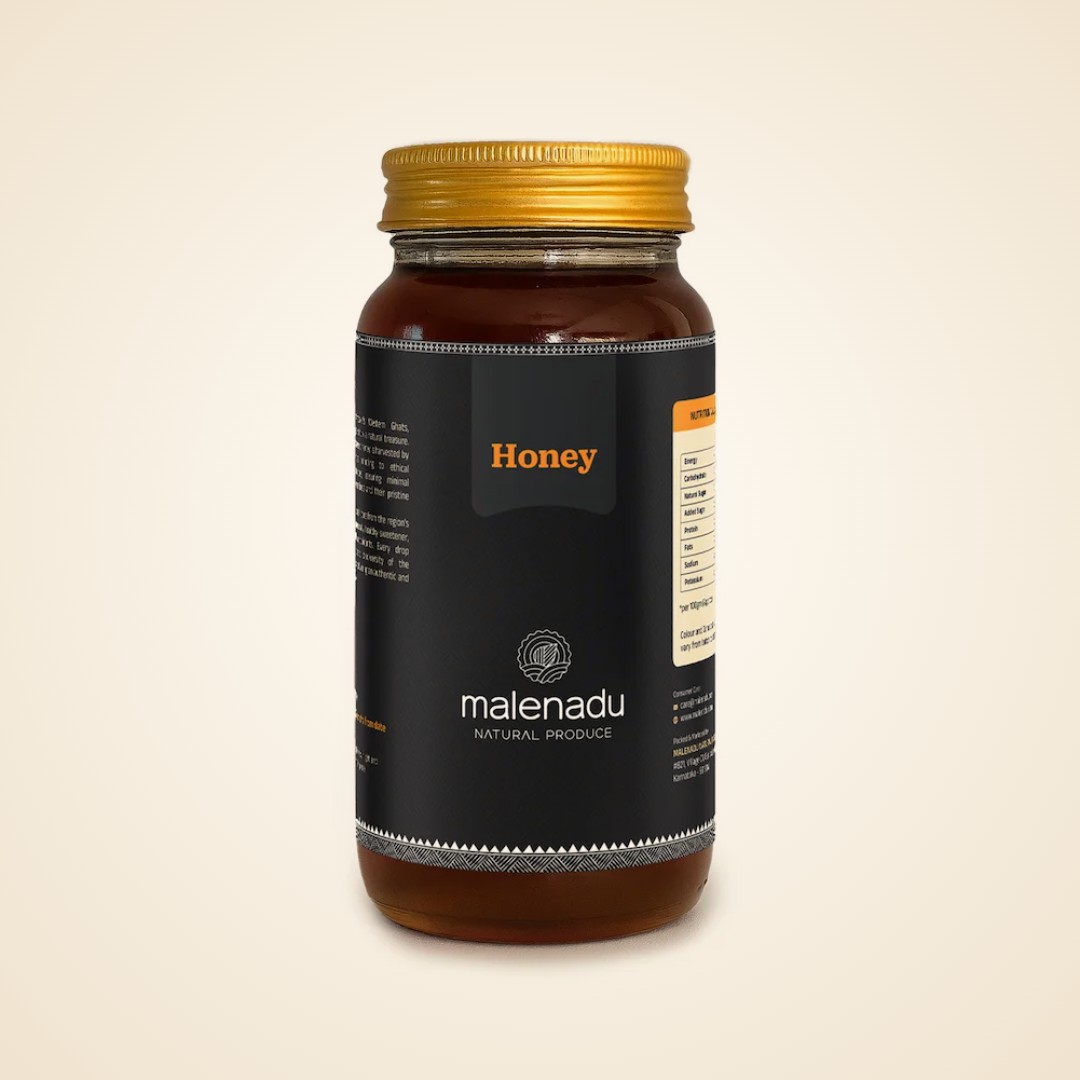
Our Honey comes from Malenadu beekeepers and is packed without additives. Like all honey, it is a food for older children and adults, never for babies under one year.
Why do farmers keep bee boxes in areca gardens?
Farmers keep bee boxes in areca gardens because the bees pollinate the crops around them and the garden feeds the bees in return. Areca palms carry flowers over a long season and bees work them along with coconut, banana and the trees around the garden. One Uttara Kannada beekeeper in the IISc survey kept his colonies mainly to pollinate areca, coconut, guava, jackfruit and sapota.
Bee boxes in areca gardens usually sit in the shade of the palms, on stands, facing open ground so the bees have a clear flight path. The damp, shaded thota stays cooler than open land in April and May, which helps colonies through the hottest weeks. Our guide to areca nut farming shows how these gardens are laid out.
Bees, pepper and cardamom
The same mixed gardens grow pepper, cardamom, nutmeg and clove. Beekeeping in Malenadu fits into this kind of farm without taking any extra land. Read how the vines and clumps are grown in our guide to pepper and cardamom farming.
From the malenadu pantry
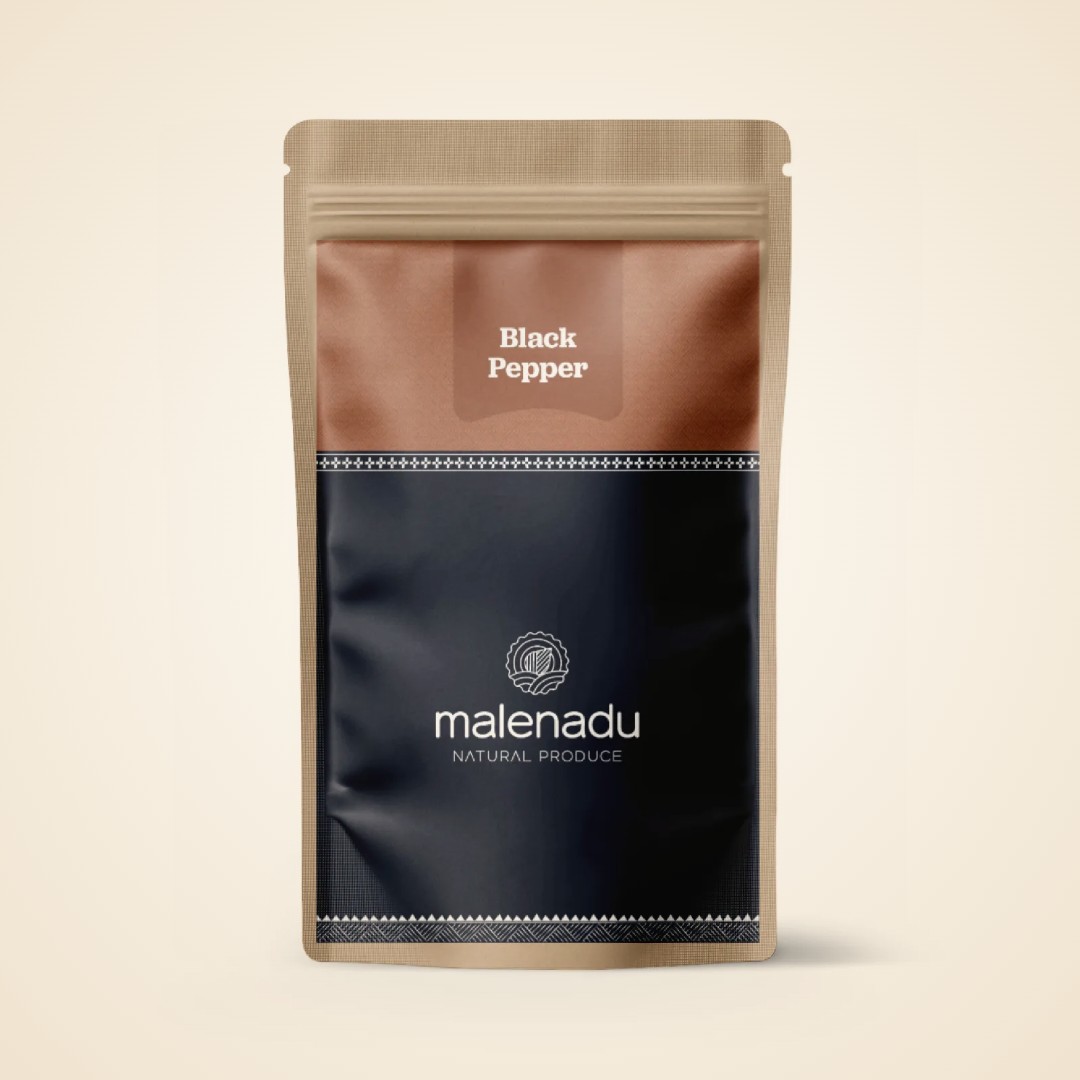
Our Black Pepper grows on vines climbing areca palms in Malenadu gardens, the same gardens where many families keep a bee box or two. The berries are picked by hand and dried in the sun.
Bees on coffee estates
Coffee estates in Kodagu, Chikkamagaluru and Hassan are the other big home of beekeeping in Malenadu. Coffee flowers open together after the blossom showers and estates with bee boxes see the bees out in force that week. Our guide to Malenadu coffee explains how the estate year runs.
Local tip
Keep chemical sprays away from the bee boxes and spray in the evening, when the bees are home. Many beekeepers stand each box leg in a small cup of water to keep ants out.
How did Thai sacbrood change beekeeping in Malenadu?
Thai sacbrood changed beekeeping in Malenadu by wiping out most box colonies in a few years. In the early 1990s the virus killed nearly 90 percent of the tuduve jenu colonies in south India, according to Deccan Herald’s report on Kodagu beekeeping. Villages that once had a box behind every house were left with empty boxes.
Thai sacbrood is a virus disease of bee larvae, first seen in Thailand. It has been studied in Karnataka since 1992 and has hit Uttara Kannada, Dakshina Kannada, Udupi, Hassan, Kodagu, Shivamogga, Chikkamagaluru and parts of Dharwad. It mainly attacks the Indian hive bee, the backbone of beekeeping in Malenadu.
How to spot Thai sacbrood
The signs show in the brood comb:
- Larvae change colour from pearly white to yellow and then dark brown.
- Some dead larvae lie with raised, pointed heads in their cells.
- Dead larvae turn into small sacs of fluid that lift out easily.
What beekeepers do about it
There is still no cure. Beekeepers fall back on simple care:
- Remove combs with dead larvae and burn them.
- Do not swap combs, boxes or tools between a sick apiary and a healthy one.
- Wash hands with soap before opening another box.
- Check every box often, so a problem is caught early.
Experts also advise building new colonies locally from the best regional bee strains instead of buying bees from far away. Beekeeping in Malenadu recovers fastest where colonies are caught and split locally.
Kodagu beekeeping history: from boom to revival
Kodagu beekeeping history is the clearest story of this rise and fall. Kodagu was once among India’s leading honey regions. Most households kept a box (potti) or a clay pot (kala) for bees.
Then came two blows. Katte roga, the mosaic disease of cardamom, ruined many shaded cardamom plantations in the 1970s and 1980s, so bees lost their nectar as growers moved to coffee. Thai sacbrood followed in the 1990s. Today about 13,000 people in Kodagu, mainly in the north of the district, are back in beekeeping with government support.
From the malenadu pantry
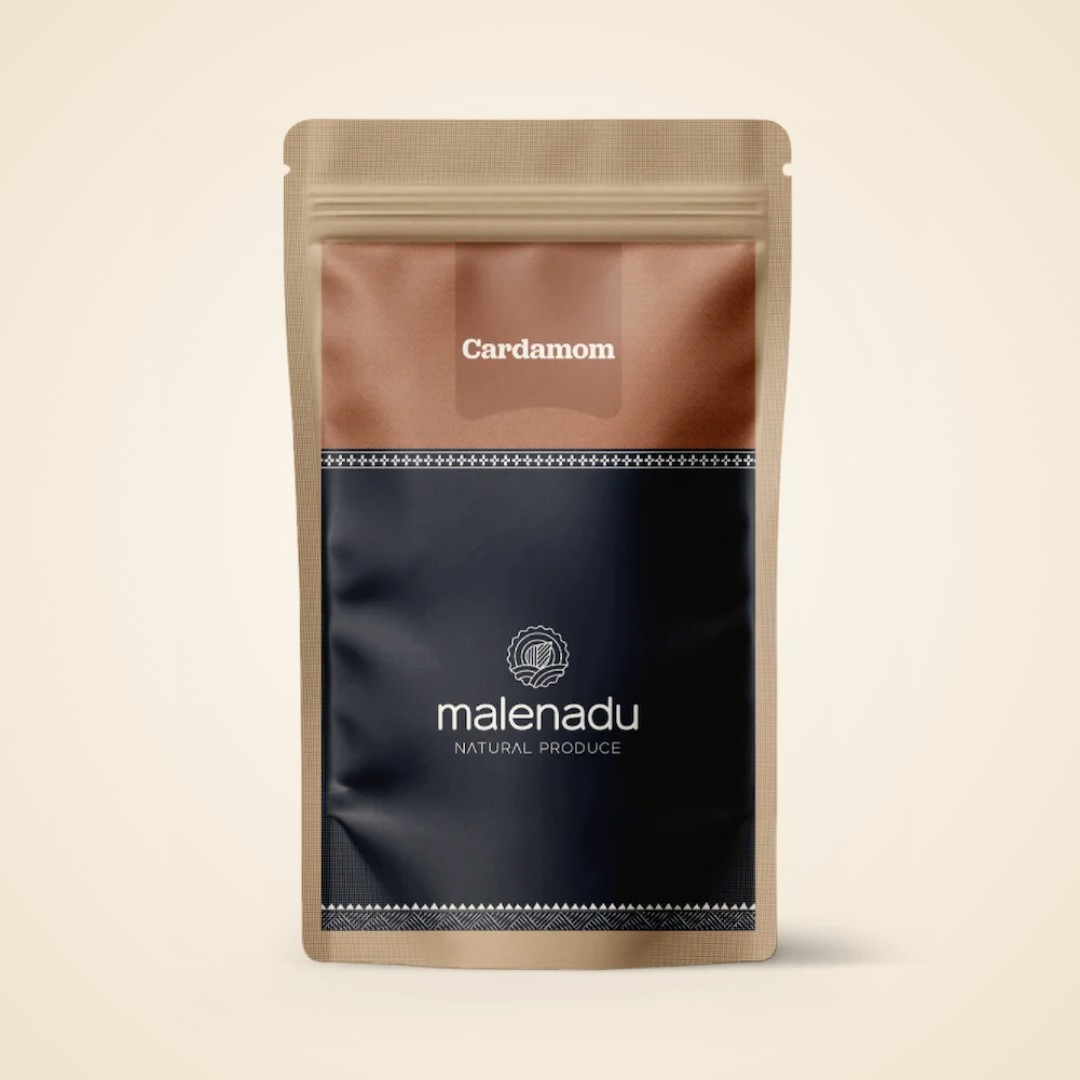
Our Cardamom grows in cool, shaded hill gardens of the kind Kodagu once had in plenty. The green pods are picked by hand round after round through the season, then dried slowly.
How much does a bee box give?
The IISc team surveyed 105 beekeepers with 1,453 boxes in 2011. Together they harvested 10,424 kg, about 6.68 kg per box on average. Sirsi taluk did best at 9.45 kg per box, while coastal Honnavar gave 5.73 kg.
What else threatens bees in Malenadu?
Poor management is the biggest threat after disease, followed by a list of pests and predators. The IISc report found that weak care caused more colony losses in Uttara Kannada than any enemy.
| Threat | What it does |
|---|---|
| Nosema and foulbrood | Diseases that weaken or kill the brood |
| Varroa mites | Feed on bees and larvae inside the box |
| Wax moth | Its larvae tunnel through and spoil old combs |
| Yellow-banded wasp | Waits at the box entrance and grabs bees |
| Bee-eaters and drongos | Birds that pick bees out of the air |
| Pesticides | Kill foragers in sprayed gardens |
| Loss of forest | Fewer flowering trees near villages |
The yellow-banded wasp (Vespa cincta) is the worst enemy in Uttara Kannada. Beekeeping in Malenadu also suffers when old forest near villages is cleared, because the bees lose their flowering trees.
Who gathers from wild hives in the forest?
Forest communities gather from wild hejjenu and tuduve jenu hives, a skill much older than box beekeeping in Malenadu. In Uttara Kannada the Siddi community is known for its wild honey skills. In Kodagu the Jenu Kurubas, whose very name links them to jenu, have a long tradition of gathering in the forest.
Climbing to a hejjenu comb takes rope, smoke and great courage, because the bees are fierce and the combs hang high. Cutting a whole comb also destroys the brood, so wild gathering needs care for the bees.
How can you start beekeeping in Malenadu?
You can start beekeeping in Malenadu with one or two boxes of tuduve jenu, set up in December or January, after some training. The steps are simple:
- Learn first. Spend a season helping an experienced beekeeper. Ask experienced beekeepers near you where training is held.
- Get a good box. A standard ISI box of good timber lasts for years. Keep a smoker, a veil and a hive tool ready.
- Use local bees. Catch a swarm or buy a colony from a nearby beekeeper whose bees are healthy.
- Pick a quiet spot. Shade, a clear flight path, no standing water and no sprays nearby.
- Check every week. Look for the queen, eggs and healthy brood. Watch for Thai sacbrood, wasps and wax moth.
- Plant for bees. Nerale (jamun), honge and nelli (amla) are among the trees the IISc report suggests planting around villages.
Beekeeping in Malenadu rewards patience. The first year is often for learning and building colonies, not for big harvests.
Local tip
Talk to a beekeeper in your own village before buying boxes. Local knowledge of lean months and healthy colonies is worth more than any manual.
Where to go next after beekeeping in Malenadu
To see how beekeeping in Malenadu fits into the wider farm, read the guides on areca and coffee linked above. To taste what the hills produce, our Honey sits with Liquid Jaggery (joni bella) among our natural sweeteners.
Bring Malenadu home
Grown and made by Malenadu farmer families, packed by malenadu, a farmer owned producer company in Honnavar.
-
29% OFF
Honey
Price range: ₹249 through ₹449 -
14% OFF
Liquid Jaggery
Original price was: ₹349.₹299Current price is: ₹299. -
8% OFF
Black Pepper
Price range: ₹165 through ₹299 -
19% OFF
Cardamom
Price range: ₹130 through ₹330 -
Coconut Jaggery Burfi
₹120 -
40% OFF
Desi Cow Ghee
Original price was: ₹1,500.₹899Current price is: ₹899.
Frequently asked questions about beekeeping in Malenadu
Which bee is used for beekeeping in Malenadu?
Beekeeping in Malenadu mostly uses the Indian hive bee, Apis cerana indica, called tuduve jenu in Kannada. Some people also keep the small stingless bee in boxes.
What is hejjenu?
Hejjenu is the Kannada name for the rock bee or giant honey bee, Apis dorsata. It builds huge single combs on cliffs and tall trees, migrates with the seasons and is too fierce to keep in boxes.
What is Thai sacbrood disease?
Thai sacbrood is a virus that kills the larvae of honey bees, mainly the Indian hive bee. In the early 1990s it killed nearly 90 percent of these colonies in south India and it still returns in some years.
When is the best time to start beekeeping in Malenadu?
December and January are the best months to start, when colonies build up in the cool, dry season. The main harvests follow from March to May, before the monsoon.
How much does one bee box give in Malenadu?
It varies a lot with the place and the year. An IISc survey in Uttara Kannada found an average of about 6.68 kg per box in 2011, with Sirsi taluk the highest at 9.45 kg.
Can stingless bees be kept at home?
Yes. The stingless bee is gentle and cannot sting, so it is easy to keep in a small box near the house. It gives very little, only about half a kilo a year.
Explore more of Malenadu
Malenadu FarmingMalenadu CropsWhat grows in Karnataka’s rain hills and why it grows
Malenadu FarmingAreca Nut Farming in MalenaduAdike, the palm that shapes every Malenadu village
Malenadu FarmingMalenadu Crop CalendarWhat grows, ripens and cooks in the hills, month by month
Malenadu FarmingMalenadu GiddaThe small, tough hill cow of Karnataka’s Western Ghats
Malenadu FarmingPepper and Cardamom FarmingHow the two great spices of the hills are grown
Malenadu FarmingMalenadu CoffeeShade grown, hand picked and sun dried in the hills
Malenadu CultureMalenadu CulturePeople, arts and old ways of Karnataka’s rain hills
Malenadu FoodMalenadu FoodRice, kokum, pepper and joni bella from the hills
Start hereMalenadu in KarnatakaWhere Malenadu is, what the name means