
Malenadu Farming
The Malenadu Gidda is the small native cow of the Western Ghats hills of Karnataka, about 90 cm tall and built to walk forest slopes in heavy rain. Gidda means short in Kannada. This guide covers where the breed lives, how to recognise it, what its milk, ghee and dung are used for and why Malenadu families still keep it.
On this page
What is the Malenadu Gidda?
The Malenadu Gidda is an indigenous cattle breed of the hilly, high rainfall belt of Karnataka, kept for milk, manure and light work. Gidda (ಗಿಡ್ಡ) simply means short or dwarf, so the name reads as “the short cow of Malenadu”. In villages you may also hear older local names such as Uradana or Varshagandhi.
For generations it was not a “breed” on paper at all. It was just the cow in the shed of almost every farming home in the hills. A paper in the Indian Journal of Animal Sciences describes it as found in almost every household of the Malenadu and coastal belt of Karnataka.
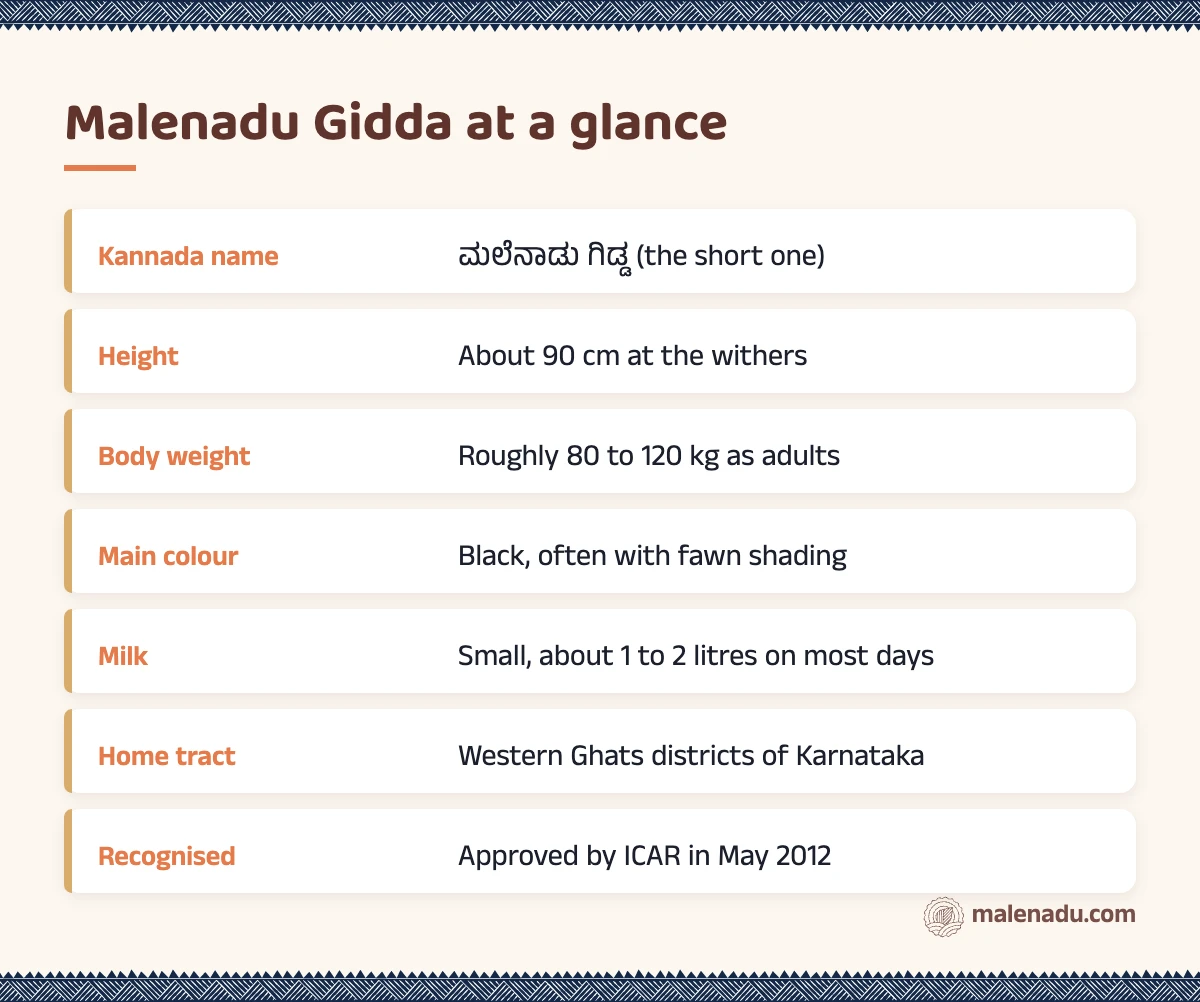
That changed in 2012. On 14 May 2012, the ICAR Breed Registration Committee approved the breed as one of three new cattle breeds of India, calling it a short statured breed of the Western Ghats of Karnataka known for stamina and disease resistance. Since then the Malenadu Gidda has an official place on the national list of Indian cattle breeds.
Where is the Malenadu Gidda found?
The Malenadu Gidda lives in the rainy hill districts of Karnataka along the Western Ghats. The National Dairy Development Board’s breed notes list its breeding tract as:
- Shivamogga
- Chikkamagaluru
- Uttara Kannada
- Udupi
- Dakshina Kannada
- Hassan
- Kodagu
Some animals are also found in neighbouring parts of Haveri. In other words, the breed sits right on top of the region we describe on our page on where Malenadu is in Karnataka. The taluk by taluk picture is on our guide to Malenadu districts and taluks.
Within these districts you see the Malenadu Gidda most in the wetter, forested taluks: the areca and pepper villages of the ghat slopes, the coastal foothills and the paddy valleys between them. These are places with long, heavy monsoons, steep paths and small family farms, which is exactly the life this cow is made for.
How do you recognise a Malenadu Gidda cow?
A Malenadu Gidda cow is easy to spot once you know the signs: she is small, compact and usually black. Adult animals stand around 90 cm at the withers, which is about waist height on a grown person. An ICAR field study in the Indian Journal of Animal Sciences measured cows at a little over 90 cm and found adult males almost the same height.
Look for these features:
- Size: very small and compact, far smaller than the big draught breeds of the plains.
- Colour: mostly black, often with light fawn shades on the thighs and shoulders. Brown, red, fawn and white animals also occur. Some carry a mix of two colours.
- Horns: small and fairly straight, pointing outward, upward and then inward.
- Hump: small, not the tall hump of the plains breeds.
- Tail: a black switch at the end of the tail.
- Udder: small and bowl shaped.
The quickest way to tell a Malenadu Gidda cow from other breeds is size plus place. The large grey-white draught cattle of Karnataka’s plains, like Hallikar and Amrit Mahal, are tall, long horned and kept in the dry maidan districts. If you are standing in a rainy hill village and the cow at the gate barely reaches your hip, she is almost certainly a Gidda or a Gidda cross.
Why is the Malenadu Gidda a dwarf cow breed? Karnataka hills explain it
The Malenadu Gidda is small because the hills reward a small animal. It is the best known dwarf cow breed Karnataka has. Its size is a fit for steep slopes, narrow bunds, thick forest and months of rain, not a flaw.
Think of a typical Malenadu farm. The areca garden (thota) sits in a valley and the house is on a slope above it. The grazing is up in the forest behind. A large cow would struggle on muddy laterite paths in July. A small one picks her way up and down with ease.
There are more reasons farmers kept the Gidda for so long:
- Low feed needs. A small body needs less fodder. The breed can live on forest grazing and roughage alone.
- Hardiness. It copes with heavy rainfall, damp sheds and the hot, humid months before the monsoon.
- Fewer vet bills. Researchers note that many tropical diseases are rare in the breed.
- Regular calving. Cows are known to calve regularly even on a low input diet.
- Dung for the garden. Manure mattered more than milk, as you will see below.
Researchers have also compared the Gidda with the two other famous dwarf breeds of south India, Punganur from Andhra Pradesh and Vechur from Kerala. A genetic study from ICAR’s National Dairy Research Institute station in Bengaluru found the Malenadu Gidda had the most genetic variety of the three, a good sign for a breed that has mostly been bred naturally in village herds.
How hardy is the Malenadu Gidda?
The Malenadu Gidda is very hardy, which is why it lasted for generations in the hills with almost no outside inputs. ICAR describes it as having notable stamina and resistance to disease. The breed is also well adapted to the climate of the Western Ghats.
Free grazing in forests
Most Gidda herds still spend the day outside. In many villages the cattle walk out each morning to graze in the forest, on fallow land and along stream banks. They come home on their own by evening. The National Dairy Development Board notes that the breed is often kept in a low input system. In some areas it is kept on zero input, living only on grazing.
Heat, rain and disease tolerance
The Gidda handles both the sticky heat of April and the cold, wet weeks of July. A small body loses heat more easily. The breed also seems to shrug off damp conditions that trouble larger exotic cows. Farmers often say a Gidda rarely needs the vet. Research papers also report that many common tropical diseases are seldom seen in the breed.
That said, hardy does not mean indestructible. Ticks, worms and foot problems still turn up in the monsoon. A sick Gidda needs a vet like any other cow.
How much Malenadu Gidda milk does a cow give?
Malenadu Gidda milk is small in quantity: most cows give about 1 to 2 litres a day. In an ICAR field survey across Shivamogga and Chikkamagaluru, elite cows averaged 2.11 kg of milk a day. The National Dairy Development Board puts the average yield for one full lactation at around 220 kg.
So nobody keeps a Gidda to run a dairy. Families keep one or two cows for the home: milk for coffee and children, curd for lunch, buttermilk on hot afternoons and a little butter saved up for ghee. A Gidda’s milk often goes first to her own calf. The family takes what is left.
What people prize is the quality and the cost. A cow that feeds herself in the forest and rarely falls sick gives milk at very little expense. In Malenadu homes that milk is the base of the morning coffee, the evening curd and the buttermilk (majjige) served with every meal.
You will see the term “A2 milk” on many labels. Indian native breeds generally carry the A2 type of beta casein protein. Gidda milk is often sold with that tag, but the science on what it means for health is still debated. We mention it once and leave it there.
Dung, manure and the areca garden
For a Malenadu farmer, the dung from a Malenadu Gidda was often worth as much as her milk. Areca, pepper and cardamom gardens need plenty of organic matter. The cattle shed was the farm’s manure factory.
The old system was simple and clever. Families cut green leaves and leaf litter from the forest and spread them as bedding in the cattle shed. The cattle stood and slept on this bedding, mixing it with dung and urine. Every few weeks the soaked leaves were forked out into a pit to rot. The finished manure was then carried down to the thota.
A small herd of Gidda cows, fed almost entirely on forest grazing, turned the forest’s leaves into fertiliser for the areca palms. You can read more about these gardens on our guide to areca nut farming. The spice vines that climb the palms have their own page on pepper and cardamom farming.
Today many farms buy fertiliser and fewer families keep cattle, but you will still find farmers who swear by Gidda manure for their pepper vines. Dung is also used to wash courtyards and floors in traditional homes. Some families still make dung cakes and use the urine in home made plant sprays.
Malenadu Gidda milk and ghee in farm homes
Malenadu Gidda ghee is made the old way at home: milk is set as curd, the curd is churned to butter and the butter is slowly heated until it turns into clear ghee. Because each cow gives so little milk, a family may take weeks to save up enough butter for one small batch.
That is why pure single breed Gidda ghee is rare and expensive. It is mostly made in small quantities by families for their own kitchens, by a few gaushalas and by small sellers who work with village herds.
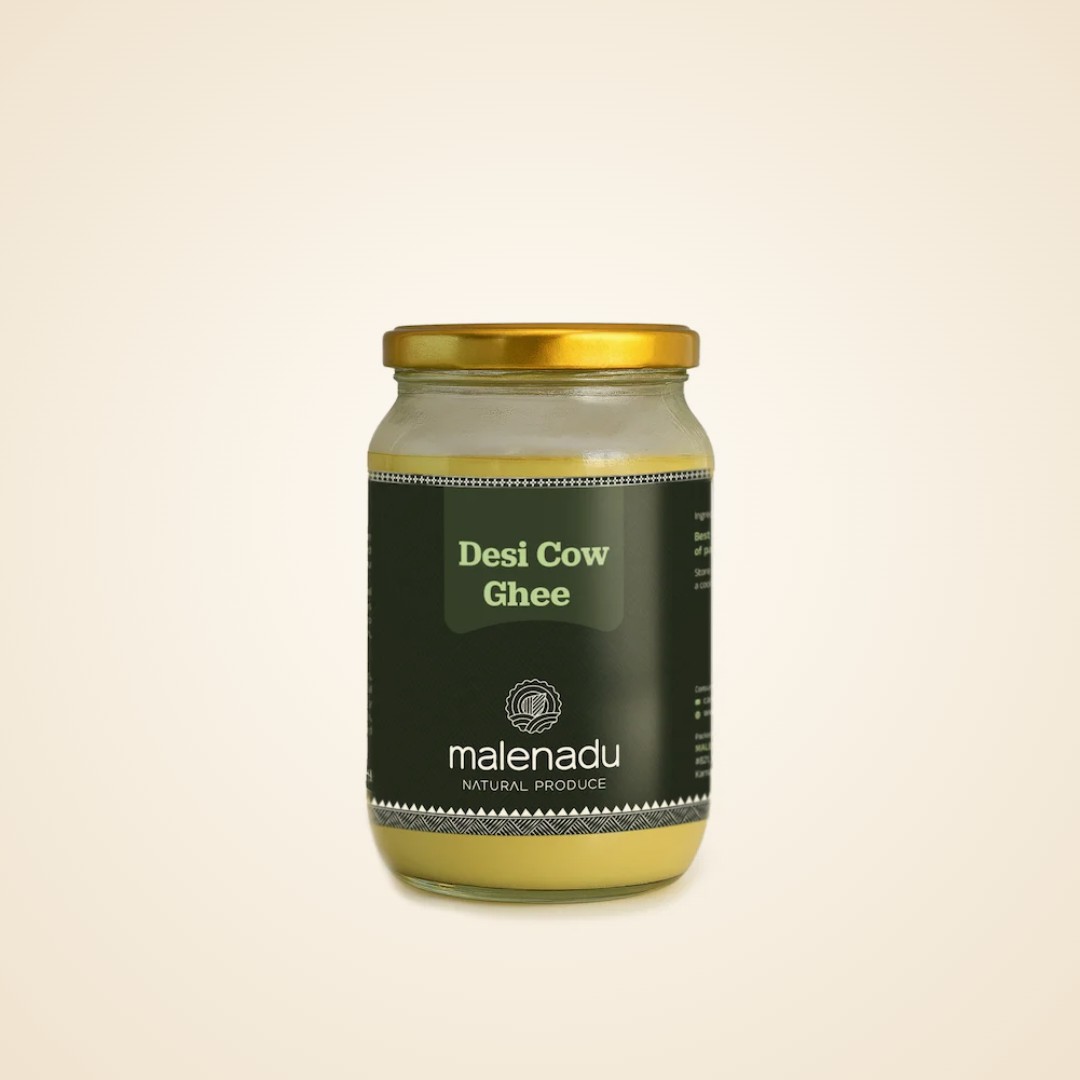
At malenadu, our Desi Cow Ghee is hand churned by farmer families from the milk of desi breeds. The Malenadu Gidda is among those breeds, along with other Indian cows kept by farmer families. We do not claim every jar is pure Gidda ghee, because with cows this small that simply would not be honest.
From the malenadu pantry
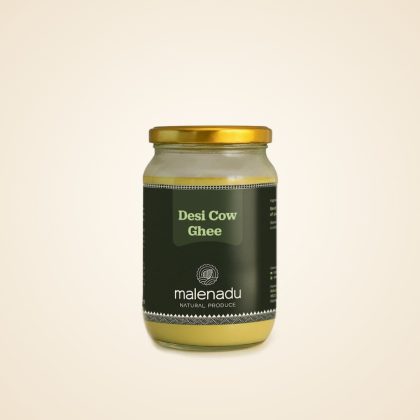
Our Desi Cow Ghee is hand churned by farmer families from the milk of desi breeds, Malenadu Gidda among them. A spoon goes on hot rice, dosa and festival sweets, the way it does in hill homes.
In Malenadu kitchens ghee is used with a light hand: a spoon on hot rice with saaru (rasam), a little on a hot dosa or a few spoons in festival sweets. A favourite plain treat is a soft dosa with ghee and a pour of joni bella, our liquid jaggery.
From the malenadu pantry
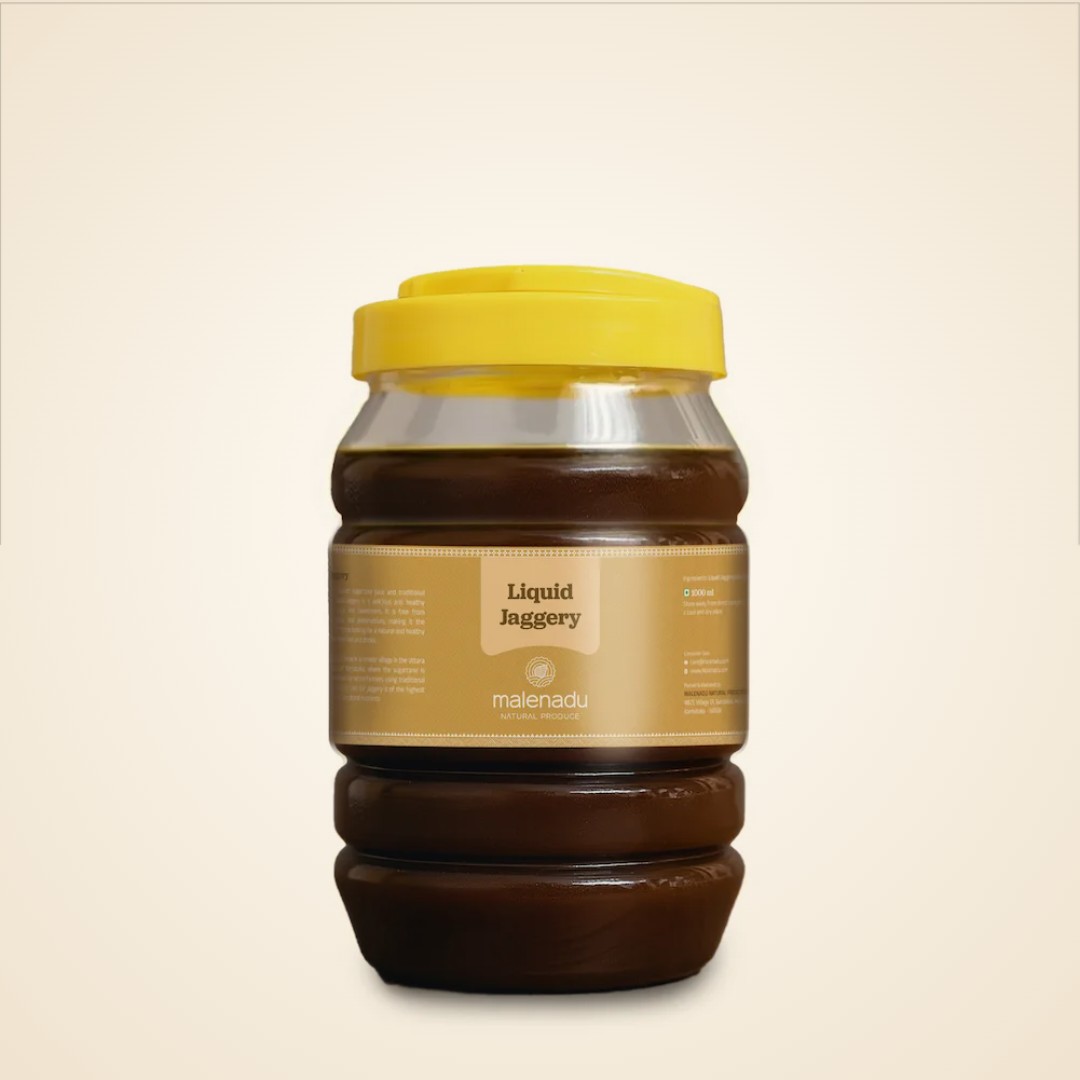
Joni bella is the runny jaggery of Malenadu winters. A spoon of it with ghee on a hot dosa or rotti is a simple breakfast many hill children grew up on.
You can find our ghee with our wood pressed coconut oil in the oil and ghee section of the shop.
Is the Malenadu Gidda endangered?
The Malenadu Gidda is still kept in many villages, but its numbers have been falling and conservation work has grown since its registration. An ICAR study estimated the population in Karnataka at around 7 to 8 lakh animals and noted a declining trend. Many farmers have moved to higher yielding crossbred cows and fewer young people keep cattle at all.
Several efforts now support the breed:
- Registration in 2012: official recognition put the breed on national records and opened the door to government schemes.
- Research centre in Shivamogga: the Veterinary College at Shivamogga, under the Karnataka Veterinary, Animal and Fisheries Sciences University, runs a Malenadu Gidda Research and Information Centre for conserving and recording the breed and for showing farmers good practice.
- Field performance recording: ICAR’s National Dairy Research Institute station in Bengaluru has recorded the performance of Gidda cows in farmers’ herds.
- National schemes: semen from elite bulls of native breeds, the Gidda among them, is used under the Rashtriya Gokul Mission. The breed is also included in a climate change conservation project under the National Adaptation Fund for Climate Change.
- Gaushalas and farmers: a number of gaushalas and farmer groups in Karnataka keep Gidda herds and sell their milk and ghee.
One quiet worry is breeding. A recent ICAR study of farmers in Karnataka’s breeding tracts found Gidda keepers rely only on natural service, partly because artificial insemination with Gidda semen is still hard to get in villages. Keeping good local bulls in the village is therefore part of keeping the breed alive.
How do you take care of a Malenadu Gidda?
Caring for a Malenadu Gidda is mostly about keeping her dry, free to graze and close to her calf. The breed asks for little, but a few habits make a big difference:
- Dry shed in the monsoon. A raised floor with good drainage and fresh leaf bedding keeps hooves and udders healthy through months of rain.
- Daily grazing. Let her walk and graze. The breed is happiest moving through forest edges and fallow land.
- Simple feed at home. Paddy straw, green grass, banana stems and leaves make up much of the home diet, with kitchen leftovers like rice water. A little salt helps.
- Calf first. Let the calf drink before you milk. Do not try to push yield with heavy concentrate feed.
- Watch for ticks and worms. Check the ears, tail and udder after monsoon grazing and follow your local vet’s deworming advice.
- A good bull. If you are breeding, find a true Gidda bull through the local veterinary hospital or a breed centre.
Local tip
If you buy a Gidda cow from another village, walk her home or move her slowly. A Gidda used to her own forest and her own herd can take a couple of weeks to settle and may give less milk at first.
Where to read more about Malenadu farms
The Malenadu Gidda is one thread in a bigger story of hill farming. Start at our guide to Malenadu farming for the full picture, then see the month by month crop calendar to know when the pepper, areca and jaggery come in. If you want a taste of the hills at home, browse all malenadu products.
Bring Malenadu home
Grown and made by Malenadu farmer families, packed by malenadu, a farmer owned producer company in Honnavar.
Frequently asked questions about the Malenadu Gidda
What does Gidda mean in Malenadu Gidda?
Gidda (ಗಿಡ್ಡ) is the Kannada word for short or dwarf. The name means the short cow of Malenadu, after its small size of about 90 cm at the withers.
How much milk does a Malenadu Gidda cow give per day?
Most cows give about 1 to 2 litres a day. In an ICAR survey, elite cows averaged 2.11 kg a day. A full lactation is around 220 kg.
Is the Malenadu Gidda a recognised breed?
Yes. The ICAR Breed Registration Committee approved it as a cattle breed of Karnataka on 14 May 2012.
Which districts is the Malenadu Gidda found in?
It is found mainly in Shivamogga, Chikkamagaluru, Uttara Kannada, Udupi, Dakshina Kannada, Hassan and Kodagu, with some in nearby Haveri.
What is the price of a Malenadu Gidda cow?
Prices vary a lot by village, age, pregnancy and whether the animal is a true Gidda or a cross. Ask the local veterinary hospital or a breed centre before buying.
Why is Malenadu Gidda ghee so rare?
A Gidda cow gives only 1 to 2 litres of milk a day, and it takes a lot of milk to make a little ghee. That is why pure single breed Gidda ghee is rare and costly.
Can I keep a Malenadu Gidda in a city home?
It is possible in a large plot, but the breed is happiest grazing outdoors with other cattle. A small yard and bought fodder alone do not suit it well.
How is the Malenadu Gidda different from Punganur and Vechur?
All three are small south Indian breeds, but they come from different homes: Punganur from Andhra Pradesh, Vechur from Kerala and the Gidda from Karnataka’s Western Ghats. Genetic studies show them to be distinct breeds.
Explore more of Malenadu
Malenadu FarmingMalenadu CropsWhat grows in Karnataka’s rain hills and why it grows
Malenadu FarmingAreca Nut Farming in MalenaduAdike, the palm that shapes every Malenadu village
Malenadu FarmingMalenadu Crop CalendarWhat grows, ripens and cooks in the hills, month by month
Malenadu FarmingPepper and Cardamom FarmingHow the two great spices of the hills are grown
Malenadu CultureMalenadu CulturePeople, arts and old ways of Karnataka’s rain hills
Malenadu FoodMalenadu FoodRice, kokum, pepper and joni bella from the hills
Start hereMalenadu in KarnatakaWhere Malenadu is, what the name means