
Malenadu Farming
Pepper and cardamom farming is the quiet second income of almost every Malenadu garden, with pepper vines climbing the palms and cardamom clumps hiding in the shade below. This guide follows both spices from planting and flowering to the harvest, drying and grading, with a short look at clove and nutmeg from the same gardens.
On this page
What is pepper and cardamom farming in Malenadu?
Pepper and cardamom farming in Malenadu means growing two native forest spices under shade, inside areca gardens and coffee estates rather than in open fields. Both plants grew wild in the Western Ghats long before anyone farmed them. Both still like the same things: rain, shade, rich leaf litter and cool air.
Black pepper (kaalu menasu, ಕಾಳು ಮೆಣಸು) is a climbing vine that needs a living support. Cardamom (elakki, ಏಲಕ್ಕಿ) is a low clump-forming plant of the ginger family that grows on the forest floor. Put them together in one garden and you use the space both above and below. That simple idea is the whole logic of pepper and cardamom farming.
Karnataka is now India’s biggest pepper state. A Spices Board note on Karnataka spices puts the state’s share at about 45 percent of India’s black pepper by volume in 2021. The same note names Kodagu, Hassan, Chikkamagaluru, Shivamogga and Uttara Kannada as the heartland of pepper and cardamom farming in the state, along with nutmeg and clove. Our Malenadu districts and taluks page shows where these sit.
The Pepper Queen of Gerusoppa
Pepper and cardamom farming has a long history on this coast. Rani Chennabhairadevi ruled from Gerusoppa on the Sharavathi river, upstream from Honnavar, for 54 years, from 1552 to 1606. The Portuguese, who came for her pepper, called her Raina da Pimenta, the Pepper Queen. Her ports at Honnavar and Bhatkal sent pepper, betel nut and nutmeg across the sea. India Post issued a stamp in her honour in 2025.
How is pepper grown in Malenadu?
Malenadu pepper is grown as a vine trained up a living tree, usually an areca palm in the valley gardens or a silver oak in the coffee estates. Farmers plant rooted cuttings at the foot of the support at the start of the monsoon. The vine clings with small roots along its stem and climbs a little higher each year.
Vines on areca and silver oak
In the areca garden, pepper and cardamom farming starts at the foot of the palm. One vine is planted at the base of each palm, so every palm carries a second crop. Our guide to areca nut farming explains how the two crops share water, mulch and manure. In coffee estates, pepper climbs the tall silver oak and forest trees that shade the coffee, which turns the estate’s shade into income. Our guide to Malenadu coffee shows how these estates work through the year.
Pepper hates standing water. In pepper and cardamom farming the drains are cleared before every monsoon, because vines on wet ground rot at the root.
Varieties grown in Karnataka
Pepper and cardamom farming in Karnataka uses a mix of old local vines and newer bred varieties. Common ones include:
- Panniyur-1, the first hybrid pepper from Kerala, high yielding but not fond of heavy shade.
- Karimunda, a popular old cultivar from Kerala. Its selections Subhakara and Sreekara, released by ICAR-IISR, suit south Karnataka.
- IISR Thevam, a variety noted for tolerance to Phytophthora foot rot.
- Local Malenadu types such as Sigandini and Malligesara, grown by farmers around Sirsi. In one study on farmers’ fields there, Sigandini did best of the local cultivars.
Many Malenadu gardens still grow vines whose names nobody remembers, cuttings passed from neighbour to neighbour. Old-style pepper and cardamom farming has always relied on such shared planting material.
Flowering with the first showers
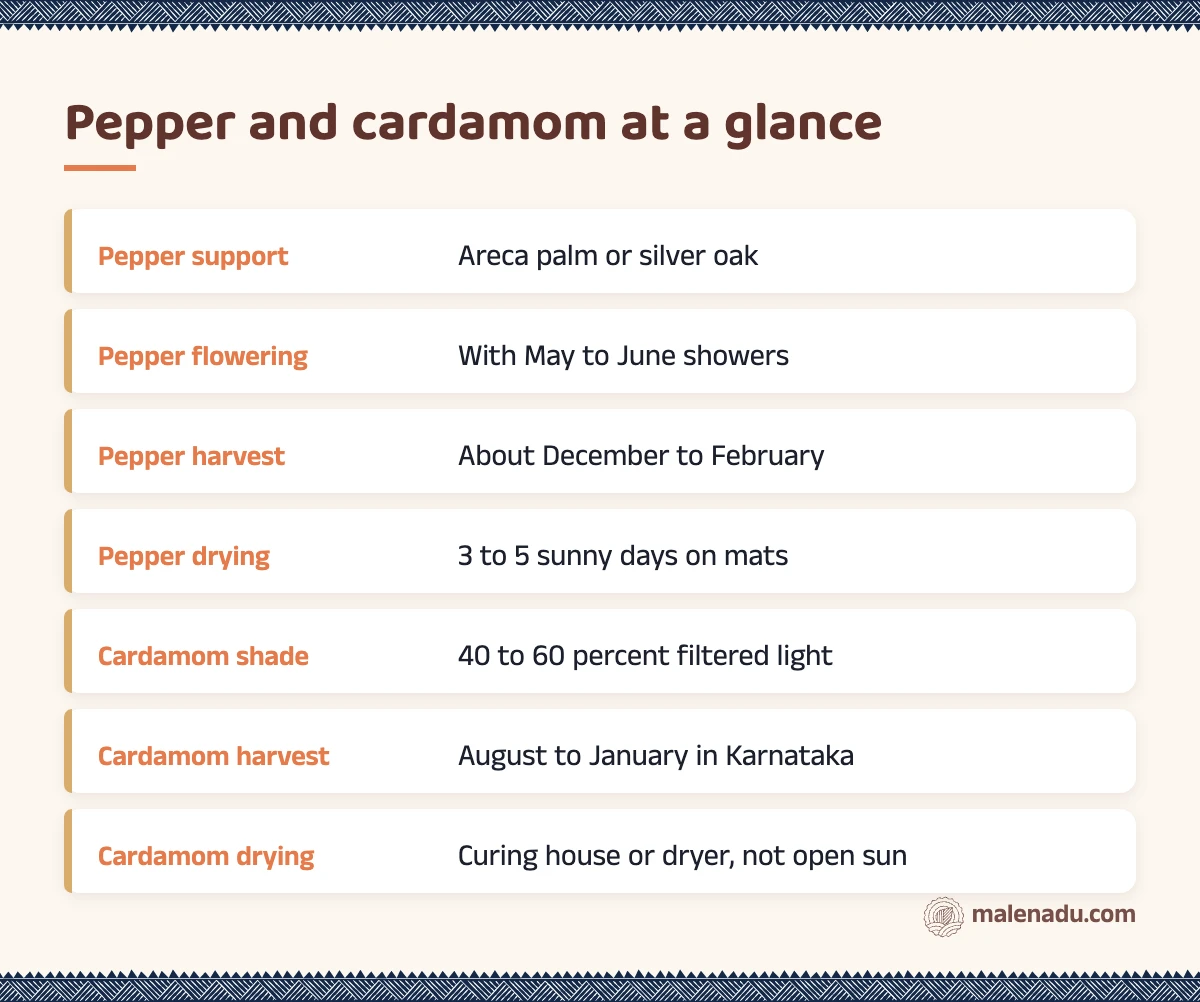
Pepper flowers when the rain returns, so the weather in May and June decides the year for pepper and cardamom farming. About 70 mm of rain within around 20 days in May or June is enough to start new shoots and flower spikes. After that, the vine needs steady rain without long dry gaps. Even a dry spell of a few days in this window can cut the year’s yield sharply.
From flowering to fully mature berries takes about seven to eight months, which is why the harvest lands in the cool, dry season.
Pepper harvest season in Malenadu
The black pepper harvest in Malenadu runs from about December to February, a little later on higher, cooler estates. Farmers pick a vine when its berries are fully mature and one or two berries on each spike start turning yellow or red. Picked too early, pepper shrivels and turns light. Picked too late, berries drop to the ground.
The harvest is the busiest time in pepper and cardamom farming. Pickers climb bamboo ladders propped against the palm or tree and pull off whole spikes by hand into a bag or basket. A tall vine may need several trips up and down. During the black pepper harvest season the whole family is busy. The courtyard smells of fresh green pepper for weeks.
Threshing and sun drying
Once picked, the berries are separated from the spike. Many families still do it the old way, by trampling the spikes on a mat. Others use small threshers, which the Spices Board has supported through its schemes for pepper growers.
The loose green berries are then spread on mats or a clean cement floor in the sun for about three to five days. They turn black and wrinkled as they dry. Some growers dip the berries in boiling water for about a minute first, which helps them darken evenly and dry faster. Dry pepper should be brittle and crack cleanly. Damp pepper grows mould in storage, so good pepper and cardamom farming always ends with patient drying.
From the malenadu pantry
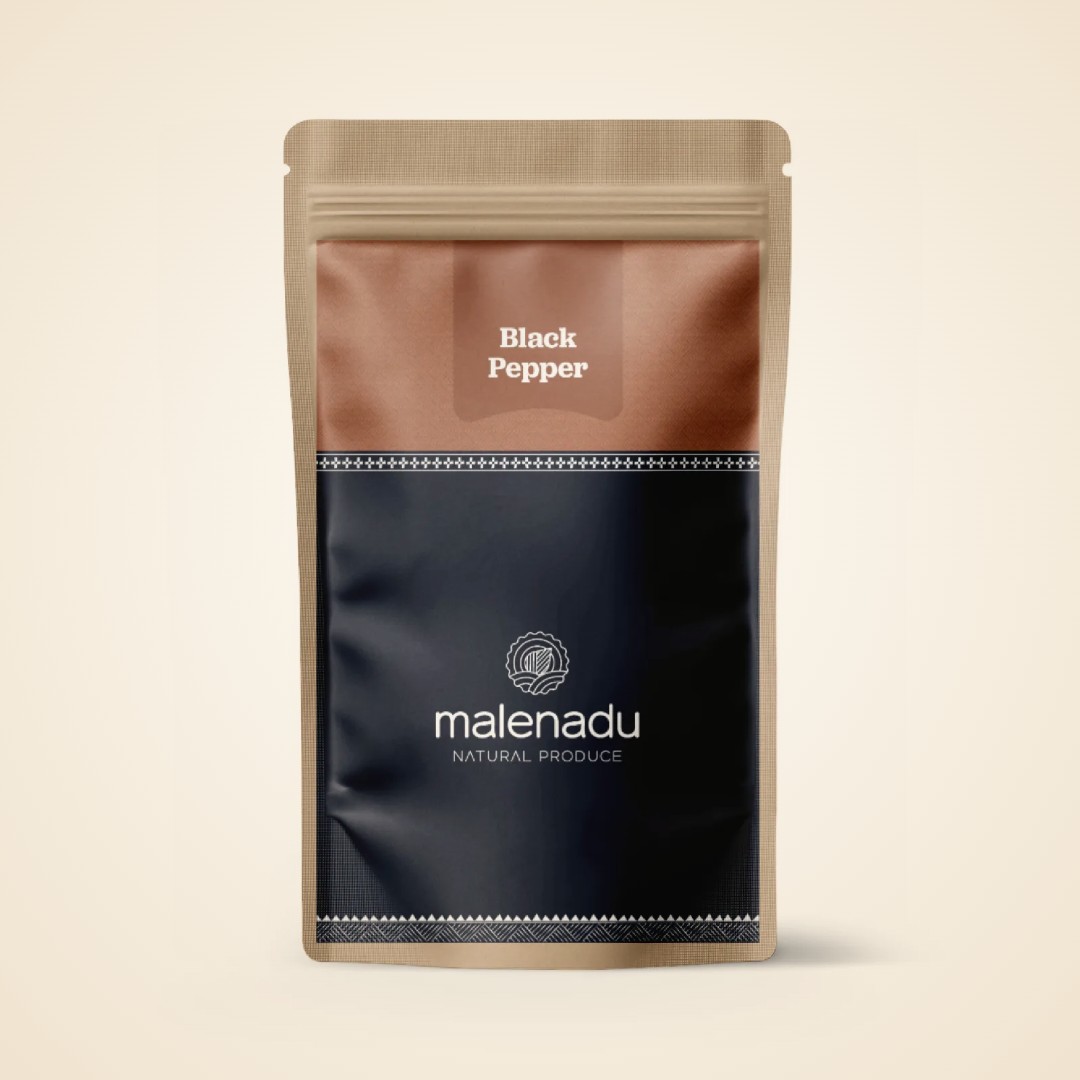
Our Black Pepper is Malenadu pepper, picked when the spikes start to turn, threshed and sun dried on mats. Crack a berry and you get a sharp, fresh smell.
Grading by density
Grading is the last step of pepper and cardamom farming before sale. Pepper is graded by size and by density, which simply means how much a fixed measure of berries weighs. Heavy, well filled berries weigh more per litre and give more flavour. Light berries are immature berries with no proper kernel inside. The FSSAI standard for spices defines them by their low density and limits how many good pepper may contain.
Traders also sort pepper by berry size into grades with old trade names, like the Tellicherry and Garbled grades. At home, the easiest check is a bowl of water: light berries float, while good ones sink.
Local tip
Store dried pepper whole in a dry, airtight jar and grind or crush it just before use. Whole Malenadu pepper keeps its smell for a long time, while ground pepper fades within weeks.
How white pepper is made in Malenadu homes
White pepper making starts with fully ripe red berries, not green ones. In Malenadu homes the ripe berries are soaked in water for about a week, till the outer skin softens and loosens. The berries are then rubbed by hand to take off the skin, washed clean and dried in the sun till they are creamy white and hard.
It is slow work for a small return. It is also the most patient job in pepper and cardamom farming. About 100 kg of ripe berries gives only about 25 kg of white pepper. That is why white pepper making is a special job done in small batches, using berries left on the vine longer than usual. You can try the result in our White Pepper.
From the malenadu pantry
Our White Pepper is made the same way: ripe berries soaked, hand rubbed and sun dried. It suits pale dishes like curd rice, soups and white sauces.
How cardamom is grown in the Malenadu hills
To understand how cardamom is grown, start with the shade. Cardamom is grown as a shade plant under thinned forest or tall trees, in cool and wet hills with deep leaf litter. It likes about 40 to 60 percent filtered light, rainfall of around 1,500 to 2,500 mm a year and heights of about 600 to 1,200 m. Too much sun scorches the leaves and too much shade cuts the yield. Pepper and cardamom farming in the same garden works because both want this same filtered light.
The plant is a clump of leafy shoots, like a small ginger plant. The flower stalks (panicles) come out from the base. In the Malabar type, which is the type widely grown in Karnataka, these panicles run along the ground. Bees are quiet workers in pepper and cardamom farming. They visit the small white and purple-streaked cardamom flowers and help them set into capsules, the green pods we buy as cardamom.
Varieties bred for these hills include Mudigere-1 and Mudigere-2 from the Regional Research Station at Mudigere in Chikkamagaluru. ICAR-IISR has released Coorg cardamom-1. Many farmers still grow their own selected local clumps.
Cardamom plantation Karnataka belts
The main cardamom plantation Karnataka belts are the hills of Sakleshpur in Hassan, Kodagu and Chikkamagaluru, with smaller pockets in the hill taluks of Uttara Kannada and Shivamogga. The Spices Board runs a research station at Donigal near Sakleshpur that supplies seedlings and advice to growers. Cardamom also grows at much lower heights under areca and coconut in parts of Dakshina Kannada, which shows how adaptable the plant can be.
A cardamom plantation in Karnataka looks nothing like a field, which surprises visitors who expect neat rows from pepper and cardamom farming. You walk under tall trees, step over trailing flower stalks and push through leafy clumps, with the smell of wet leaves all around.
Cardamom harvest, curing and grading
In Karnataka the cardamom harvest runs from about August to December or January, picked by hand in rounds every 15 to 30 days. A capsule takes about 120 to 135 days to ripen after it forms. This is the most labour-heavy part of pepper and cardamom farming. Pickers take only those with a dark green rind and black seeds inside, so each plant is visited many times in a season. You can read more on the government’s cardamom cultivation page.
Curing in dryers
Fresh capsules are full of water, about 80 percent of their weight. To keep their green colour they are dried slowly in a curing house or dryer, not in open sun. The temperature is kept at about 45 to 55°C for most of the drying, which takes roughly a day in a traditional curing house and less in newer dryers. At the end, the moisture is down to about 10 to 12 percent.
Sun dried cardamom turns pale or brownish and loses much of its green colour. Too much heat in the dryer causes brown streaks. Good curing is half the skill in pepper and cardamom farming.
Colour and grading
Grading closes the season of pepper and cardamom farming. Cured cardamom is rubbed to remove stalks, then sorted by size, weight per litre and colour. Bigger, heavier, greener pods fetch the best price. Indian trade grades use names like AGEB (extra bold) and AGB (bold) for the largest green pods, down to lighter grades for smaller and paler ones.
Why are some cardamom pods bleached or coloured?
Not every pod in the market comes straight from honest pepper and cardamom farming. Some cardamom pods are bleached because certain buyers prefer a pale cream pod, while others are coloured because bright green pods sell for more. Bleaching with sulphur dioxide is an old, permitted trade practice: FSSAI rules say bleached pods may be pale cream to white. Adding colour to cardamom is not allowed. The standard says it must be free from added colouring matter.
Here is how to spot naturally green cardamom without a lab:
- The colour varies a little. Natural pods range from deep to lighter green in one pack. A pack where every pod is the same bright shade deserves a second look.
- The colour stays put. Rub a few pods between damp fingers or on a wet white tissue. Natural pods leave nothing behind.
- The seeds look right. Split a pod. The seeds should be dark brown to black and slightly sticky.
- The smell is strong. A good pod smells sweet and strong the moment you crack it.
From the malenadu pantry
Our Cardamom comes from shaded Malenadu gardens and has no added colour, so expect a little variation in shade from pod to pod.
Clove and nutmeg: the quiet partners of pepper and cardamom farming
Clove and nutmeg are the other two spices most often found alongside pepper and cardamom farming in Malenadu gardens. They are trees, so a farmer plants them once and waits years for the first crop. For a family that lives by pepper and cardamom farming, they are a long-term savings account.
Nutmeg trees fit into the shaded rows of an areca garden and start bearing about eight to nine years after planting. The ripe fruit splits open to show a brown nut wrapped in a bright red lace, the mace. Both are dried separately, the nut in its shell and the mace flattened on mats for a few days. The main nutmeg season peaks in June and July. Our Nutmeg and Nutmace (mace) come from such trees.
Clove trees grow in some of the same gardens. Their flower buds are picked by hand in clusters when they turn from green to pink, just before they open. The buds are sun dried till they turn dark brown. Our whole Clove comes from gardens like these.
Where to go next
For the bigger picture of what grows in these hills, read our guide to Malenadu crops and the month-by-month Malenadu crop calendar. If you want to know the Kannada names for every spice in your kitchen, see our list of spice names in Kannada. To taste the result of pepper and cardamom farming, browse the spices from Malenadu farms.
Bring Malenadu home
Grown and made by Malenadu farmer families, packed by malenadu, a farmer owned producer company in Honnavar.
-
8% OFF
Black Pepper
Price range: ₹165 through ₹299 -
26% OFF
White Pepper
Price range: ₹185 through ₹399 -
19% OFF
Cardamom
Price range: ₹130 through ₹330 -
6% OFF
Clove
Price range: ₹150 through ₹440 -
8% OFF
Nutmeg
Original price was: ₹60.₹55Current price is: ₹55. -
8% OFF
Nutmace
Original price was: ₹60.₹55Current price is: ₹55.
Frequently asked questions about pepper and cardamom farming
When is the black pepper harvest in Karnataka?
In Malenadu the black pepper harvest runs from about December to February, a little later on higher estates. Vines are picked when one or two berries on each spike turn yellow or red.
How is cardamom grown?
Cardamom is grown under shade trees in cool, wet hills, from clumps or seedlings planted in rich leaf litter. It needs about 40 to 60 percent filtered light and steady moisture.
Can pepper and cardamom be grown together?
Yes. Pepper and cardamom farming in one garden is common in Malenadu, with pepper climbing the palms or shade trees and cardamom growing in the shade below.
Where is cardamom grown in Karnataka?
The main areas are the hills around Sakleshpur in Hassan, Kodagu and Chikkamagaluru, with smaller pockets in Uttara Kannada and Shivamogga.
Why is cardamom dried in a dryer and not in the sun?
Slow drying at about 45 to 55°C keeps the pods green. Sun dried cardamom turns pale or brownish and loses its colour.
How is white pepper made from black pepper vines?
White pepper is made from fully ripe red berries soaked in water for about a week, rubbed to remove the skin, washed and sun dried. It comes from the same vines as black pepper.
Is pepper and cardamom farming profitable in Malenadu?
It adds good income to an areca garden or coffee estate because both spices use shade and space that would otherwise be empty. Prices swing with world markets, so most families grow them alongside other crops.
Explore more of Malenadu
Malenadu FarmingMalenadu CropsWhat grows in Karnataka’s rain hills and why it grows
Malenadu FarmingMalenadu CoffeeShade grown, hand picked and sun dried in the hills
Malenadu FarmingBeekeeping in MalenaduBee boxes, wild hives and the people who tend them
Malenadu FarmingAreca Nut Farming in MalenaduAdike, the palm that shapes every Malenadu village
Malenadu FarmingMalenadu Crop CalendarWhat grows, ripens and cooks in the hills, month by month
Malenadu FarmingMalenadu GiddaThe small, tough hill cow of Karnataka’s Western Ghats
Malenadu CultureMalenadu CulturePeople, arts and old ways of Karnataka’s rain hills
Malenadu FoodMalenadu FoodRice, kokum, pepper and joni bella from the hills
Start hereMalenadu in KarnatakaWhere Malenadu is, what the name means