
Malenadu Farming
Areca nut farming in Malenadu is the work of the thota, the shaded garden of tall adike palms with pepper on their trunks and banana at their feet. This guide walks through areca nut farming in Malenadu from planting and monsoon care to the harvest, the two big ways of processing the nut and the diseases that keep growers awake.
On this page
What is areca nut farming in Malenadu?
Areca nut farming in Malenadu means growing adike (ಅಡಿಕೆ), the areca palm, in shaded valley gardens with several other crops planted under and around it. The palm gives the cash. The pepper, banana, cardamom and nutmeg under it give the rest of the family’s income.
Areca has been grown in these hills for centuries. The ports of Honnavar and Bhatkal shipped betel nut along with pepper in the sixteenth century, when Rani Chennabhairadevi ruled from Gerusoppa on the Sharavathi river. Today the gardens around Sirsi, Siddapura, Sagara, Thirthahalli, Shivamogga, Koppa and Sringeri are the classic areca belt. Our list of Malenadu districts and taluks shows where each one sits. Our page on Malenadu in Karnataka explains the region itself.
Karnataka grows by far the most areca in India: about 79 percent of the country’s production in 2020 to 21, according to the Directorate of Arecanut and Spices Development. Much of that now comes from the plains, but areca nut farming in Malenadu is where the crop’s traditions, varieties and best-known nuts come from.
Why the hills suit adike
Areca nut farming in Malenadu works because the palm wants heavy rain, deep well-drained soil and water in the dry months. Malenadu valleys give all three: the monsoon from June to September, red laterite soil on gentle slopes and streams that keep flowing after the rain stops. Read more about the rain in our guide to Malenadu monsoon and rainfall.
How is an areca garden laid out?
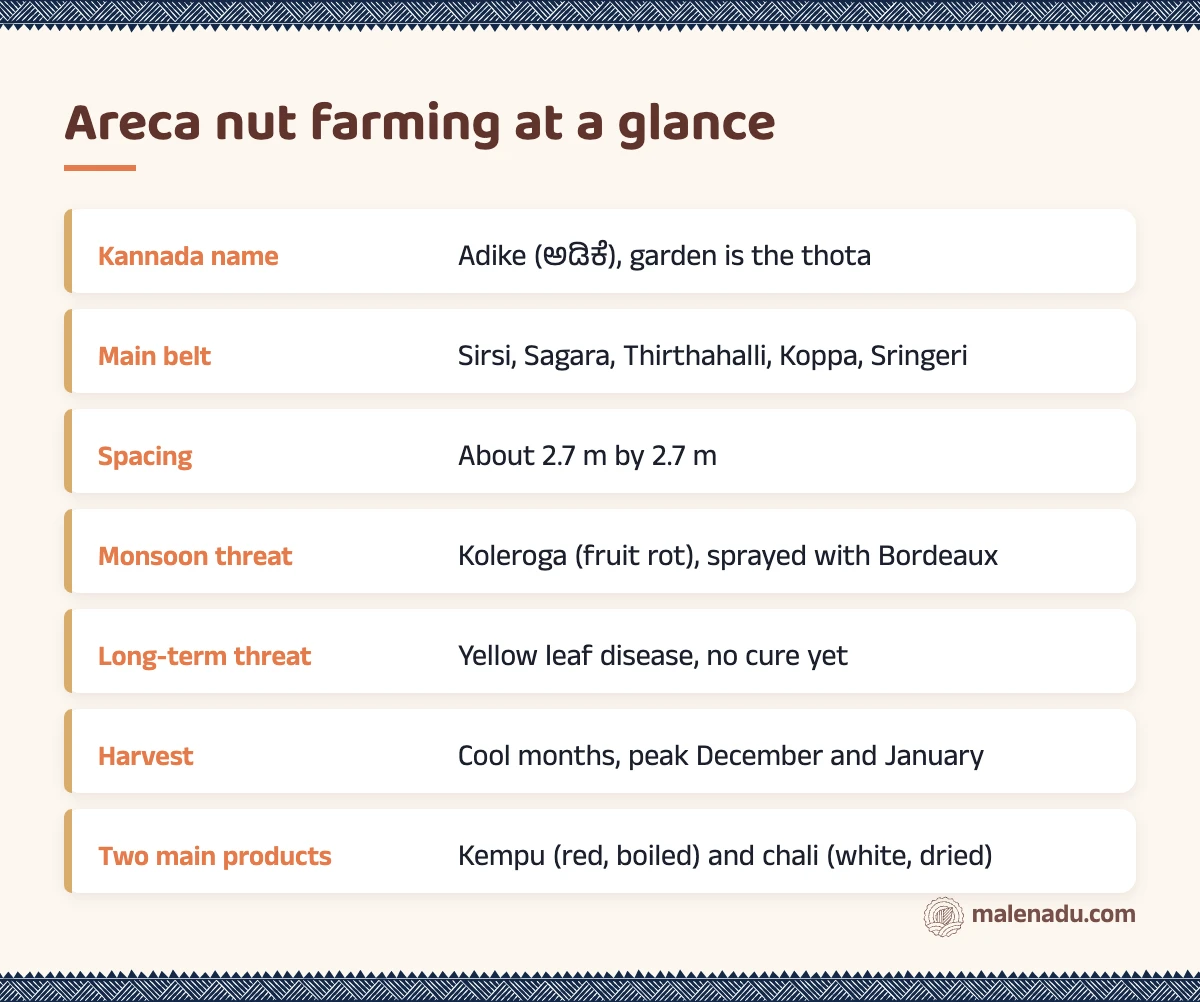
An areca garden is laid out in straight rows of palms about 2.7 m apart each way, with drainage channels for the monsoon and water channels for summer. The CPCRI guide to arecanut cultivation recommends this 2.7 x 2.7 m spacing, with rows running north to south and turned slightly toward the west.
Spacing and shade
In areca nut farming in Malenadu, young palms burn easily in the afternoon sun. Growers protect the outer rows on the south and south-west side with tall shade trees or with dried areca fronds tied around the trunks. Inside the garden, banana planted between the rows shades young palms for their first few years. Once the palms close their canopy, the garden makes its own shade.
Irrigation channels
For areca nut farming in Malenadu, water in the dry months decides the next year’s crop. Older gardens are watered by small channels (kaaluve, ಕಾಲುವೆ) that bring stream water down the slope by gravity. Newer gardens use sprinklers or drip lines. CPCRI suggests watering every 7 days in November and December, moving to every 4 days by March to May.
In the monsoon, areca nut farming in Malenadu faces the opposite problem: too much water. Deep drainage channels between the rows carry it out, because areca roots rot in standing water.
Mulch with leaves
Mulching is the oldest habit in areca nut farming in Malenadu. Every year the soil in the thota is covered with a thick layer of leaves. Fallen areca fronds, green leaves cut from the forest and dry leaves from the cowshed all go around the palms. The mulch keeps the soil cool and damp in summer, feeds it as it rots and stops the heavy rain from washing the topsoil away.
Varieties
Traditional areca nut farming in Malenadu relies on local tall palms. CPCRI lists Thirthahalli as a variety suited to the hill areas of Karnataka, with small oblong nuts. Newer gardens also plant improved varieties such as Mangala, Sumangala and Sreemangala.
How do farmers protect areca from koleroga in the monsoon?
Farmers protect areca from koleroga by spraying the bunches with 1 percent Bordeaux mixture before the heavy rain and again during the monsoon. Koleroga (ಕೊಳೆರೋಗ, “rot disease”), also called mahali, is a fruit rot caused by a Phytophthora fungus. It spreads fast in the wettest weeks and makes young nuts drop in heaps under the palm. It is the main monsoon risk in areca nut farming in Malenadu.
CPCRI’s advice is simple:
- Give the first spray after the pre-monsoon showers, before the rain sets in.
- Give the second spray 40 to 45 days later.
- Give a third spray if the monsoon goes on longer than usual.
- Pick up and destroy fallen, rotting nuts so the disease does not spread.
Bordeaux mixture is made by dissolving copper sulphate and lime separately in water and mixing them just before spraying. The blue spray works only as a shield, so it has to coat every nut in the bunch. That means a skilled climber goes up every palm with a spray pipe, often in rain. This is one of the hardest jobs in areca nut farming in Malenadu. Climbers are getting harder to find every year.
Local tip
In August, blue-green stains on bunches and trunks are a common sight wherever areca nut farming in Malenadu is done. That is Bordeaux mixture, a sign the farmer sprayed in time.
What is yellow leaf disease and why does it worry farmers?
Yellow leaf disease is a slow decline of the areca palm that turns its leaves yellow, cuts the yield and has no cure. It is the single biggest fear in areca nut farming in Malenadu today, especially around Sringeri and Koppa in Chikkamagaluru district.
The signs build over a few years:
- Leaves turn yellow from the tips of the outer leaflets.
- Nuts fall before they ripen.
- Kernels turn dark and are not fit for the market.
- The crown shrinks and the palm stops bearing.
Scientists link yellow leaf disease to a phytoplasma, a tiny bacteria-like organism that lives in the palm’s sap. No spray cures it. CPCRI advises removing badly affected palms in lightly affected areas so the disease does not spread. Feeding the rest of the garden well helps keep yields up.
For many families in the worst-hit villages, this has meant replanting with other crops or leaning harder on pepper, cardamom and coffee. It is a strong reason why areca nut farming in Malenadu has always worked best as a mixed garden rather than areca alone.
When is the areca nut harvest season in Malenadu?
The areca nut harvest season in Malenadu runs through the cool months, roughly November to February, with the busiest weeks in December and January. The main Malenadu harvest falls in December and January, while areca in the plains is picked earlier, in August and September.
The harvest depends on what the nut will become:
- For kempu adike, bunches are cut while the nuts are still green and tender, at about six to seven months.
- For chali, bunches are left on the palm till the nuts are fully ripe and orange.
Harvest day is the high point of the year in areca nut farming in Malenadu. It is a team job. A climber goes up the palm, cuts the bunch and lowers it by rope so the nuts do not bruise on the ground. Below, the family carries the bunches to the courtyard where the processing begins. During the areca nut harvest season, every courtyard in a Malenadu village turns into a drying yard.
Areca nut processing: how chali and kempu adike are made
Areca nut processing in Malenadu takes two main forms: chali and kempu adike. Chali is the ripe nut dried whole in the sun, while kempu is the green nut peeled, boiled and dried. Processing is where areca nut farming in Malenadu turns into money. Each village has its own way of doing both and the names change from Sirsi to Shivamogga.
Kempu adike, the red boiled nut
Kempu (ಕೆಂಪು) means red. To make it, tender green nuts are peeled, then cut or left whole and boiled for about 45 to 60 minutes in kali. Kali is the thick brown liquid saved from earlier boilings. It gives the nut its deep red colour and gloss. The boiled nuts are then sun dried for about 10 to 12 days.
The Shivamogga and Sirsi belt is known for kempu. Shivamogga is famous for boiled split nuts (chooru), while Sirsi is known for rashi, peeled and boiled whole nuts. Traders also use names like api, bette and idi for different sizes and cuts.
Chali, the white dried nut
Chali (ಚಾಲಿ) is made from fully ripe nuts. They are spread in a single layer in the sun, still in their husk. They dry for about 40 to 45 days. The farmer turns them once a week so they dry evenly. Once the nut rattles inside, the husk is removed to give the pale, hard chali nut.
Sirsi and the coastal markets toward Mangaluru are known for chali. In 2019 ‘Sirsi Supari’, grown in Sirsi, Yellapur and Siddapura taluks, received a GI tag.
| Type | Nut used | How it is made | Known in |
|---|---|---|---|
| Kempu (red) | Tender green nuts | Peeled, boiled in kali, sun dried | Shivamogga, Sirsi |
| Chali (white) | Fully ripe nuts | Dried whole in husk about 40 to 45 days | Sirsi, coastal belt |
Both forms of areca nut processing need dry, sunny weather, which is why the harvest calendar of areca nut farming in Malenadu follows the end of the rains. An unexpected shower on drying nuts can turn a good crop into a poor price.
Where is Malenadu areca sold?
Most Malenadu areca is sold in graded lots at local auction markets, often after the dried nut has been stored for some months. Growers watch prices closely and sell a little at a time rather than all at once after the harvest.
Prices still swing hard from season to season, which is why mixed gardens matter.
Intercrops that make areca nut farming in Malenadu pay
Intercrops make areca nut farming in Malenadu pay because they turn the shade and space between the palms into extra harvests. A good thota can give pepper, cardamom, banana, nutmeg and clove from the same acre as the areca.
Pepper on the palms
Black pepper is the most important intercrop. Vines are planted at the foot of each palm and trained up the trunk, so a single palm gives two crops. Our guide to pepper and cardamom farming explains how the vines are grown and harvested.
From the malenadu pantry
Our Black Pepper grows on vines like these, climbing areca palms in Malenadu gardens. The berries are picked by hand, threshed and dried in the sun.
Nutmeg and clove between the rows
Nutmeg trees fit well into the shaded rows of an areca garden. When the fruit ripens and splits, it shows a brown nut wrapped in a bright red lace called mace. Both are dried separately and sold as two spices. Clove trees grow in some gardens too, their buds picked by hand before they open.
From the malenadu pantry
Our Nutmeg comes from trees growing under areca palms in Malenadu gardens. Grate it only as needed and a whole nut stays fresh for months.
You can also buy the red lace on its own as Nutmace (mace). Our whole Clove comes from the same kind of gardens.
Cardamom and banana in the shade
In cooler gardens, cardamom clumps grow on the ground in the deep shade of the palms. Banana fills the gaps in younger gardens, giving fruit for the house and leaves for meals and festivals.
From the malenadu pantry
Our Cardamom grows in cool, shaded hill gardens like these. The green pods are picked by hand when ripe, round after round through the season.
Cattle and bees
Most areca gardens rely on cow dung and leaf compost from the family’s cattle, often hill cows like Malenadu Gidda. Many also keep bee boxes at the edge of the garden. Together they make areca nut farming in Malenadu a small, closed circle of forest, animals and palms.
Where to see and learn more
The best time to see areca nut farming in Malenadu is the harvest season from November to February, when nuts are being cut, boiled and dried. Karnataka Tourism’s Sirsi plantations page suggests the same window for visits. For the wider picture of what grows in these hills, read our guide to Malenadu crops and the month-by-month Malenadu crop calendar. To taste what grows under the palms, browse the spices from Malenadu farms.
Bring Malenadu home
Grown and made by Malenadu farmer families, packed by malenadu, a farmer owned producer company in Honnavar.
-
8% OFF
Black Pepper
Price range: ₹165 through ₹299 -
8% OFF
Nutmeg
Original price was: ₹60.₹55Current price is: ₹55. -
19% OFF
Cardamom
Price range: ₹130 through ₹330 -
6% OFF
Clove
Price range: ₹150 through ₹440 -
8% OFF
Nutmace
Original price was: ₹60.₹55Current price is: ₹55. -
29% OFF

Honey
Price range: ₹249 through ₹449
Frequently asked questions about areca nut farming in Malenadu
When is the areca nut harvest season in Malenadu?
The main harvest runs from about November to February, with the peak in December and January. Tender nuts for kempu are cut earlier than ripe nuts for chali.
What is the difference between chali and kempu adike?
Chali is made from fully ripe nuts dried whole in the sun for about 40 to 45 days. Kempu is made from tender green nuts that are peeled, boiled in kali and sun dried, which gives them a red colour.
What is koleroga in areca nut?
Koleroga is a fruit rot of areca caused by a Phytophthora fungus during the monsoon. Farmers prevent it by spraying 1 percent Bordeaux mixture before and during the rains.
Is there a cure for yellow leaf disease in areca?
No. There is still no cure for yellow leaf disease. Growers remove badly affected palms, feed the rest of the garden well and add other crops to protect their income.
What spacing is used in areca nut farming in Malenadu?
CPCRI recommends about 2.7 m between palms each way, in rows running roughly north to south. Banana is often planted between rows to shade young palms.
Is areca nut farming in Malenadu profitable?
It can be, but prices swing from year to year and diseases like koleroga and yellow leaf disease can cut yields. Growers who add pepper, cardamom and nutmeg to their gardens usually feel the swings less.
What crops are grown with areca nut in Malenadu?
Black pepper climbs the palms, while banana, cardamom, nutmeg, clove, betel leaf and sometimes cocoa grow between and under them.
Which district is famous for areca nut farming in Malenadu?
Shivamogga and Uttara Kannada are the best known, with Chikkamagaluru close behind. Sirsi, Sagara and Thirthahalli are classic areca towns.
Explore more of Malenadu
Malenadu FarmingMalenadu CropsWhat grows in Karnataka’s rain hills and why it grows
Malenadu FarmingMalenadu Crop CalendarWhat grows, ripens and cooks in the hills, month by month
Malenadu FarmingMalenadu GiddaThe small, tough hill cow of Karnataka’s Western Ghats
Malenadu FarmingPepper and Cardamom FarmingHow the two great spices of the hills are grown
Malenadu CultureMalenadu CulturePeople, arts and old ways of Karnataka’s rain hills
Malenadu FoodMalenadu FoodRice, kokum, pepper and joni bella from the hills
Start hereMalenadu in KarnatakaWhere Malenadu is, what the name means