
Malenadu Food
Malenadu koli saaru (ಕೋಳಿ ಸಾರು) is a hill style chicken curry cooked in a masala of roasted coconut, black pepper, coriander seeds and red chillies, finished in coconut oil. This page explains what makes it different, gives a tested home recipe for country or broiler chicken, the variations, what to serve with it and the mistakes to avoid.
On this page
What is Malenadu koli saaru?
Malenadu koli saaru is a chicken curry with a thin to medium gravy, made with a ground paste of roasted coconut and whole spices. “Koli” means chicken in Kannada and “saaru” is any thin curry or rasam that you pour over rice. So koli saaru simply means chicken curry. Each region of Karnataka makes its own. Malenadu koli saaru is the version of the hills.
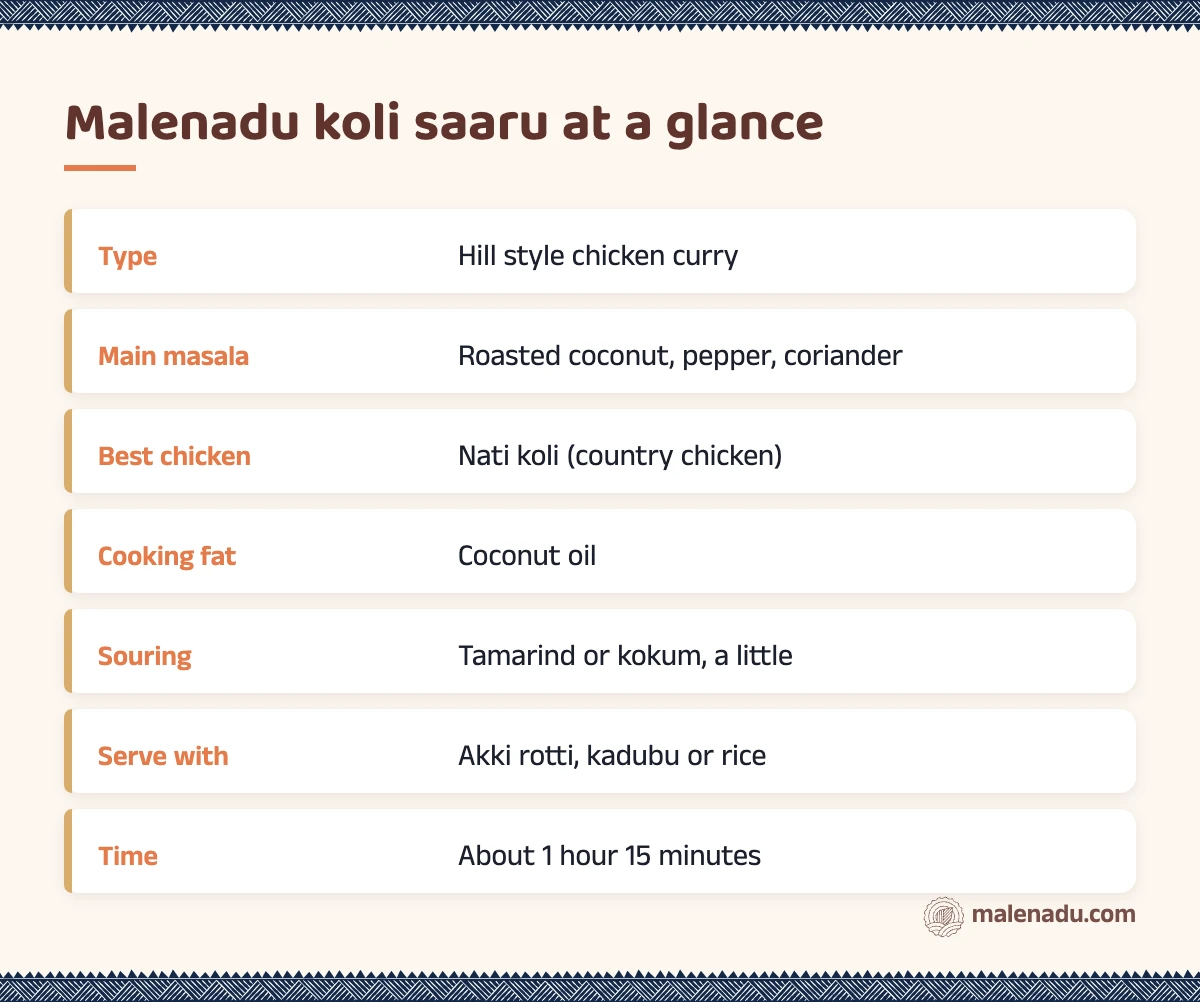
What sets Malenadu koli saaru apart is the masala. Grated coconut is roasted in a dry pan until it turns golden brown and smells nutty, then ground with coriander seeds, black pepper, cumin, poppy seeds and dry red chillies. The result is a brown, fragrant gravy that is spicy without being oily.
In hill homes Malenadu koli saaru is not daily food. It is cooked on Sundays, when guests come, during festivals in families that eat meat and on cold monsoon days. It is usually eaten with akki rotti, kadubu or rice.
Is koli saaru a curry or a rasam?
It sits in between. Malenadu koli saaru is thinner than a North Indian chicken curry, so it soaks into rice and rotti, but thicker than a vegetarian saaru like kokum saaru. The ground coconut gives it body.
How is Malenadu chicken curry different from other Karnataka chicken curries?
Malenadu chicken curry is defined by roasted coconut and plenty of black pepper, while curries of the plains and coast lean on other flavours. Karnataka has many chicken curries. Knowing the neighbours helps you see what makes Malenadu koli saaru special.
| Curry | Region | Main flavour |
|---|---|---|
| Malenadu koli saaru | Shivamogga, Chikkamagaluru, Hassan hills | roasted coconut, pepper, coriander seeds |
| Nati koli saaru | Old Mysore and across the state | country chicken, coconut with poppy seeds and greens |
| Kodava koli curry | Kodagu | ground Kodava spices, coconut, tamarind |
| Kundapura koli saaru | Udupi coast | red chillies, coriander seeds, coconut, tamarind |
Karnataka Tourism describes the Kodava chicken curry of Coorg as chicken simmered with freshly ground spices, coconut, tamarind and curry leaves and served with rice or ragi mudde. On the coast, it describes Kundapura koli saaru as a coconut curry with red chillies, coriander seeds and tamarind.
The Malenadu style chicken curry sits between these two. Malenadu koli saaru takes coconut from the coast and pepper from the estates of the Ghats. You can see which taluks count as Malenadu on our page of Malenadu districts and taluks.
Why nati koli saaru tastes different
Nati koli saaru tastes richer because it is made with nati koli, the native country chicken raised free range around village homes. The meat is firmer and darker, with more flavour than broiler chicken. It needs longer cooking, but the gravy it makes is deeper.
In Malenadu villages, many homes keep a few country hens that roam the thota and the backyard. When guests come, one of them goes into the pot. That is why a Malenadu koli saaru made with nati koli is still the dish people ask for when they visit relatives in the hills. Read more about the region on our Malenadu in Karnataka page.
Country chicken has less fat and tougher muscle. Cook it in a pressure cooker or simmer it for a long time with the lid on. Broiler chicken cooks in about 20 minutes and works fine in the same recipe, but the gravy is lighter.
The roasted coconut and pepper masala
The masala for Malenadu koli saaru is made by dry roasting coconut and whole spices separately, then grinding them to a smooth paste. Roasting each ingredient on its own lets you take it off the heat at the right moment, so nothing burns.
| Ingredient | What it does |
|---|---|
| Grated coconut, roasted golden | body, colour and a nutty sweetness |
| Coriander seeds | the base flavour of the gravy |
| Black pepper | the main heat and aroma |
| Dry red chillies | colour and a second layer of heat |
| Cumin, poppy seeds (gasagase) | thickness and a mellow taste |
| Cloves and cinnamon | a little warmth, used lightly |
| Onion, garlic and ginger | sweetness and depth |
Chicken saaru with pepper: why it matters
Chicken saaru with pepper is the Malenadu answer to a cold, wet evening. In the hills, black pepper vines climb the shade trees in coffee and areca gardens, so pepper is used by the spoon, not the pinch. ICAR-IISR, the national spices research centre, notes that black pepper is native to the Western Ghats and that Kerala and Karnataka are its major producing states.
For Malenadu koli saaru, use whole pepper and roast it lightly with the coriander seeds. Freshly roasted and ground, it gives the gravy a warm heat that builds slowly. Pre-ground pepper loses its smell quickly and makes the curry taste flat.
From the malenadu pantry
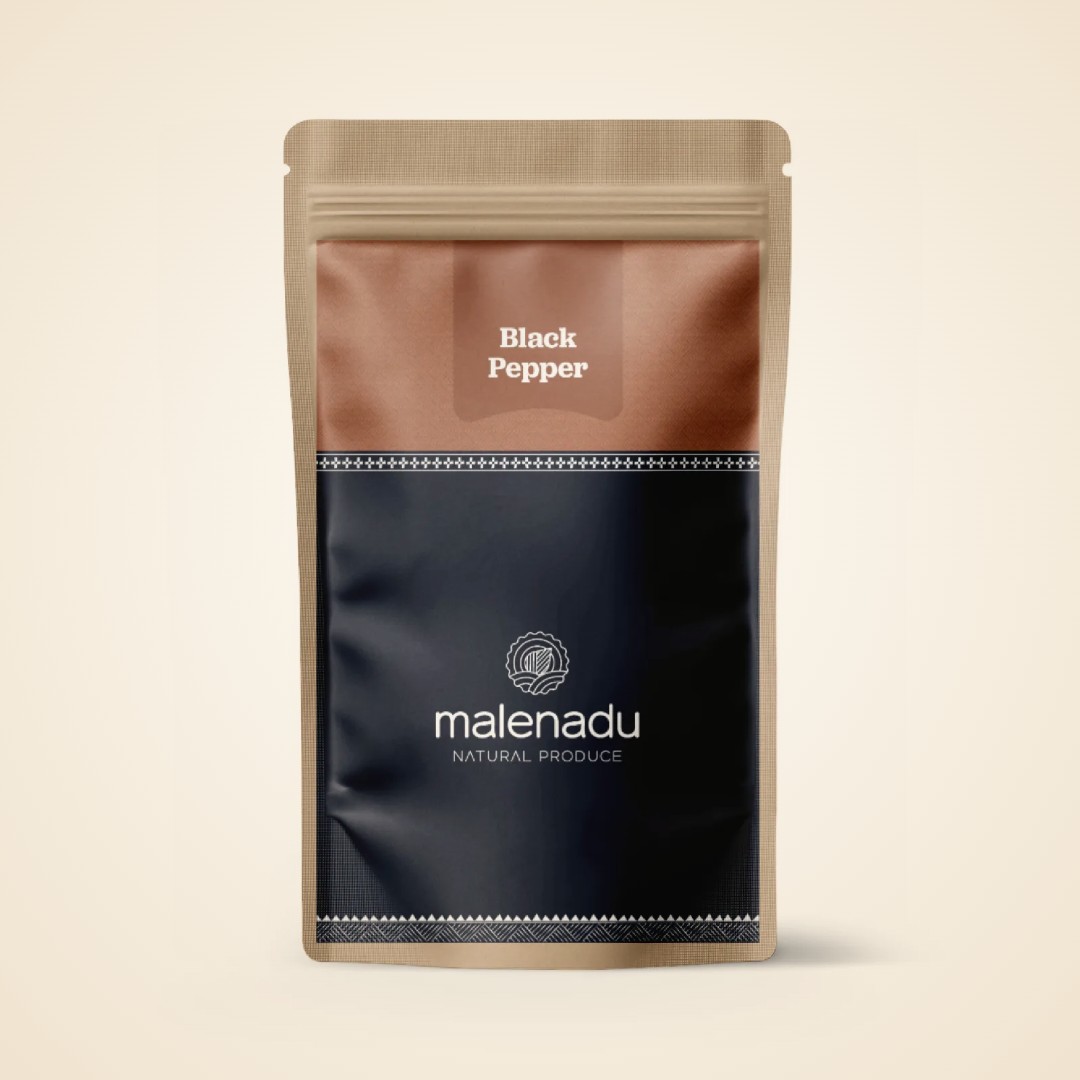
malenadu Black Pepper comes from the hills where this curry is cooked. One and a half teaspoons, roasted and ground with the coconut, gives Malenadu koli saaru its slow, warm heat.
Read how pepper is grown and picked on our page on pepper and cardamom farming.
Koli saaru recipe: how to make Malenadu koli saaru at home
This koli saaru recipe serves five to six people with rotti or rice and works for country or broiler chicken. Most of the time goes into roasting the masala and cooking the chicken. Read it through once before you start, because the masala is roasted in stages.
Recipe card
Malenadu Koli Saaru
Hill style chicken curry with a roasted coconut, pepper and coriander masala, cooked in coconut oil the Malenadu way.
Ingredients
- 1 kg chicken with bone, curry cut (country chicken or broiler)
- 1/2 teaspoon turmeric powder
- 1 1/2 teaspoons salt, divided (adjust to taste)
- 1 cup freshly grated coconut
- 2 tablespoons coriander seeds
- 1 1/2 teaspoons black pepper
- 1 teaspoon cumin seeds
- 1 tablespoon poppy seeds (gasagase)
- 6 to 8 dry red chillies (byadagi for colour)
- 3 cloves
- 1 inch piece of cinnamon
- 8 cloves of garlic
- 1 inch piece of ginger
- 2 medium onions (1 sliced for the masala, 1 finely chopped)
- 1/2 cup coriander leaves with tender stems
- 4 tablespoons coconut oil, divided
- 12 to 15 curry leaves
- 1 small marble-sized ball of tamarind or 3 to 4 pieces kokum rind, soaked in 1/4 cup water
- 3 to 4 cups water
Method
- Wash the chicken, drain well and rub it with the turmeric and 1/2 teaspoon salt. Keep aside for 20 minutes.
- In a dry pan on medium heat, roast the coriander seeds, pepper, cumin, red chillies, cloves and cinnamon for 2 to 3 minutes until fragrant. Tip them onto a plate. Roast the poppy seeds for 1 minute and add them to the plate.
- In the same pan roast the grated coconut, stirring all the time, for 6 to 8 minutes until it is evenly golden brown. Do not let it turn dark.
- Heat 1 tablespoon coconut oil and fry the sliced onion, garlic and ginger until the onion is soft and brown at the edges. Add the coriander leaves for the last 30 seconds.
- Cool everything and grind it with about 1 cup of water into a smooth, thick paste.
- Heat 3 tablespoons coconut oil in a heavy pot or pressure cooker. Add the curry leaves and the chopped onion and fry until golden. Add the chicken and fry on high heat for 5 minutes until it changes colour.
- For country chicken, add 1 cup water, close the cooker and cook for 3 to 4 whistles (longer for an older bird). For broiler, skip the cooker and simmer covered for 10 minutes.
- Add the ground masala, the tamarind or kokum water, the rest of the salt and 2 to 3 cups water for a pouring gravy. Simmer uncovered for 10 to 12 minutes, stirring now and then, until oil shows at the edges and the chicken is tender.
- Taste and adjust the salt and sourness. Rest the curry for 10 minutes before serving, so the masala settles into the meat.
Local tip
Roast the coconut last and in a clean pan. It burns faster than the spices. One dark batch makes the whole Malenadu koli saaru bitter.
When it is ready, Malenadu koli saaru should be a rich brown, pour easily off a spoon and smell of pepper and roasted coconut. If it is too thick, add hot water. If it is too thin, simmer a few more minutes without the lid.
From the malenadu pantry
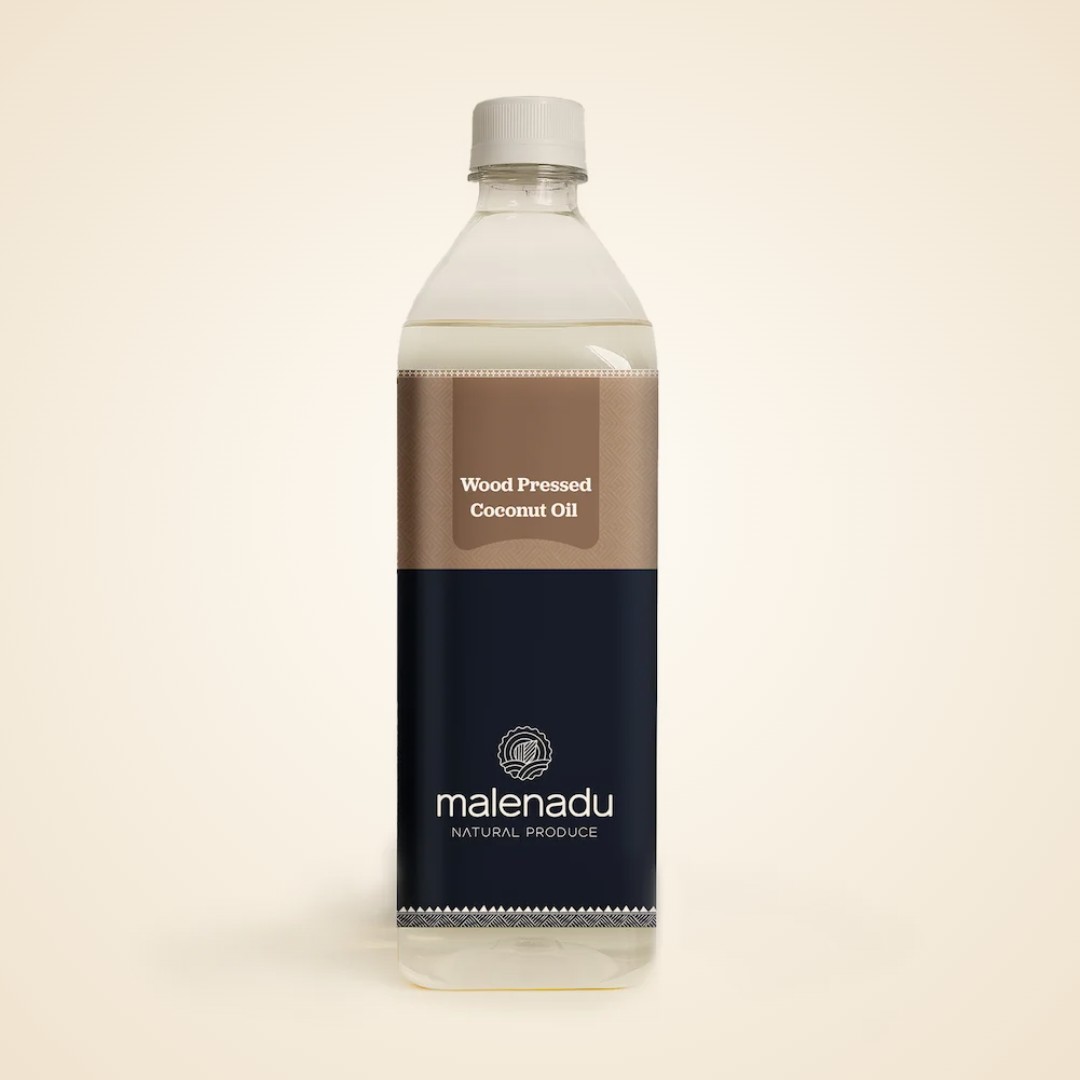
malenadu Wood Pressed Coconut Oil is made from sun dried copra in a wooden ghani. Frying the onion and chicken in it gives Malenadu koli saaru the coconut aroma that a neutral oil cannot.
Malenadu style chicken: variations to try
Malenadu style chicken changes from house to house, but almost every version keeps the coconut and the pepper. These four are the ones you are most likely to meet in the hills.
Green koli saaru
Some homes grind fresh coriander leaves, mint and green chillies into the coconut paste and leave out most of the red chillies. The gravy turns green, fresher and lighter. Use 1 cup coriander leaves, 1/4 cup mint and 4 to 5 green chillies in place of 6 dry red chillies.
With kokum instead of tamarind
In Uttara Kannada and the ghat taluks above the coast, many cooks sour curries with kokum rind (murugalu) instead of tamarind. Soak 3 or 4 pieces in warm water for 15 minutes and add the red water in step 8. The sourness is cleaner and the gravy takes a reddish tint.
From the malenadu pantry
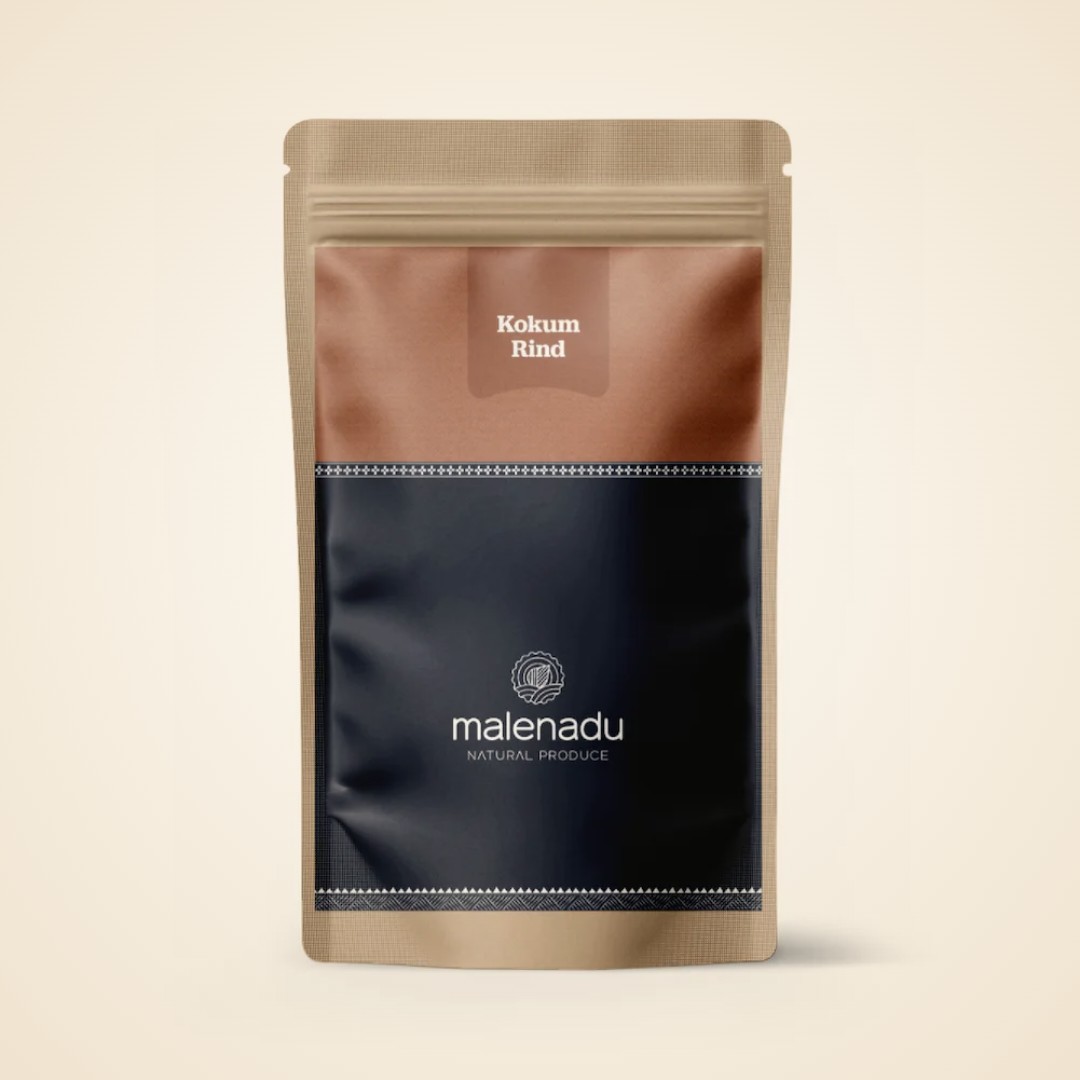
malenadu Kokum Rind is sun dried murugalu from the Western Ghats. Three or four pieces, soaked and squeezed, give Malenadu koli saaru a clean sourness in place of tamarind.
Pepper chicken dry (koli pepper fry)
Use the same chicken and fry it with a coarse paste of pepper, garlic, curry leaves and a little coconut until dry. It is a side dish rather than a saaru and goes well with rice and a thin rasam.
A note on Kodagu
Kodagu, at the southern end of the hills, has its own Kodava chicken curry, cooked with ground spices, coconut and tamarind and often served with rice or akki otti. It is a separate tradition with its own spice mix, so it is best learnt from Kodava cooks rather than copied into this recipe.
What to serve with Malenadu koli saaru
Malenadu koli saaru is best with soft rice flatbreads, steamed rice dumplings or plain rice. The gravy is made to be soaked up, so choose something that drinks it in.
- Akki rotti. Thin, soft Malenadu akki rotti or rolled ubbu rotti is the classic pairing. Tear the rotti and dip it in the gravy.
- Kadubu. Plain rice kadubu or kara kadubu soaks up the gravy well.
- Rice. Hot rice with a spoon of the gravy and a piece of chicken, followed by curd rice.
- Ragi mudde. In Hassan and the plains side of the hills, ragi balls are common with nati koli saaru.
- Neer dose. The thin rice crepes of the coast are another good partner.
Add a sliced onion with lemon and a green chilli on the side. Many homes finish the meal with buttermilk or a plain rasam to cool the palate after the pepper.
Common Malenadu koli saaru mistakes and how to fix them
Most Malenadu koli saaru problems come from burnt coconut, raw masala or undercooked country chicken. This table shows what went wrong and how to fix it.
| Problem | Likely cause | Fix |
|---|---|---|
| Bitter gravy | coconut or spices roasted too dark | roast on medium, take off at golden brown |
| Raw, powdery taste | masala not simmered enough | simmer 10 to 12 minutes after adding paste |
| Tough chicken | country chicken undercooked | pressure cook longer before adding masala |
| Grainy gravy | paste not ground fine | grind with water until fully smooth |
| Too sour | too much tamarind or kokum | add a little water and coconut paste |
| Flat taste | pre-ground pepper | roast and grind whole pepper fresh |
Salt the chicken before cooking so the meat in your Malenadu koli saaru is seasoned through, not just the gravy. Do not add the coconut masala too early with country chicken, because the coconut catches at the bottom during long cooking.
Where to go next after Malenadu koli saaru
If you enjoyed Malenadu koli saaru, make a batch of akki rotti or kadubu to go with it next time. Our Malenadu food guide brings all the hill recipes together. For whole spices, turmeric and chillies for your masala, see the spices section of our shop, including our turmeric powder.
Bring Malenadu home
Grown and made by Malenadu farmer families, packed by malenadu, a farmer owned producer company in Honnavar.
-
8% OFF
Black Pepper
Price range: ₹165 through ₹299 -
24% OFF
Wood Pressed Coconut Oil
Original price was: ₹899.₹679Current price is: ₹679. -
17% OFF
Kokum Rind
Original price was: ₹240.₹200Current price is: ₹200. -
13% OFF
Turmeric Powder
Price range: ₹70 through ₹120 -
Bird Eye Chilli
₹200 -
40% OFF
Desi Cow Ghee
Original price was: ₹1,500.₹899Current price is: ₹899.
Frequently asked questions about Malenadu koli saaru
What is koli saaru?
Koli saaru is the Kannada name for chicken curry. Koli means chicken and saaru means a thin curry. Each region of Karnataka has its own version.
What is the difference between nati koli saaru and broiler chicken curry?
Nati koli saaru is made with country chicken, which is firmer and more flavourful and needs longer cooking. Broiler chicken is softer, cooks in about 20 minutes and gives a lighter gravy.
Why is my koli saaru bitter?
The coconut or the spices were roasted too dark. Roast them on medium heat, stir all the time and take them off as soon as they turn golden brown.
What do you eat with koli saaru in Malenadu?
Akki rotti, kadubu and plain rice are the usual partners. Ragi mudde and neer dose are also common in some areas.
Can I make Malenadu koli saaru without coconut?
Coconut is what gives this curry its body and nutty taste, so the result will be very different. If you must, grind the spices with a handful of roasted chana dal and a little poppy seed to thicken the gravy.
How long does koli saaru keep?
Kept covered in the fridge, it is good for two days and often tastes better the next day. Reheat it until it boils before serving.
How much pepper goes into koli saaru?
For 1 kg of chicken, about 1 1/2 teaspoons of whole black pepper is right for most families. Add another half teaspoon if you like it hot.
Explore more of Malenadu
Malenadu FoodMalenadu FoodRice, kokum, pepper and joni bella from the hills
Malenadu FoodHalasina KadubuSweet jackfruit dumplings steamed in leaves
Malenadu FoodSpices Names in KannadaEnglish, Kannada and Hindi names for a Malenadu kitchen
Malenadu FoodKara KadubuSpicy steamed rice dumplings from Malenadu kitchens
Malenadu FoodKokum SaaruThe sour, peppery everyday rasam of Malenadu homes
Malenadu FoodMenthya TambuliA cool fenugreek and curd side for the first rice course
Malenadu FoodMalenadu FruitsJackfruit, kokum, wild mango and the fruits of the forest
Malenadu FoodKesuvina GojjuThe sweet and sour colocasia leaf relish of the monsoon
Start hereMalenadu in KarnatakaWhere Malenadu is, what the name means