
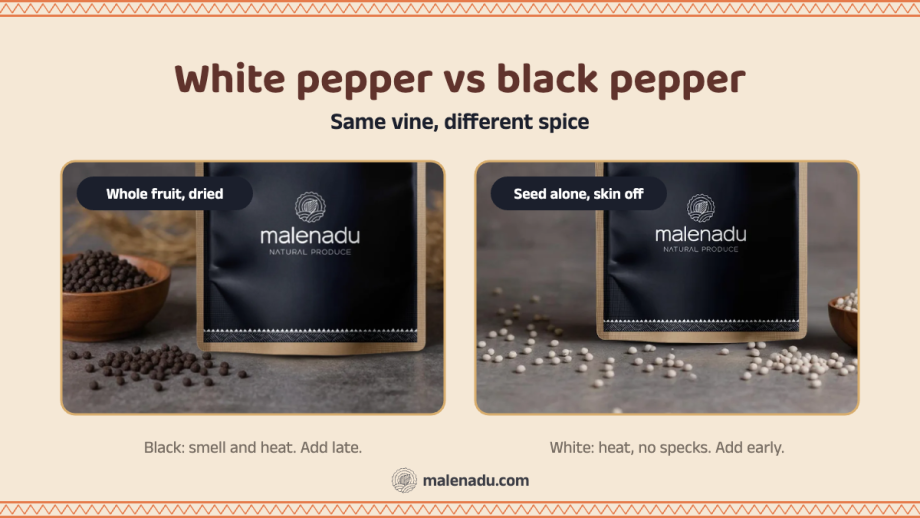
Take the skin off a pepper berry and you get a different spice. That is the whole of the white pepper vs black pepper story. Almost nobody who buys either one knows it. Black pepper and white pepper are not two plants. They are the same berry from the same vine, picked at slightly different times and dried two different ways. Everything else, the colour, the smell, the heat, the price, the dishes each one belongs in, follows from that one decision about the skin.
We grow pepper (our member farmers do, strictly speaking) on vines that climb the areca palms and forest trees of Malenadu. The same vine gives us both our black pepper and our white pepper. So we can describe the difference from the farm end rather than the shop end, which turns out to be a much simpler explanation.
Table of Contents
One vine, one berry
Pepper is Piper nigrum, a climbing vine that needs a tree to hold on to, shade over its head and a great deal of rain. Malenadu, the land of rain in the Western Ghats of Karnataka, gives it all three. The vine flowers after the monsoon and the berries hang in long green spikes through the cooler months, turning from green to yellow to red as they ripen.
A vine takes three or four years to give its first proper crop and then goes on giving for twenty or thirty, which is why a pepper garden is planted by one generation and picked by the next. Our member farmers tend vines their parents planted and a few that their grandparents did.
Every peppercorn you have ever used started as one of those berries. A pepper berry is a small fruit. It has a thin skin, a layer of pulp under the skin and a hard seed in the middle. The pungency, the thing that makes pepper hot, is piperine. Most of it is in the seed. The aroma, the thing that makes pepper smell like pepper rather than just taste hot, is in the oils of the skin and the pulp.
Hold on to that. Heat in the seed, smell in the skin. It explains the entire white pepper vs black pepper difference in one line.
What changes when you take the skin off
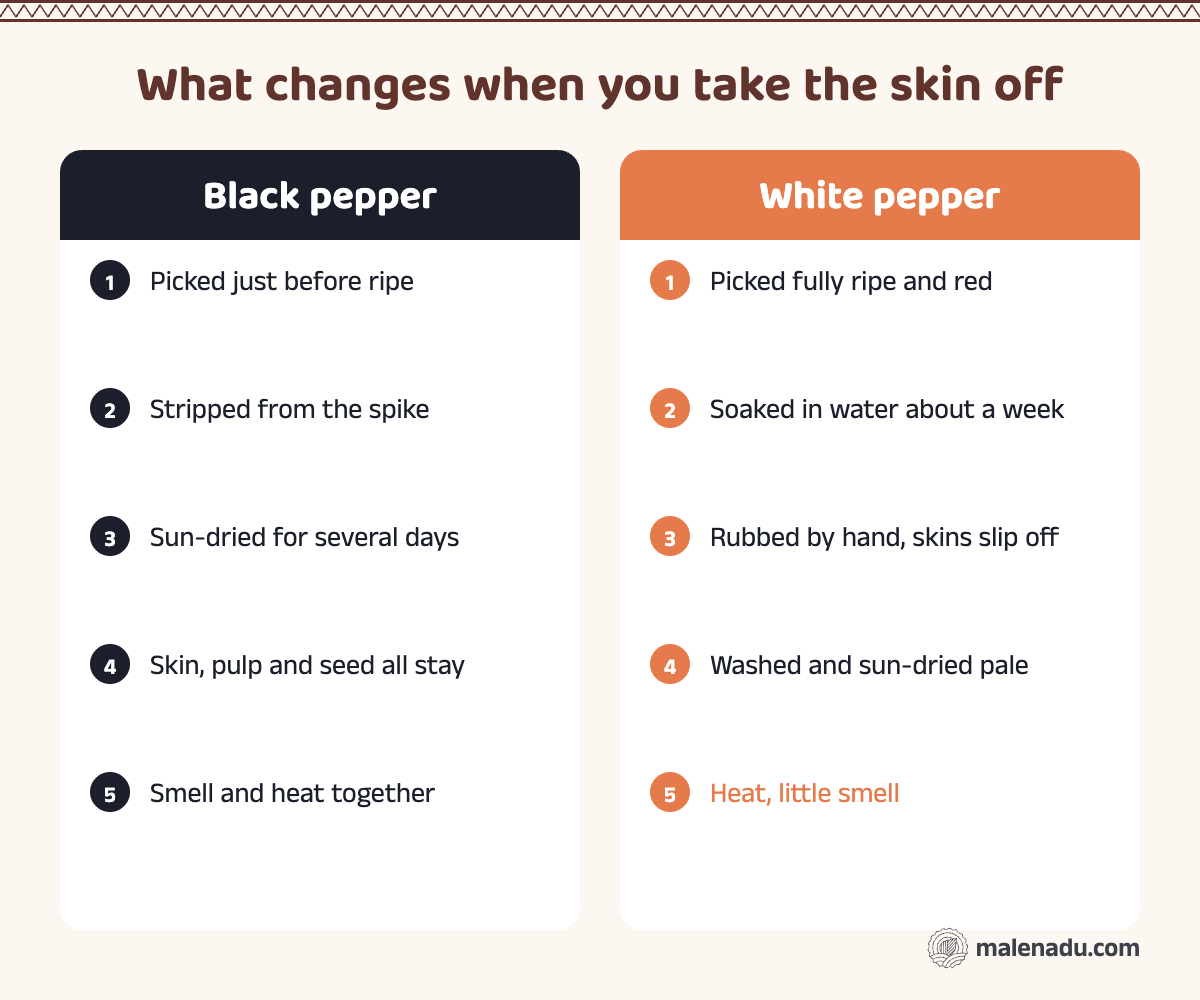
In Malenadu the picking starts around December and runs into February, spike by spike, by hand, up ladders leaned against the areca palms. The spikes are picked when the first one or two berries on each have turned yellow or red. For black pepper that is the moment. For white pepper the farmer waits a little longer, until the spike is mostly red, because a riper berry gives a bigger, cleaner seed and the skin comes away more easily in the soak. The same vine, picked a week apart, for two different spices.
Black pepper is the berry picked a little before it is fully ripe, when the spikes are still mostly green with the first berries turning yellow. The berries are stripped from the spike, sometimes blanched in hot water for a minute to speed things along and then spread out in the sun for several days. As they dry, the skin shrinks, wrinkles and turns black. The seed, the pulp and the skin all stay together. That is why black pepper has both heat and aroma. You dried the whole fruit.
White pepper is the berry picked fully ripe and red. Then the skin is removed. The traditional way, which is how it is done in Malenadu, is to soak the ripe berries in water for about a week. The soaking softens and rots the skin and pulp, the berries are rubbed by hand to slip the skins off, the clean seeds are washed and then they are dried in the sun until they are a pale cream colour. What you have left is the seed alone. The heat stayed, because it was in the seed. Most of the aroma went, because it was in the skin you threw away.
There is a shortcut some producers use, which is to take dried black pepper and mechanically scrape or peel the skin off. It gives a paler, less even result and the pepper tastes flatter, because the berry was never allowed to ripen fully. Our white pepper is made the first way, from ripe berries soaked, hand-rubbed and sun-dried, by the farmers who grew them.
So in the white pepper vs black pepper comparison, the processing is really this. Black pepper is the whole fruit dried. White pepper is the seed alone, from a riper fruit, with the skin retted off. One extra step, one quite different spice.
How they differ in the kitchen
Once you know where the heat and the smell live, the white pepper vs black pepper differences in the kitchen stop being mysterious.
Smell. This is the first thing people notice in white pepper vs black pepper. Black pepper has the big, resinous, almost citrus smell that fills the kitchen when you crack it. That smell is the skin. White pepper has much less of it. In its place there is a sharper, slightly earthy, slightly fermented note that comes from the soaking. People who are new to white pepper sometimes describe that note as musty or barnyard. People who grew up with it in Chinese soups and European white sauces find black pepper crude by comparison. Neither is wrong. They are different smells.
Heat. White pepper is usually a little hotter, weight for weight, because it is all seed and the seed is where the piperine is. The heat is also cleaner and comes later in the mouth, without the aromatic lift in front of it. Black pepper feels hot and fragrant at once.
Colour. This is the practical reason most cooks reach for white pepper. Black pepper leaves dark specks. In a saaru or a meat curry nobody cares. In a white sauce, a cream soup, mashed potato, a clear broth, a light coloured chutney or a pale marinade, the specks look like dirt. White pepper gives you the heat without the dots.
How it behaves in cooking. Black pepper is best added towards the end or cracked at the table, because long cooking boils off the aromatic oils and leaves only the heat. White pepper does not have those oils to lose, so it can go in early and simmer along with the dish without changing much. This is why Chinese hot and sour soup and European stocks use white pepper from the start. It is also why a good pepper rasam is finished with freshly crushed black pepper at the very end.
Price. In white pepper vs black pepper terms, white costs more. It takes a riper berry, a week of soaking, hand rubbing and washing. About a third of the weight is lost with the skin. You are paying for the extra work and the lost weight, not for a rarer plant.
Where black pepper wins
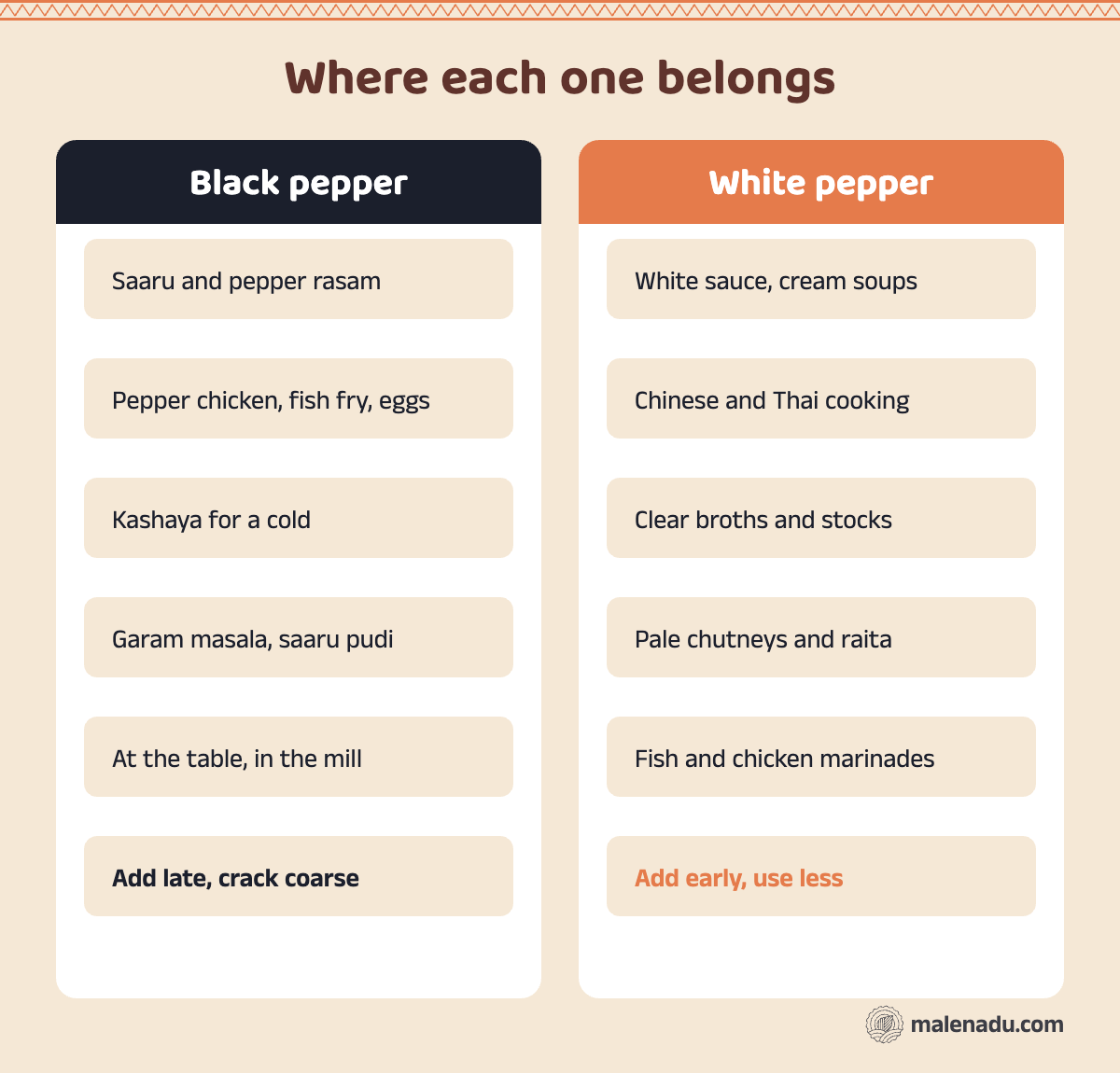
In the white pepper vs black pepper contest in a Malenadu kitchen, black pepper is the default and it is hard to think of a savoury dish that does not take it somewhere.
Saaru and pepper rasam. Whole black pepper roasted with cumin and ground fresh is the backbone of menasina saaru, the pepper rasam that every Kannadiga household makes on a cold evening or when someone has a cold. White pepper in a rasam would be a strange thing. You want the aroma.
Meat, fish and eggs. Pepper chicken, pepper mutton, a fish fry, a simple omelette. The big black pepper smell is the point of all of these. Crack it coarse and add it late.
Kashaya and home remedies. A decoction of black pepper, dry ginger and tulsi, sweetened with a little honey or jaggery, is the first thing made in most homes here when a cold starts. Black pepper is also added to turmeric milk for the same reason. It is one of the few old remedies where there is a sensible explanation. Piperine helps the body take up curcumin from turmeric. We say that carefully, as an observation and not a promise.
Spice blends. Garam masala, saaru pudi, sambar powder, rasam powder, chettinad masala, every one of them leans on black pepper for the aromatic base. Whole black pepper fried in ghee with cashew is the start of a proper pongal.
At the table. A pepper mill with whole black pepper next to the salt. Nothing else does that job.
Where white pepper wins
White pepper has a smaller territory in the white pepper vs black pepper map, but it owns it completely.
Anything white or pale. Cream of mushroom soup, white sauce, bechamel, mashed potato, a cauliflower soup, a potato salad, a creamy pasta sauce. Black specks in these look wrong and white pepper gives the heat invisibly.
Chinese and Thai cooking. Hot and sour soup, wonton soup, fried rice, a stir fry, the pepper on a Hainanese chicken rice. In these cuisines white pepper is the pepper. Black pepper tastes foreign in them.
Clear broths and stocks. A chicken stock or a vegetable broth that you want clear and clean. White pepper seasons it without clouding the colour or adding a resinous note.
Light pickles and chutneys. A pale coconut chutney, a white lime pickle or a cucumber raita where you want a little bite without changing the colour.
Marinades for fish and chicken. Where the piece is going to be fried or grilled pale and you want it seasoned through rather than spotted.
Long simmered dishes. A stew or a soup that cooks for an hour, where black pepper would lose its smell anyway. White pepper added at the start gives a steady heat all the way through.
Where each one does not belong
No white pepper vs black pepper guide is honest unless it says where each one is the wrong choice.
Black pepper does not belong, in the white pepper vs black pepper sense, in anything that needs to stay white, in long cooked soups where its aroma will vanish and in delicate dishes where its smell shouts over everything else. It is also wasted when added at the start of a long cook. Add it late.
White pepper does not belong in a pepper rasam, a pepper chicken or anything where the aroma is the reason you reached for pepper. It is the wrong spice for a kashaya and a dull one at the table. And a word of warning, white pepper is hotter than it looks. People who treat it as a mild pepper and use it by the spoonful regret it.
Neither belongs in the cupboard for more than a year, ground. Pepper loses its oils fast once it is cracked. Buy whole, grind as you need and buy small enough quantities that you finish a packet in a few months.
Grades and sizes, in plain language
Grades matter in the white pepper vs black pepper question less than people think, but they matter. Pepper is sold by size and by where it came from. The names can be confusing. The big trade names, Malabar and Tellicherry, both refer to the same coast, from Kerala up into coastal Karnataka. Tellicherry is not a variety. It is a grade, the largest berries sorted from the crop, originally shipped from the port of Thalassery. A big berry has more surface, more skin and more oil, so it smells stronger. That is the whole secret of a premium peppercorn.
Within Malenadu the pepper comes from vines on areca and coffee estates and from forest edge gardens where a few vines are trained up wild trees. The bold black berries from these gardens are sorted by hand. White pepper is graded by colour and evenness. A good one is a pale, uniform cream rather than grey or patchy.
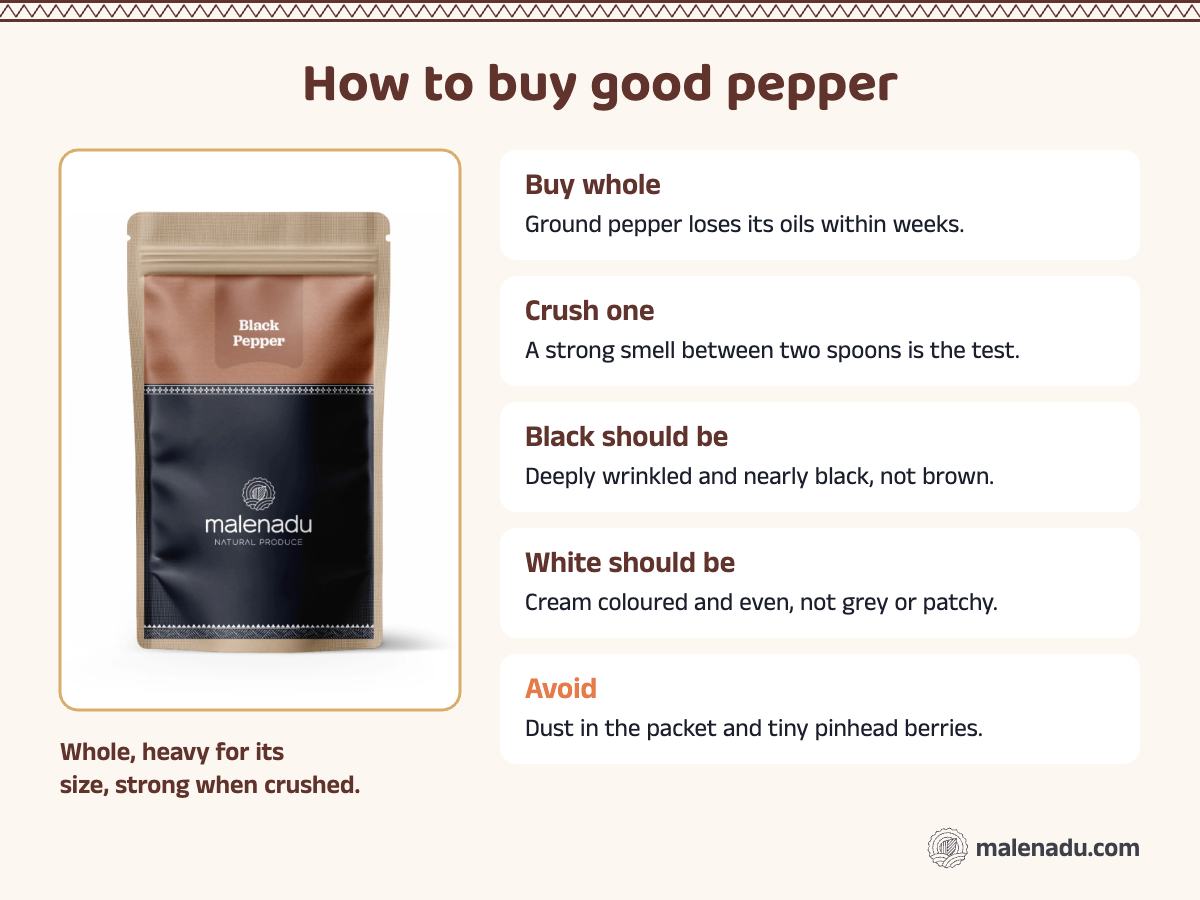
Whichever side of white pepper vs black pepper you are buying, look for whole berries that are heavy for their size, with a strong smell when you crush one between two spoons. Black pepper should be deeply wrinkled and nearly black, not brown and smooth. White pepper should be cream coloured and clean. Dust at the bottom of the packet is a sign of old stock or rough handling. Pinheads, the tiny immature berries, are a sign of a poorly sorted crop.
The pepper queen who lived up the road
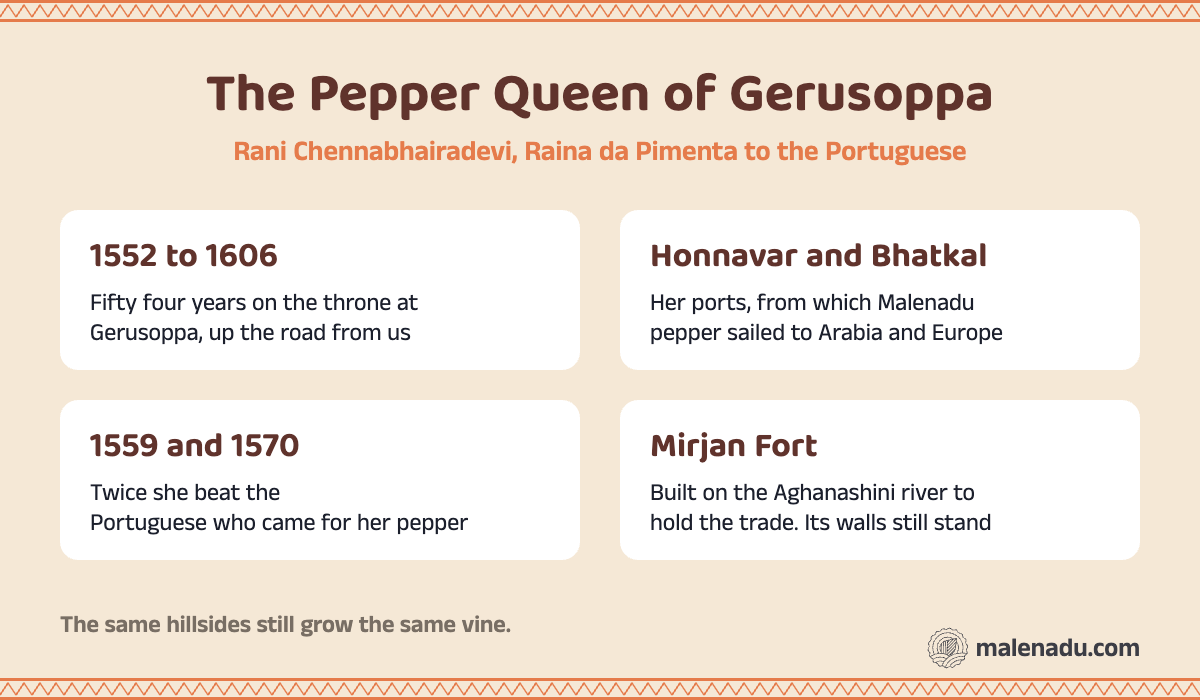
It is impossible to write about pepper in this part of the world without mentioning the woman the Portuguese called Raina da Pimenta, the Pepper Queen. Rani Chennabhairadevi ruled from Gerusoppa, a few kilometres from where we are, for fifty four years, from 1552 to 1606. Her kingdom ran from the Ghats down to the coast and she controlled the pepper that left the ports of Honnavar and Bhatkal for Arabia and Europe. The Portuguese wanted that pepper badly enough to fight her for it. She beat them in 1559 and again in 1570. She built Mirjan Fort on the Aghanashini river to hold the trade. Its walls still stand.
Four and a half centuries later the same hillsides still grow the same vine, the berries still dry in the same winter sun and some of the farmers who sell to us are working land that was pepper garden in her time. India Post issued a stamp in her name in 2025, which is a nice thing to see on a letter. When you buy pepper from Malenadu you are buying from the Pepper Queen’s own country. We are rather proud of that.
How to store pepper
Storage is one place white pepper vs black pepper barely differs. Whole pepper of either kind keeps well. Store it in an airtight jar away from the stove and out of the sun and it will hold its smell for a year or more. Ground pepper does not keep. It loses its aroma within weeks, which is why a jar of pre-ground black pepper from a supermarket smells of so little. Buy whole, keep a small pepper mill or a mortar and grind what you need.
White pepper is a little more forgiving of grinding ahead because it has less aroma to lose, but it still does better whole. In the humid Malenadu monsoon both kinds will pick up moisture if the jar is left open, so close the lid and keep a dry spoon.
A simple way to remember it
If you remember nothing else from this white pepper vs black pepper comparison, remember this. Black pepper is the whole fruit, so it has smell and heat. Use it where you want the smell and add it late. White pepper is the seed alone, so it has heat and almost no smell. Use it where you want the heat without the specks and add it early.
And keep both. A kitchen with only black pepper will put dots in its white sauce. A kitchen with only white pepper will make a very sad rasam.
Frequently asked questions about white pepper vs black pepper
Are white pepper and black pepper from the same plant?
Yes. The white pepper vs black pepper difference is in the processing, not the plant. Both come from the berries of the same vine, Piper nigrum. Black pepper is the nearly ripe berry dried whole with its skin. White pepper is the fully ripe berry soaked, rubbed to remove the skin and dried as the bare seed.
Which is hotter, white pepper or black pepper?
White pepper is usually a little hotter weight for weight, because it is all seed and the seed carries most of the piperine. Black pepper feels hot and aromatic together, so the heat seems softer than it is.
Why does white pepper smell different?
The soaking that removes the skin gives white pepper a slightly earthy, fermented note. It loses the citrus and resin aromas that live in the skin of black pepper. Some people find the smell strange at first. In Chinese and European cooking it is the expected pepper smell.
Can I substitute white pepper for black pepper?
In most dishes yes, with two white pepper vs black pepper cautions. Use a little less, because white pepper is hotter. And expect less aroma, so in a dish like pepper rasam or pepper chicken where the smell is the point, the result will be flatter.
Why is white pepper more expensive?
It needs riper berries, a week of soaking, hand rubbing and washing. It loses about a third of its weight with the skin. You pay for the labour and the lost weight, not for a rarer plant.
Is white pepper just peeled black pepper?
Some commercial white pepper is made by mechanically peeling dried black pepper. It is flatter in taste. Traditional white pepper, including ours, is made from fully ripe berries soaked in water and rubbed by hand, which gives a cleaner, more even result.
Should I buy ground or whole pepper?
Whole, always. Pepper loses its aromatic oils within weeks of grinding. A small hand mill or a mortar and pestle takes ten seconds and the difference in a dish is obvious.
What is Tellicherry pepper?
A grade, not a variety. Tellicherry refers to the largest berries sorted from the Malabar coast crop, named after the port of Thalassery. Bigger berries have more skin and more oil, so they smell stronger. Any good black pepper, including Malenadu pepper, can be sorted into a bold grade the same way.
One last thought
Two spices, one vine. The difference between white pepper vs black pepper is one decision made in a farmer’s yard in the picking season, whether to dry the whole berry or to take the skin off first. Everything you taste follows from that. Keep both in the kitchen, use black where you want the smell and white where you want the colour clean. Buy whole from someone who can tell you which hillside it came from.
Ours come from the Pepper Queen’s hills. Our black pepper and white pepper are sun-dried and hand sorted by the families who grow them. Everything else in the spices section comes from the same gardens.