
Every December the same message arrives. Someone bought a bottle of coconut oil in April and used it happily all through the summer. Then one cold December morning in Bengaluru or Pune or Hyderabad they picked it up and found a white, waxy block where the oil used to be. Has it gone off? Is something wrong with it? Why does coconut oil go solid at all, when the sunflower oil next to it is still pouring?
Then there is the smell. A bottle of oil that was pressed the old way has a strong coconut smell. Someone who has grown up on refined oil opens it and wonders whether that is normal. And there is the cloudiness, the milky haze or the pale flecks that appear in the bottle for no obvious reason.
All three of these, starting with why does coconut oil go solid, are the same story told three ways. Coconut oil is an unusual fat. The things it does that other oils do not are the things that tell you it is the real thing. This post answers the three questions in the title and then the dozen smaller ones that follow them, the way we would answer a customer who called us.
Table of Contents
Why does coconut oil go solid
Short answer to why does coconut oil go solid: because it is supposed to.
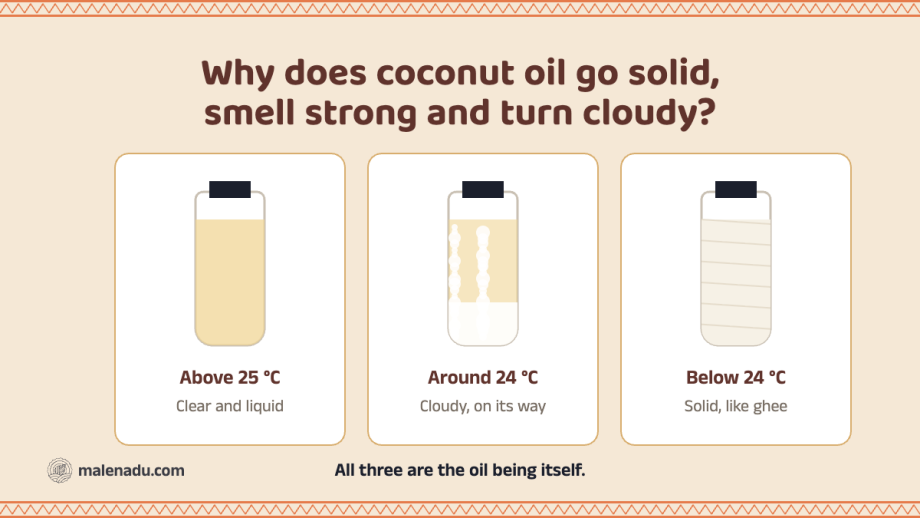
Coconut oil is mostly saturated fat. Saturated fats are solid at cooler temperatures. The melting point of coconut oil is about 24 to 25 degrees Celsius. Above that it is a clear liquid. Below it, it sets, first going cloudy, then soft and creamy, then into a firm white solid if the kitchen gets cold enough. Nothing has happened to the oil. It has simply done what butter and ghee do, at a slightly lower temperature.
That is why the question of why does coconut oil go solid gets asked mostly in December and January and mostly from the cities. On the coast and in the plains in summer it never happens. In a Malenadu kitchen in winter, where a morning can be twelve or thirteen degrees, the oil is solid for weeks and nobody gives it a thought. The dabba sits by the stove, you scoop out what you need with a spoon and it melts in the pan in a second.
If you know why does coconut oil go solid and would still prefer it liquid, stand the bottle in a bowl of warm water for a few minutes. Do not boil it and do not put the bottle on the stove. Warm tap water is enough. A sunny windowsill does the job too. The oil will go clear again and can go solid again and back as many times as the weather likes without any harm.
One thing to notice. Coconut oil that goes solid in the cold is coconut oil behaving like coconut oil. A bottle sold as coconut oil that stays thin and clear through a cold snap deserves a second look. We will come to that.
Why does some coconut oil never go solid
Because it is not whole coconut oil any more.
There is a product sold as liquid coconut oil or fractionated coconut oil, made by removing the part of the fat that sets, the lauric fraction. The part that stays liquid is kept. It is useful in cosmetics and massage oils because it does not harden in the bottle. It is not what you want in the kitchen, because the part that was removed is most of what makes coconut oil taste and behave like coconut oil.
The other reason a bottle might stay liquid is that it is not entirely coconut. Oil blended with a cheaper vegetable oil will set less readily or set in layers, with a soft white portion and a liquid portion that do not mix. If your coconut oil stays thin in a cold kitchen while a neighbour’s goes solid, that is worth noticing.
So the honest answer to why does coconut oil go solid is also a small test of what is in the bottle. Real coconut oil sets in the cold. Oil that does not is either processed to stop it or is not all coconut.
Why does coconut oil smell strong
Because it is coconut.
Coconut oil pressed from dried coconut, without refining, carries the smell of the coconut it came from. That smell is a mix of natural aromatic compounds that live in the fat itself, the same ones that make a fresh coconut smell like a fresh coconut, plus a little toastiness from the drying of the copra. In our part of Karnataka that smell is the smell of a kitchen. It is what a dosa fried in coconut oil smells of. It is a fish curry and a child’s freshly oiled hair on a Sunday.
Refined coconut oil smells of almost nothing because it has been through a process designed to remove the smell. The oil is bleached to lighten the colour and deodorised with steam at high temperature to strip out the aromatic compounds. What is left is a neutral fat that behaves like coconut oil in the pan but tastes of nothing in the mouth. Some people prefer that for cooking dishes where they do not want coconut in the flavour. That is a fair preference. But it means a strong smell is not a fault. It is the oil as it came out of the press.
There is a difference between a strong smell and a bad smell. It is worth learning. Good coconut oil smells sweet, nutty and faintly toasted, like fresh coconut or like the inside of a copra store. Oil that has gone rancid smells sharp and sour, a little like old paint or crayons, with a soapy note behind it. Once you have smelled both you will never confuse them. If your oil smells strongly of coconut, it is fine. If it smells sharp or sour, it is not.
The smell will also vary a little from bottle to bottle, because copra varies with the season and the drying. A more toasted batch smells deeper. A paler batch smells fresher and milder. In the same way that two jars of hand churned ghee never smell quite alike, two pressings of wood pressed coconut oil do not either.
Why does coconut oil turn cloudy
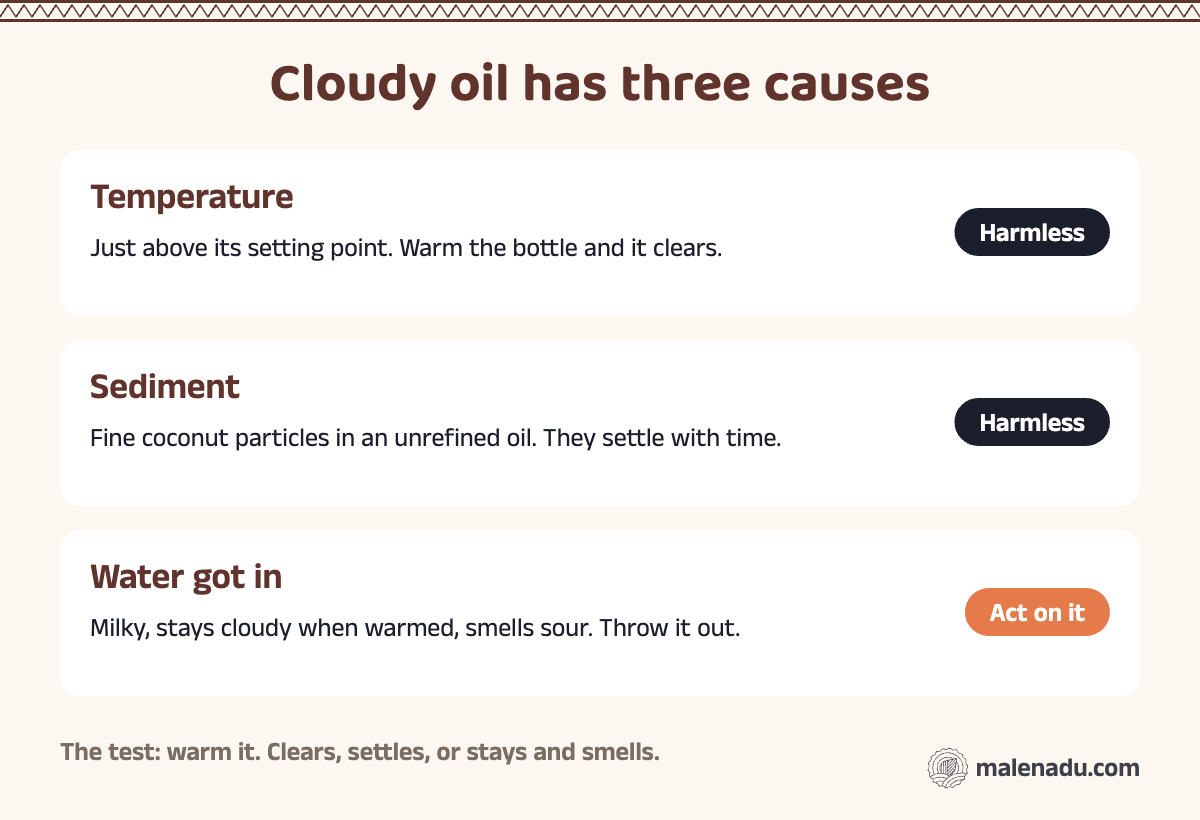
Cloudiness has three possible causes. Only one of them is a problem.
The first and most common is temperature. Just above its setting point, around 24 to 26 degrees, coconut oil does not go cleanly from clear to solid. It passes through a cloudy stage where some of the fat has started to crystallise and the rest is still liquid. You get a milky haze. Or white flecks and threads hanging in clear oil. Or a soft white layer at the bottom with liquid above. This is the same thing as going solid, caught halfway. Warm the bottle a little and it clears. Cool it a little and it sets. It is harmless.
The second is the oil itself. Oil pressed the traditional way and not refined may carry a very small amount of fine coconut particles, which settle slowly to the bottom of the bottle as a pale sediment or a faint haze. This is more visible in a fresh pressing and settles with time. It is the sign of an oil that has not been filtered to death. It does no harm. Leave the sediment at the bottom or shake it in, as you like.
The third is water. This one matters. If water has got into the oil, from a wet spoon, a drop of rain on the lid or a bottle left open in the monsoon, the oil will go cloudy in a different way, a milky, uneven cloudiness that does not clear when you warm it, often with a sour smell and sometimes with mould on the surface. Water lets microbes grow in a fat that would otherwise keep for a year. This is the one cloudiness to act on. Throw the oil out and start a new bottle with a dry spoon.
The way to tell them apart is simple. It is the same test as for why does coconut oil go solid. Warm the bottle in your hands or in warm water. Temperature cloudiness clears. Sediment settles. Water cloudiness stays. And it smells.
The other everyday questions
Once the three big ones are answered, starting with why does coconut oil go solid, the smaller ones come quickly.
Why is there a white layer at the bottom and clear oil on top? The same reason as why does coconut oil go solid. Partial setting. The denser fraction has started to crystallise and sunk. Warm and shake. Or just use it as it is.
Why does the colour change from bottle to bottle? Copra that was dried more or toasted a little in the drying gives a deeper, more golden oil. Paler copra gives a water-white oil. Both are normal. A very dark oil with a burnt smell is from copra that was overheated and is not what you want.
Why does it froth when I fry with it? A little froth when the oil first heats is moisture from the food cooking off, with sometimes a trace from the oil. It settles in a few seconds. Heavy, persistent foaming is a sign of old oil that has been reused too many times.
Can I deep fry with it? Yes. Unrefined coconut oil has a smoke point around 175 to 180 degrees, which is enough for chakkuli, banana chips and pakoda. It is the traditional frying oil of the whole Karnataka coast and the Malenadu hills. Do not let it smoke. If it smokes, the pan was too hot.
Does it need to be refrigerated? No. The answer to why does coconut oil go solid tells you why. It will set in the fridge for no gain. A cool, dry cupboard away from the stove is right. The fridge turns it into a block you have to chip at, for no benefit.
How long does it keep? Unopened, well over a year. Opened and kept dry, most of a year. The enemies are water, heat and light, in that order. A dry spoon, a closed lid and a shelf out of the sun are the whole storage rule.
Why does my grandmother’s oil taste different from the shop bottle? Because hers was pressed from copra she dried herself, in a ghani or a village mill. It never saw a refinery. The shop bottle, unless it says wood pressed or cold pressed and means it, has been refined and deodorised. They are different products with the same name.
Is the smell going to come through in everything I cook? In some things, yes. That is the point. A dosa, a fish fry, an upma or a chutney tadka made in coconut oil is meant to taste of it. For a dish where you do not want coconut in the flavour, use ghee or a neutral oil. We keep both. Desi cow ghee for the dishes where ghee shows, coconut oil for the rest.
Can I use the same oil for hair? Many homes do, from the same bottle. It is what coconut oil was used for in Malenadu long before anyone wrote about it. Warm a spoon in your palms, work it into the scalp, leave it an hour and wash. Whether it does anything beyond conditioning the hair and the scalp we would rather not claim. It smells good and it has been done for a very long time.
How wood pressed coconut oil is made and why it does all of the above
Everything in this post, from why does coconut oil go solid to why it smells, comes back to one thing. The quirks of coconut oil, the setting, the smell, the haze, are the quirks of an oil that has not been refined. So it is worth knowing what unrefined actually means.
Coconuts are husked, split and the white kernel is dried in the sun over several days until it becomes copra, hard and a little translucent. The copra is broken up and fed into a ghani, a wooden press in which a heavy wooden pestle turns slowly inside a wooden mortar, crushing the copra and squeezing the oil out. The wood keeps the pressing cool and slow, which is why the aroma survives. The oil runs out, is left to stand so that the solids settle and is bottled. That is the whole process. No solvent, no heat beyond what the pressing makes, no bleaching, no deodorising.
Our wood pressed coconut oil is made this way from sun-dried copra grown by farmers in Malenadu. It goes solid in the cold, it smells of coconut and a fresh bottle may carry a little haze. If it did none of those things we would be worried about it.
A refined oil starts the same way but then goes through a refinery. The crude oil is treated to remove free fatty acids, bleached with clay to remove colour and deodorised with steam at well over 200 degrees to remove smell and taste. The result keeps longer on a shelf and tastes of nothing. That is the oil most people in cities grew up with, which is why the real thing surprises them.
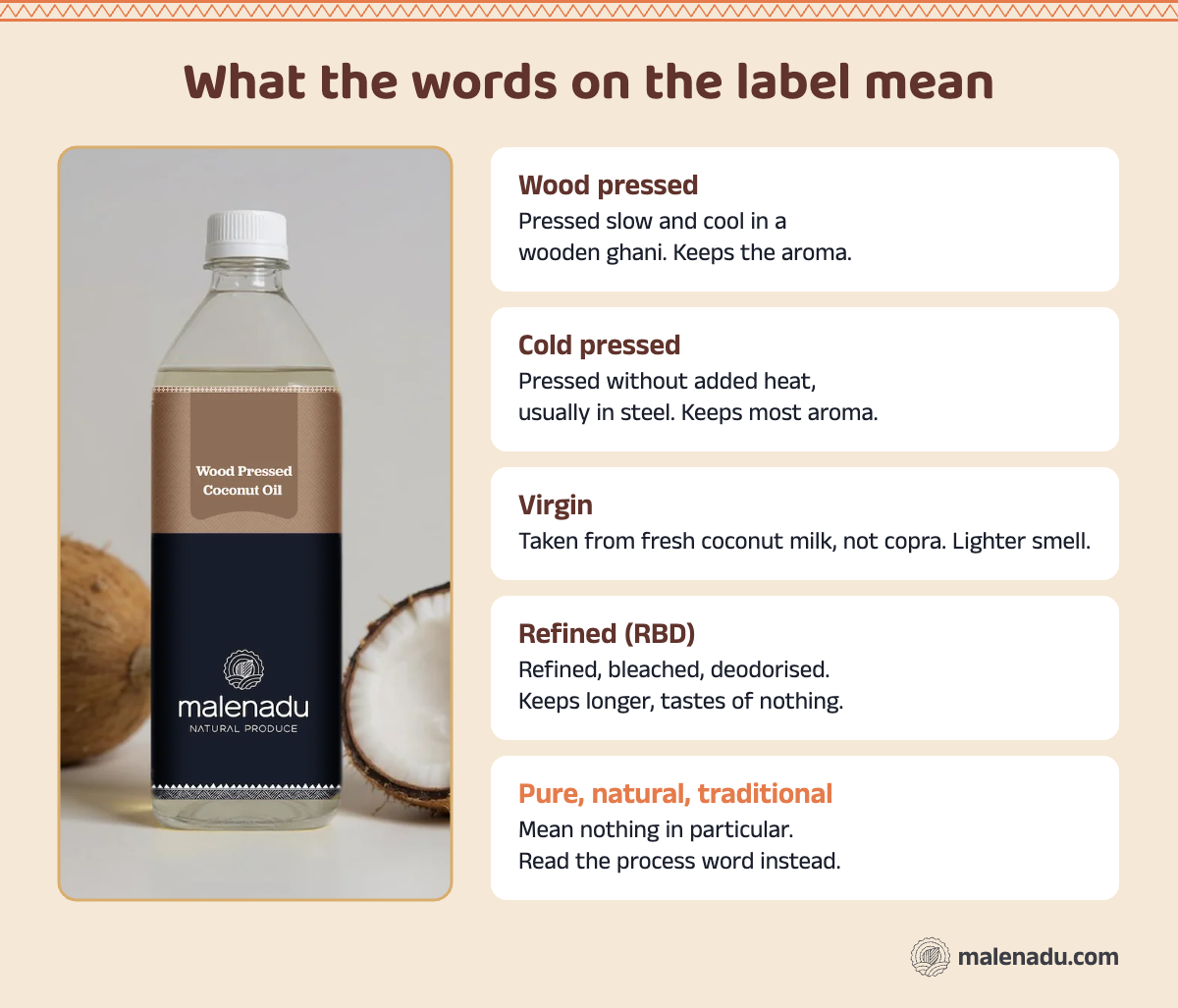
The words on the label matter here. Cold pressed means pressed without added heat, usually in a steel expeller. It keeps most of the aroma. Wood pressed means pressed in a wooden ghani, slower and cooler still. Virgin coconut oil, properly used, means oil taken from fresh coconut milk rather than copra, with a lighter, fresher smell. Refined (RBD) means refined, bleached and deodorised. Pure, natural and traditional mean nothing in particular and are used on every kind of bottle. Read the process word, not the adjectives.
When to actually worry
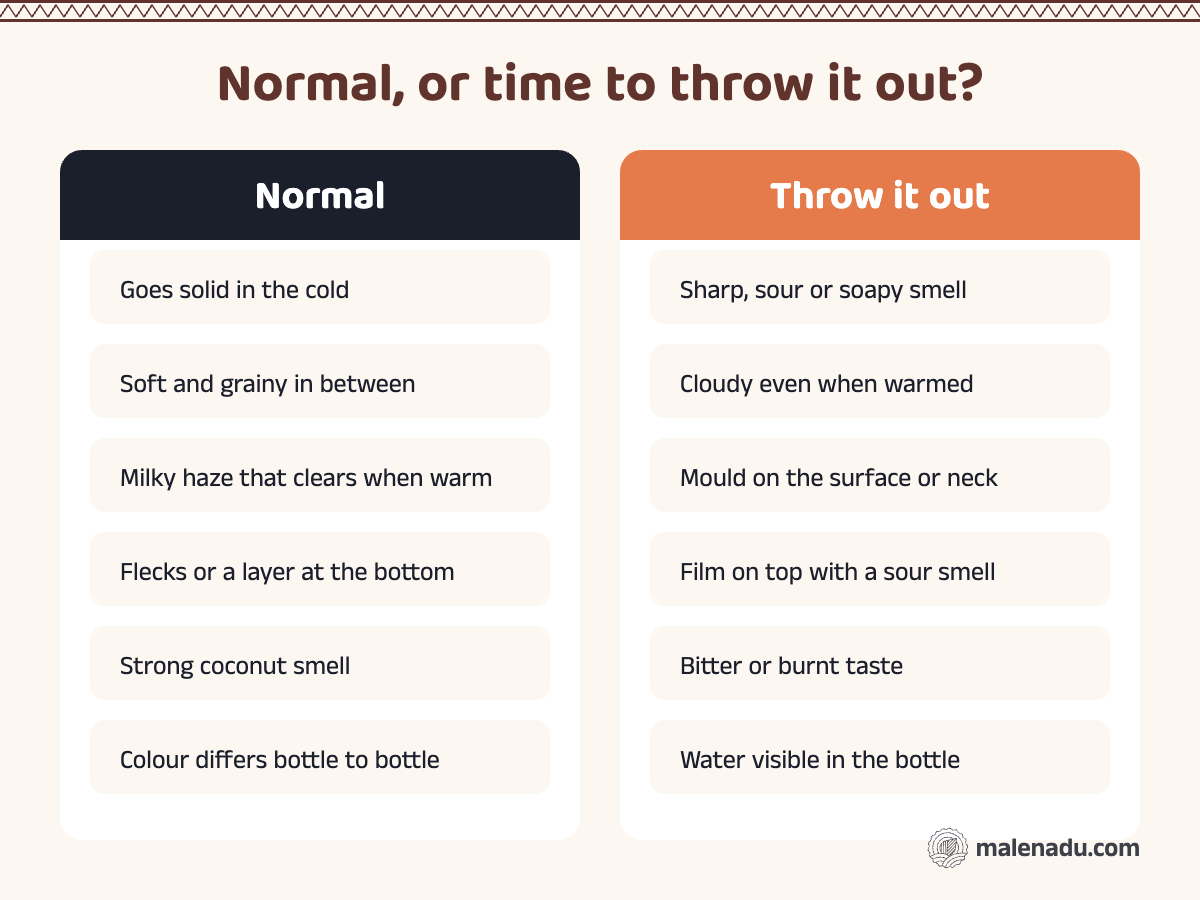
Having answered why does coconut oil go solid and the rest, with most of what it does being normal, here is the short list of things that are not.
A sharp, sour, paint-like or soapy smell means the oil has gone rancid. It will not make you ill in small amounts but it tastes bad and it is time to replace it.
Cloudiness that does not clear with warmth, especially with a sour smell or a film on the surface, means water got in and the oil is spoiling. Throw it away.
Mould of any kind, which looks like grey or green spots on the surface or around the neck of the bottle, means the same. Throw it away and wash the bottle in hot water before reusing it.
A bitter taste or a burnt smell in the oil means the copra was scorched in drying or the oil was overheated. It is not dangerous, but it is not good oil.
Everything else, the setting, the softening, the haze, the flecks, the layer at the bottom, the strong smell, the change in colour between bottles, is the oil being itself.
How to store it so it behaves
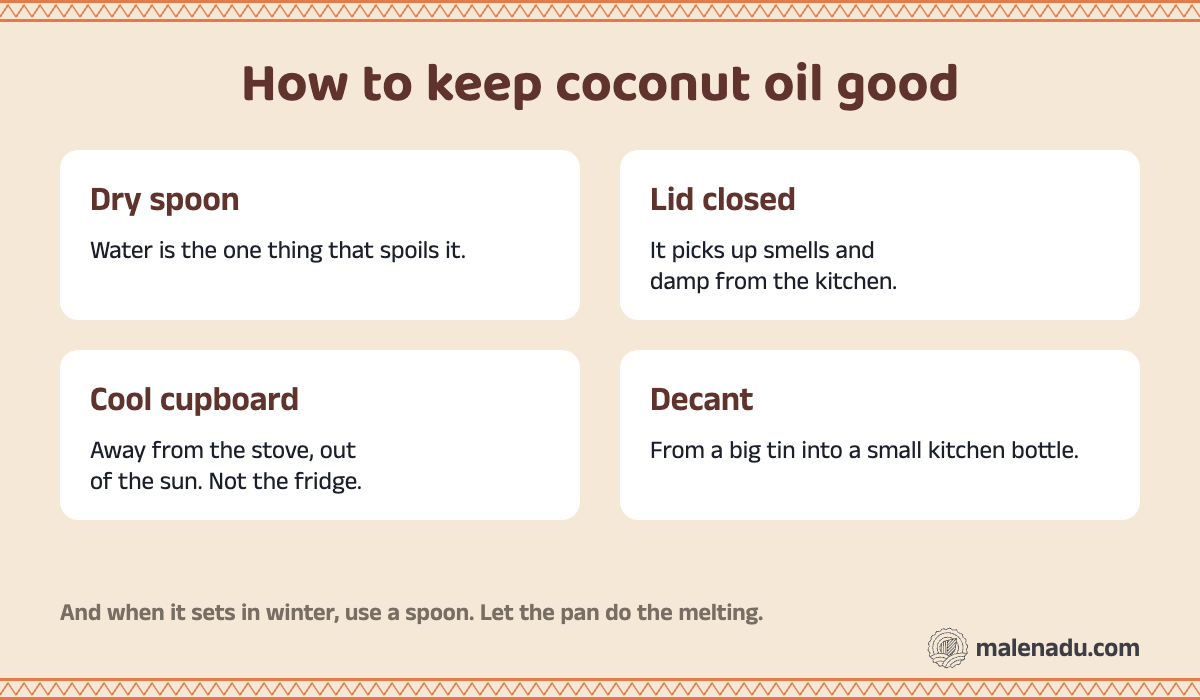
Keep the bottle closed and the spoon dry. That is nearly the whole of it. Why does coconut oil go solid, smell and cloud is answered above. How to keep it good is answered here.
Store it in a cool cupboard away from the stove and out of sunlight. Heat and light age an oil faster than anything else. Do not store it in the fridge. Use a clean, dry spoon every time. Never let a wet spoon or a drop of water into the bottle. In the monsoon, when everything in a Malenadu kitchen is damp, this matters most. Wipe the neck of the bottle before you close it.
If you buy a large tin, decant a month’s worth into a small bottle for the kitchen and keep the tin closed. The less often the main container is opened, the longer it keeps.
And when winter comes and you find yourself asking again why does coconut oil go solid, do not fight it. Keep a small spoon beside the dabba, scoop what you need and let the pan do the melting. That is how it has always been done here.
Frequently asked questions
Why does coconut oil go solid in winter?
Because it is mostly saturated fat with a melting point of about 24 to 25 degrees Celsius. Below that it sets, the way ghee does. It is completely normal and the oil is not spoiled. Warm the bottle in warm water or use it with a spoon.
Is it safe to use coconut oil that has gone solid?
Yes. Once you know why does coconut oil go solid, the worry goes. Solid coconut oil is the same oil at a lower temperature. Scoop it out and it melts in the pan. It can set and melt any number of times without harm.
Why does my coconut oil smell so strong?
Because it has not been refined. Unrefined coconut oil carries the natural aroma of the coconut and the copra. A strong, sweet, nutty coconut smell is the sign of a real oil. A sharp, sour or soapy smell is the sign of a rancid one, which is a different thing.
Why does coconut oil turn cloudy?
Usually because it is just above its setting point and has begun to crystallise, which gives a milky haze or white flecks. Warming clears it. A fresh unrefined oil can also carry a little fine sediment that settles. Cloudiness that will not clear with warmth and smells sour means water has got in. That oil should be thrown out.
Why does some coconut oil stay liquid in the cold?
Either it has been fractionated, which removes the part of the fat that sets. Or it has been blended with another oil. Whole coconut oil always sets below about 24 degrees.
Can I cook and fry with wood pressed coconut oil?
Yes. It has a smoke point around 175 to 180 degrees, enough for everyday frying, tadka and shallow frying. Keep the heat below smoking. It is the traditional cooking oil of coastal and hill Karnataka.
How long does coconut oil last?
Unopened, more than a year. Opened and kept dry, closed and out of the sun, most of a year. Water is the main thing that spoils it, so use a dry spoon.
Should coconut oil be kept in the fridge?
No. A cool cupboard is right. The fridge makes it rock hard for no benefit and does not make it keep meaningfully longer.
One last thought
Most of the questions people ask about coconut oil, why does coconut oil go solid being the most common, are really the same question, which is whether the oil is behaving the way it should. It goes solid because it is a saturated fat. It smells strong because nobody took the smell out. It turns cloudy because it is on its way to setting or because it has not been filtered into nothing. Those are not faults. They are the signs of an oil that was pressed from copra and bottled. Nothing more.
Keep the spoon dry, keep the lid closed, keep it out of the sun. Let the weather do what it likes to the bottle. Our wood pressed coconut oil is made the slow way from sun-dried Malenadu copra and will do all three of the things in the title. Everything else in the oil and ghee section is made with the same patience.