
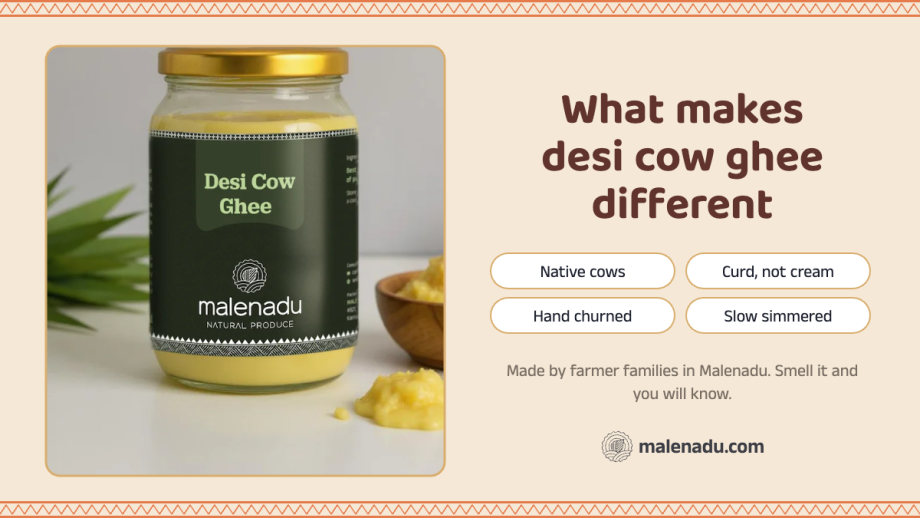
Open a jar of desi cow ghee that was made the old way and the first thing you notice is not the taste. It is the smell. A warm, slightly nutty, slightly sour smell that fills the kitchen before the spoon has reached the rice. People who grew up with it know it in a second. People who grew up on dairy ghee from a tin often do not know what they have been missing until the first dosa.
Every brand on the shelf now calls its ghee desi. The word has been used so loosely that it has stopped meaning anything on a label. So this post is about what desi cow ghee actually is, how farmer families in Malenadu make it, why that process gives it a smell, a grain and a taste that factory ghee does not have and how to tell the real thing from the rest when you are standing in a shop.
We sell desi cow ghee, so we have an interest. We have tried to write this the way we would explain it to a cousin who asked, with the things we know first hand and without the claims we cannot stand behind.
Table of Contents
What desi cow ghee actually means
Two words in the name do the work. Desi and cow.
Cow is the easy one. Most ghee sold in India is made from buffalo milk or from a mix, because buffalo milk has more fat and gives more ghee per litre. Buffalo ghee is white and has a heavier, flatter taste. Cow ghee is yellow, lighter and has more aroma. The yellow comes from the carotene in the grass the cow eats, which is why ghee from a grazing cow is deeper in colour than ghee from a stall-fed one.
Desi is the one that gets stretched. In plain use it means native, from here, as opposed to the crossbred or exotic dairy breeds that give far more milk. In our part of Karnataka the native breed is the Malnad Gidda, a small, hardy hill cow that gives very little milk by commercial standards, a couple of litres a day at best. It grazes on the forest edge and the paddy bunds rather than living in a shed.
Other desi breeds you will hear of are Gir, Hallikar and Kangayam. Our desi cow ghee comes from the milk of these native cows, kept by farmer families in Malenadu, not from a dairy.
You will often see the milk of native breeds described as A2 milk and a lot of health claims are hung on that. We would rather not lean on them. Buy desi cow ghee because of how it is made and how it tastes. If the A2 story turns out to be as good as some people say, that is a bonus.
How farmer families make it
This is the part that makes the difference, so it is worth going slowly.
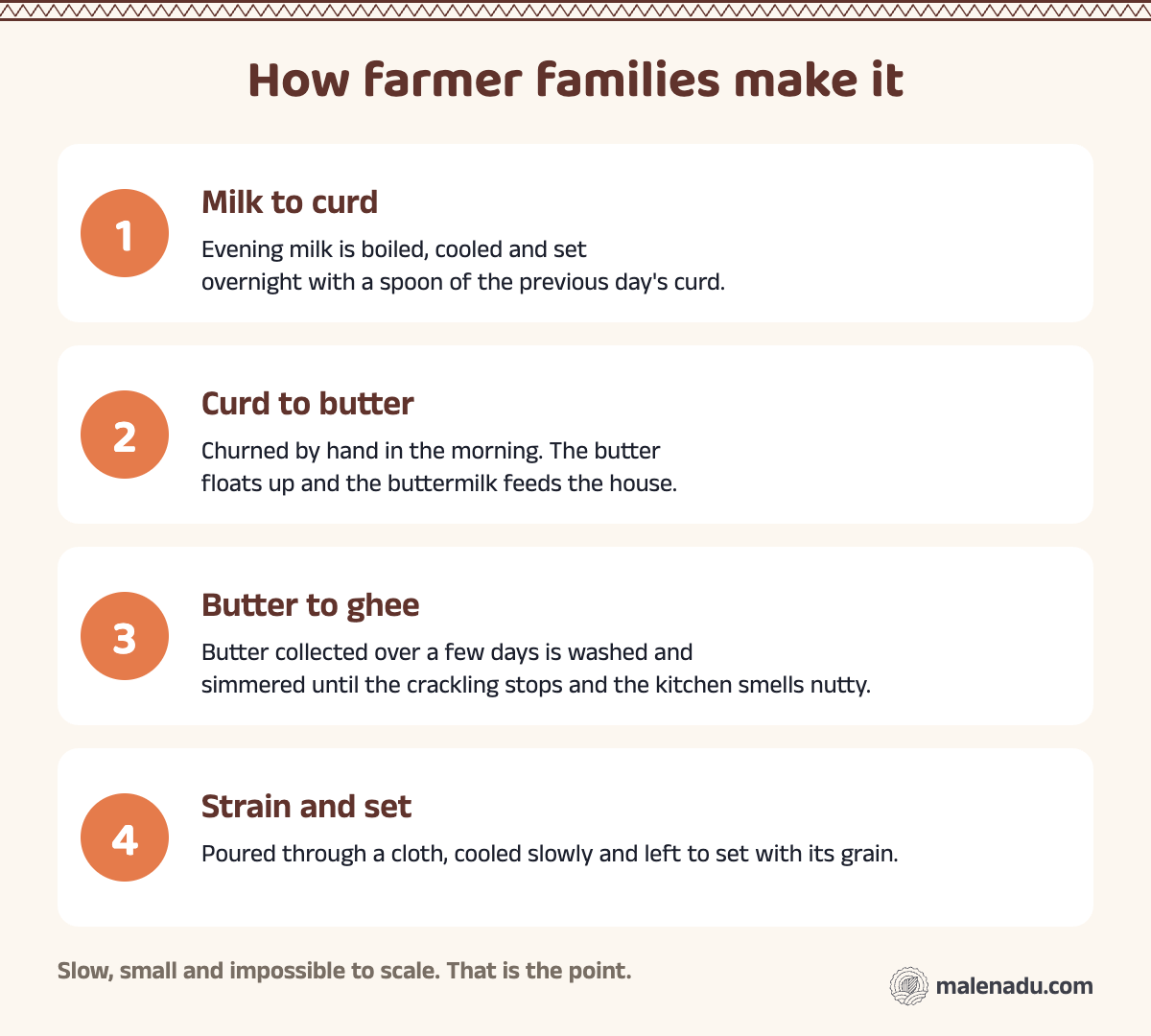
Milk to curd. The evening milk is boiled, cooled and set with a spoon of the previous day’s curd. Overnight it turns into thick, mildly sour curd. This step is the one most ghee makers skip. It is also the one that gives desi cow ghee its character. Fermentation changes the fat. It develops the aroma compounds that you later smell in the finished ghee. Ghee made directly from cream or from factory butter never goes through this step, which is why it smells of not much.
Curd to butter. In the morning the curd is churned by hand with a wooden churner, the mathu or the taller kadagolu, pulled back and forth with a rope. It takes a while. The butter, the benne, slowly separates and floats up and is lifted out by hand. What is left is buttermilk, majjige, which goes into the kitchen for the day’s saaru and into a glass with a pinch of salt and curry leaves for whoever is passing. Nothing is wasted.
Butter to ghee. The fresh butter is collected over a few days, because a Malnad Gidda does not give enough milk for a batch of ghee in one morning. Then it is washed, put in a heavy vessel and simmered gently. The water in the butter boils off, the milk solids sink and turn golden brown and the clear fat on top is the ghee.
The lady of the house knows it is ready by the smell and by the sound. When the crackling stops and the kitchen smells nutty, the vessel comes off the heat. The ghee is poured through a cloth, the browned solids at the bottom are scraped out for the children and the ghee is left to cool and set.
This is the method people call bilona, after the churning. It is slow and it does not scale, which is exactly why big brands do not use it. For a dairy, it is far cheaper to separate cream from milk in a centrifuge, turn the cream into butter and boil that into ghee in a few hours. The result is a clean, pale product that is technically ghee and tastes of very little.
Our ghee is made the first way, by farmer families in their own homes and collected from them. That is the whole supply chain. It is also why we sometimes run short.
Why that process changes the ghee
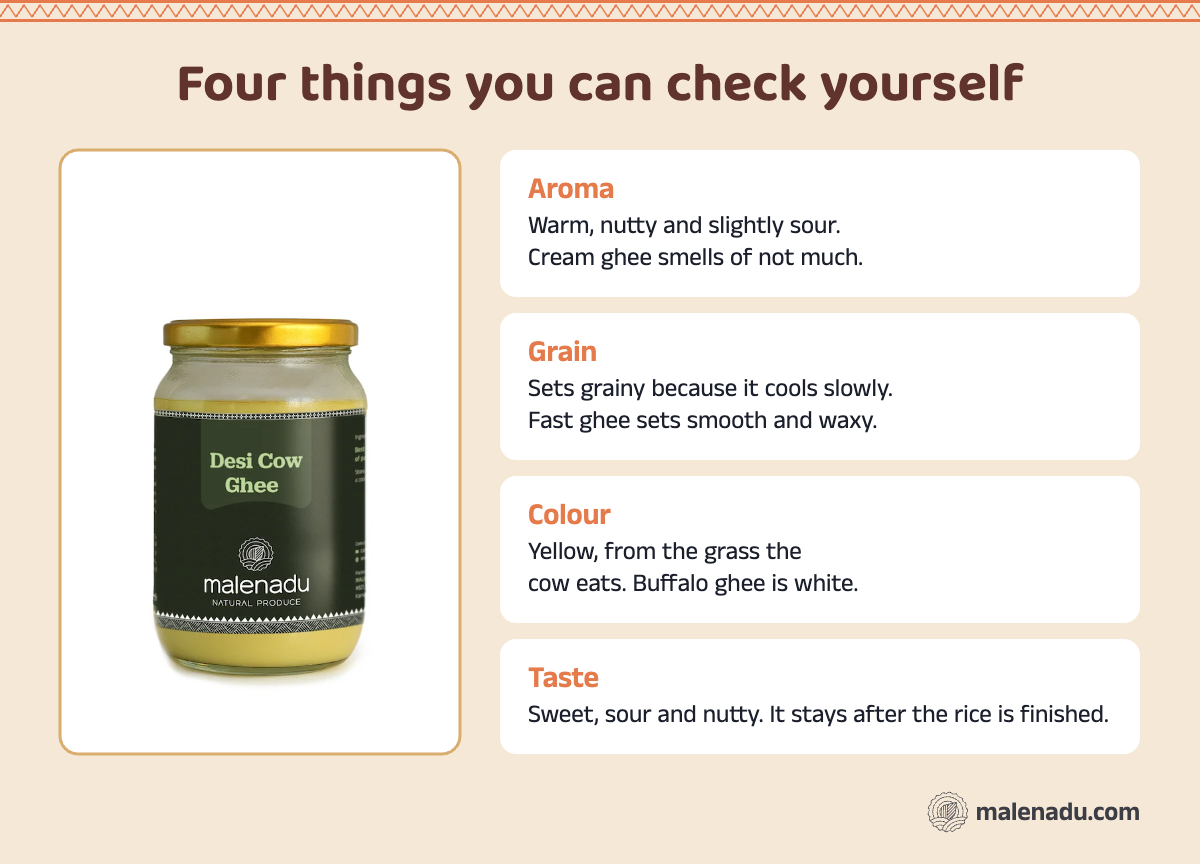
It is fair to ask whether all that effort shows up in the jar. It does, in four ways you can check yourself.
Aroma. Fermented curd gives the ghee a smell that cream ghee cannot have. Open both jars side by side and the difference is obvious within a second. Desi cow ghee smells warm and slightly sour and nutty. Cream ghee smells faintly of butter and not much else.
Grain. Properly made desi cow ghee sets with a grainy texture, which people describe as danedar. The grains form as the ghee cools slowly after simmering. Ghee that is boiled fast or cooled fast sets smooth and waxy. Grain is not a guarantee of quality on its own, but a complete absence of grain in a jar that claims to be hand made is a question worth asking.
Colour. Cow ghee is yellow. Ghee from a grazing cow is deeper yellow than ghee from a stall-fed one. Buffalo ghee is white. A pure white ghee labelled cow ghee is either from a cow that has never seen grass or is not entirely cow.
Taste and after taste. Desi cow ghee tastes of more than fat. There is a sweetness from the browned milk solids, a sourness from the curd and a nuttiness that stays in the mouth after the rice is finished. Factory ghee tastes clean and disappears.
There is one more difference that does not show up in the jar but shows up in the village. Making ghee from curd keeps the buttermilk, which is food. Separating cream in a machine throws the skimmed milk into the dairy chain and the family sees none of it. The old method feeds a household. The new one feeds a balance sheet.
What desi cow ghee is good for in the kitchen
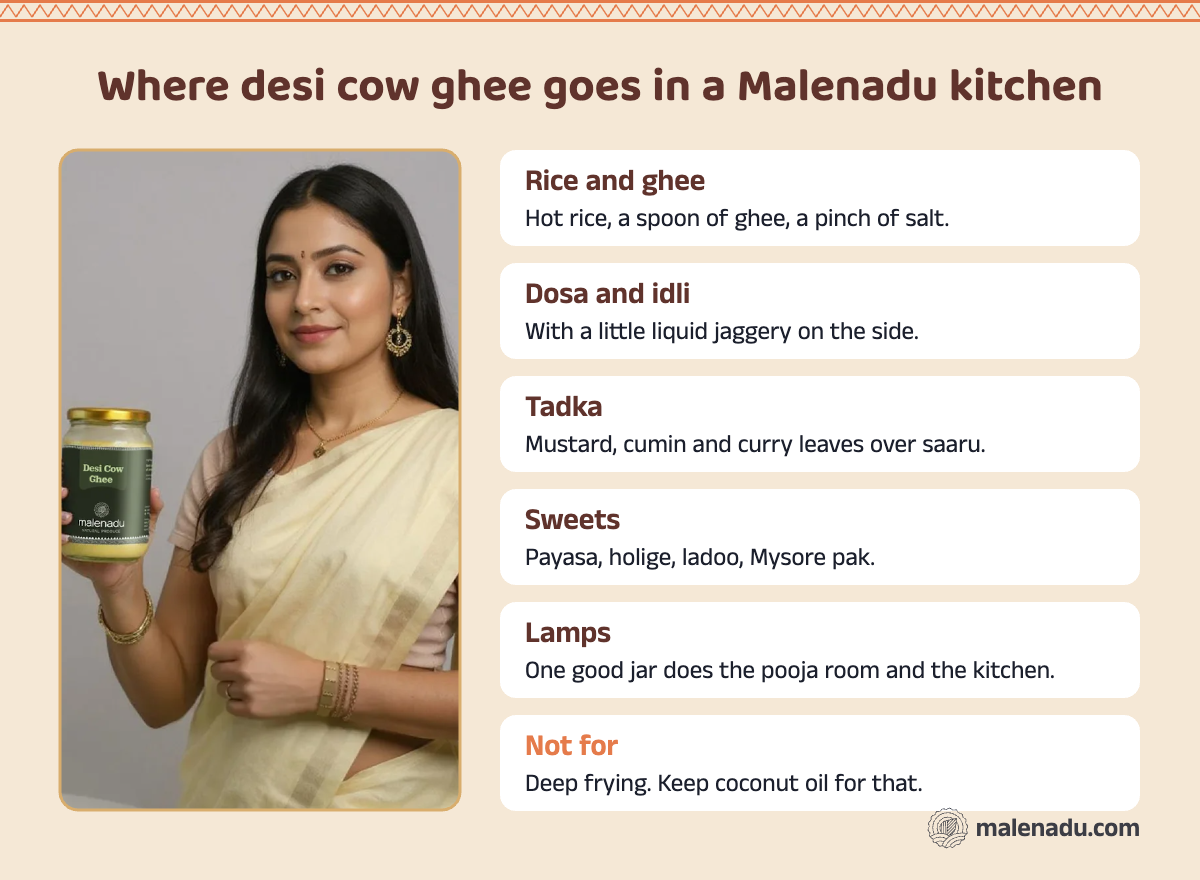
In a Malenadu home, ghee is not a special ingredient. It is on the table every day in small amounts. It goes into a surprising range of things.
Rice and ghee. The first spoon of hot rice with a spoon of ghee and a pinch of salt, before the saaru goes on. Children are started on it. Elders end their meals with it. When guests come, the ghee bowl goes round the table before anything else. How generously it is poured says more about the welcome than any words do.
Dosa, idli and chapati. A smear of ghee on a hot dosa with a little liquid jaggery on the side is one of the oldest breakfasts in the region. Ghee on idli instead of oil. Ghee folded into the dough for a softer chapati.
Tadka and frying. Desi cow ghee has a high smoke point, well above most cooking oils, so it is good for the final tempering of mustard, cumin and curry leaves over a dal or a saaru. It is also what makes a good upma, a good pongal and a good kesari bath taste the way they should.
Sweets. Payasa, holige, obbattu, ladoo, Mysore pak, halwa. There is no replacing ghee in these. A sweet made with vanaspati or refined oil instead of ghee tastes like a photocopy. Our own coconut jaggery burfi is finished with ghee for this reason.
Lamps. At Deepavali and on every festival day, ghee lamps are lit in the pooja room. Ghee burns cleaner than oil, with less smoke and a steadier flame. The smell of a ghee lamp is part of the festival for most Kannadiga homes. If you are buying ghee for the lamps as well as the kitchen, buy one jar for both. There is no need for a separate, cheaper ghee for the lamps. A good one burns better anyway.
With honey. Ghee and honey together on a hot chapati or a piece of bread is a treat children ask for and elders remember. Add the honey after the chapati is on the plate, not in the pan.
Everything else. A spoon in the morning coffee for those who like it. A little rubbed on cracked heels and dry lips in winter. A spoonful in warm milk at night. None of these need a doctor’s note. None of them should be taken as medicine either.
How to tell a good ghee from the rest

Every post on ghee has a list of home tests. Most of them are more folklore than science. Here is what we think is worth doing and what is not.
Smell it first. This is the test that actually works. Good desi cow ghee smells warm, nutty and slightly sour. A ghee that smells of nothing has been made from cream or has been deodorised. A ghee that smells sharp or rancid has gone off. A ghee that smells of nothing and then tastes faintly of coconut or vegetable oil has been cut with something.
Look at the texture at room temperature. In most Indian weather, desi cow ghee sits as a soft, grainy semi-solid. In the cold it goes firm. In the heat it goes liquid with grains at the bottom. All of that is normal and changes through the year. A ghee that stays perfectly smooth and uniform in every season, like a spread, is behaving more like a hydrogenated fat than like ghee.
The palm test. Rub a little between your fingers or on your palm. Pure ghee melts almost at once from body heat and leaves no greasy film. Vanaspati or a blend stays waxy and sticky. This one is simple and reasonably reliable.
The fridge test, with a caution. Put a spoon of ghee in a glass and refrigerate it. Pure ghee sets in one even layer. A ghee cut with another oil will often separate into layers because the fats set at different temperatures. It works for crude adulteration, but it will not catch everything, so do not treat a clean result as proof of purity.
Read the label, properly. The ingredient line should say cow milk ghee or cow ghee and nothing else. If you see vegetable fat, vanaspati, blended, “ghee flavour” or a long list, it is not what you want. Look at the net weight and the price together. Ghee takes roughly twenty litres of milk per litre of ghee from a native cow. A Malnad Gidda gives only a couple of litres a day. A very cheap desi cow ghee is cheap for a reason.
Ask who made it. The best check of all is one no test can do. Ask where the milk came from and who churned it. A seller who knows the farmer families will tell you. A seller who does not will change the subject.
How to store it
Desi cow ghee does not need a fridge. Keep it in a clean, dry, airtight jar in a cupboard away from the stove and direct sunlight. The two rules are simple. Always use a dry spoon, because a drop of water in the jar is the fastest way to spoil ghee. Always close the lid, because ghee picks up smells from the kitchen.
Kept this way, ghee lasts for months and its flavour deepens a little with age. Old ghee, kept for a year or more, has its own uses in traditional homes and is prized rather than thrown away. If your ghee ever smells sharp or sour in a bad way or has gone cloudy with a strange colour, that is the time to let it go.
In older Malenadu homes the ghee lived in a small steel or brass dabba with a tight lid, kept on the highest shelf where the children could not reach it and the heat of the stove did not. That is still the best place for it. Glass is fine too, as long as it is out of the sun.
The grain and the colour will change with the season. Firmer and paler in December, softer and more yellow in May. That is the sign of a real fat that has not been standardised, not a fault.
Where desi cow ghee does not belong
Being honest means saying this too. Ghee is a fat. It is a good fat, in our view, but it is still mostly saturated fat and a spoon of it carries the calories of a spoon of any other fat. Anyone who has been told to watch their fat intake or their cholesterol should follow that advice and treat ghee as the small daily pleasure it was always meant to be, not as a supplement. A spoon or two a day on rice and dosa is how it was eaten for centuries. A bottle a week is not.
It is also not a cure. Ghee has a long place in Ayurveda and in home remedies. We respect that. But we would rather not make health claims we cannot show and we would be suspicious of any seller who does. Buy desi cow ghee because it is the best tasting fat you can put on a dosa and because the money reaches a farmer family. Those are reasons enough.
And it is not a frying oil for every day. A good ghee is too precious and too dear to deep fry pakoda in. Keep the wood pressed coconut oil for the daily cooking and the ghee for the dishes where it shows.
Frequently asked questions about desi cow ghee
What is the difference between desi cow ghee and normal ghee?
Normal dairy ghee is usually made from buffalo milk or a mix, by separating cream in a machine and boiling it. Desi cow ghee is made from the milk of native cow breeds, set into curd, hand churned to butter and then simmered. The curd step gives it the aroma, grain and taste that dairy ghee does not have.
What is the bilona method?
Bilona is the name for the traditional way of making ghee from curd rather than cream. Milk is set into curd, the curd is churned by hand to separate butter and the butter is simmered into ghee. The word comes from the churning. It is slow and gives a small yield, which is why most brands do not use it.
Which cow breeds count as desi?
Native Indian breeds that have not been crossed with exotic dairy cattle. In Malenadu the local breed is the Malnad Gidda, a small hill cow. Gir, Hallikar and Kangayam are others you will hear of. These cows give far less milk than crossbreeds, which is one reason real desi cow ghee costs more.
Why is desi cow ghee yellow and buffalo ghee white?
The yellow comes from carotene in the grass the cow eats, which passes into the milk fat. Buffalo milk does not carry carotene the same way, so buffalo ghee sets white. A grazing cow gives a deeper yellow ghee than a stall-fed one.
Why does my ghee have grains in it?
Grain forms when ghee cools slowly after simmering and is a normal sign of ghee made the traditional way. The amount of grain changes with the weather. It is not a fault and it does not mean the ghee has spoiled.
Does desi cow ghee need to be refrigerated?
No. Keep it in a clean, dry, airtight jar in a cupboard away from heat and sunlight. Always use a dry spoon. Kept this way it lasts for months. Refrigerating it does no harm but makes it hard and is not needed.
How much ghee a day is reasonable?
Traditionally a spoon or two with meals. Ghee is a fat, so it carries the calories of any fat. Anyone with medical advice on fat intake should follow it. Think of desi cow ghee as a daily pleasure in small amounts, not as a health product to be taken by the spoonful.
Can I use desi cow ghee for Deepavali lamps?
Yes. It burns better than cheap lamp ghee or oil, with a steady flame and little smoke. There is no need to buy a separate ghee for the pooja room. One good jar does the lamps and the kitchen.
One last thought
Most of what makes desi cow ghee different cannot be printed on a label. It is a cow that grazes instead of standing in a shed, a pot of curd set overnight, a rope churner pulled back and forth in the morning and a vessel watched until the crackling stops. None of that is efficient. All of it ends up in the jar.
If you have only ever had ghee from a tin, buy one jar of the real thing and put it on hot rice with a pinch of salt. You will understand the rest of this post in one spoon.
Our desi cow ghee is hand churned by farmer families in Malenadu from the milk of native cows and we sell it while the batch lasts. Everything else in the oil and ghee section is made with the same patience.