
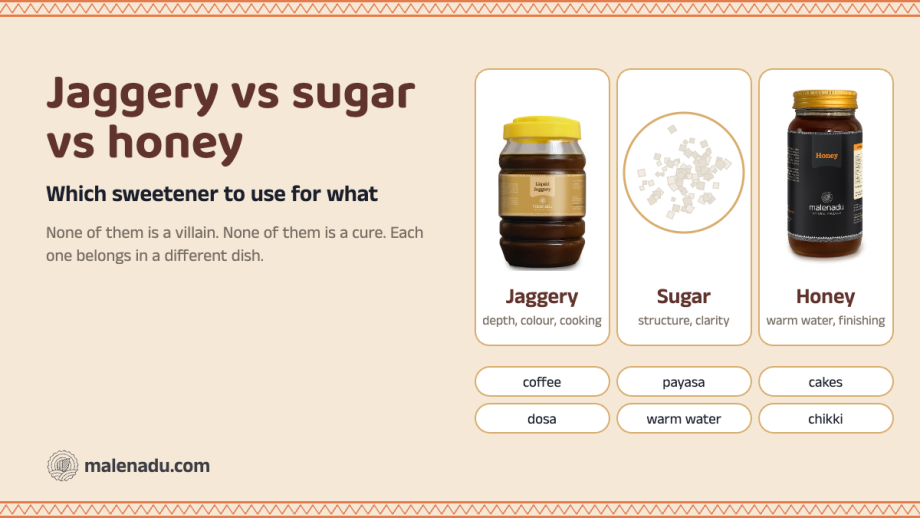
Walk into any kitchen in Karnataka and you will find at least two of these three on the shelf. A dabba of sugar for the guests’ coffee. A jar of jaggery, solid or liquid, for the payasa and the coffee the family actually drinks. And a bottle of honey somewhere near the back, brought by a relative, used for a sore throat and otherwise forgotten. The jaggery vs sugar vs honey question comes up every time someone in the house decides to eat a little better and the usual answer online is a ranking. Honey wins or jaggery wins. Sugar loses.
That answer is not very useful in a kitchen. Sugar does things in a cake that jaggery cannot. Jaggery does things in a payasa that honey cannot. And honey does things in a glass of warm water on a cold Malenadu morning that neither of the other two comes close to. The honest version of jaggery vs sugar vs honey is not which one is best but which one belongs in which dish and which habit.
We make liquid jaggery and we collect honey, so we have a view. We have tried to keep that view honest below. Where sugar is the right choice, we say so.
Table of Contents
Where the three sweeteners come from
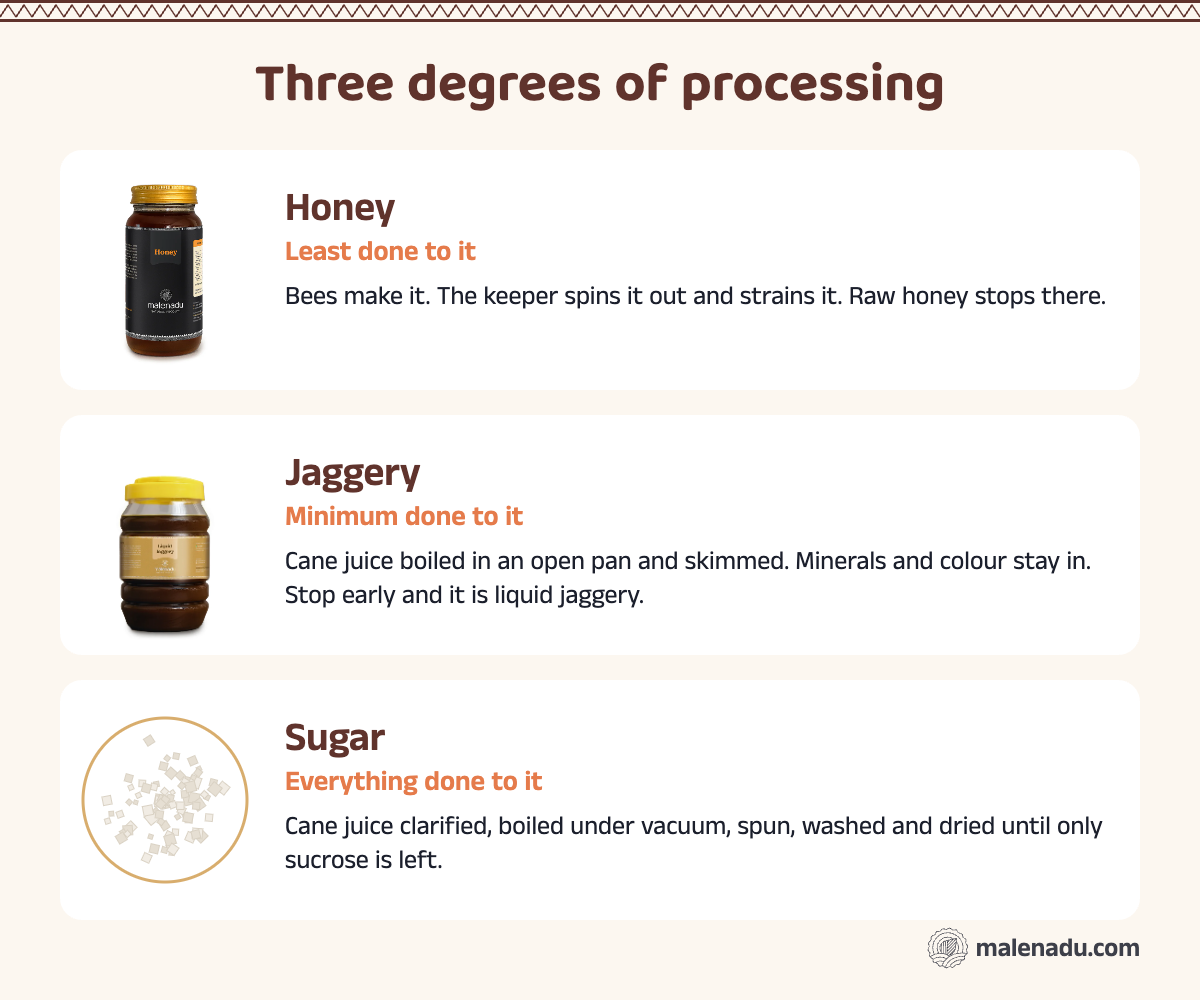
The jaggery vs sugar vs honey comparison starts with how each one is made, because the process explains almost everything else about them.
Sugar starts as sugarcane juice (beet juice in colder countries). The juice is clarified with lime and sulphur dioxide or phosphoric acid, boiled under vacuum until crystals form, spun in a centrifuge to throw off the molasses and then washed and dried. What is left is sucrose, about 99.9 per cent pure.
Everything else that was in the cane, the minerals, the plant colour, the slightly bitter notes, has been deliberately removed. That is why sugar is white, why it tastes of nothing but sweetness and why it keeps for years.
Jaggery starts from the same cane juice and stops much earlier. The juice is boiled in open pans, the scum is skimmed off and the thickened syrup is either poured into moulds to set as solid bella or stopped a little earlier and bottled as liquid jaggery, which we call joni bella in Malenadu. Nothing is spun off. The molasses, the minerals and the colour all stay in. That is why jaggery is brown, why it tastes of caramel and earth as well as sweetness and why two batches from two farms never taste quite the same.
Our liquid jaggery is made from cane grown on our member farms in the Ghats, boiled down the traditional way without whitening agents. The colour is dark because it has not been bleached. More on that below, because colour is one of the ways to tell good jaggery from bad.
Honey is not made by people at all. Bees collect nectar, which is mostly sucrose and water. In the hive they break the sucrose into glucose and fructose and fan it until most of the water has gone.
A beekeeper then takes the frames, spins or presses out the honey and strains it. If the honey is sold raw, that is the whole process. Our honey is collected in Malenadu and tastes of the flowers the bees were working, not of sugar.
So the jaggery vs sugar vs honey line-up is really three different degrees of processing. Honey is a natural product with the least done to it. Jaggery is a cane product with the minimum done to it. Sugar is a cane product with everything done to it.
What is actually in them
Here the jaggery vs sugar vs honey answer disappoints people who want a magic sweetener. All three are mostly sugar.
Sugar is sucrose and nothing else. Jaggery is roughly two thirds to four fifths sucrose, with a little glucose and fructose, some moisture and a small amount of the minerals that were in the cane, mainly potassium, with some iron, magnesium and calcium. Honey is about four fifths sugar, mostly fructose and glucose in nearly equal amounts, with the rest being water and a trace of enzymes, pollen and plant compounds.
Calorie for calorie they are close. A spoon of jaggery and a spoon of sugar give you about the same energy. A spoon of honey gives a little less, because honey is heavier and sweeter so you use less of it and because part of it is water.
The minerals in jaggery are real but they are small. A teaspoon of jaggery in your coffee is not a mineral supplement. If you eat jaggery the way people in Malenadu eat it, a piece with a banana after lunch or a generous spoon of joni bella over hot dosa, the minerals add up to something, but nobody should eat more jaggery for the iron. The right way to think about it is that jaggery gives you sweetness plus a little of what the cane had in it and sugar gives you sweetness and nothing.
Honey has one thing the other two do not. Because it is mostly fructose and glucose rather than sucrose, it tastes sweeter per gram, so you use less for the same effect. It also carries whatever the bees collected, so every honey tastes of the flowers it came from. Raw honey has a little pollen and some enzymes in it too. How much that matters for health is argued about and we would rather not claim more than we can show.
Blood sugar: the part everyone asks about
Every jaggery vs sugar vs honey article has a paragraph on the glycaemic index, usually with different numbers from the one before it. We will keep it simple and honest.
All three raise blood sugar. None of them is a free pass. If a doctor has told you to watch your sugar, that advice covers jaggery and honey as well and anyone managing diabetes should decide with their doctor rather than with a blog post, including this one.
Within that, honey tends to raise blood sugar a little more slowly than sugar because of its fructose content and because you use less of it. Jaggery is close to sugar and some tests put it slightly higher because it is partly broken down into glucose already. The differences are smaller than the marketing suggests. What makes a bigger difference is quantity, what you eat the sweetener with and whether you are having it with a meal or on an empty stomach. A spoon of jaggery in a bowl of ragi ganji is a very different thing from a spoon of jaggery in a glass of water.
If you want a practical rule, use less of whichever one you use and prefer the ones with some flavour of their own, because a sweetener that tastes of something lets you stop at a smaller amount. That is the quiet advantage of jaggery and honey over sugar. A good joni bella is so rich that half a spoon does the job of a full spoon of sugar.
How they behave in cooking
This is where jaggery vs sugar vs honey stops being about health and becomes about results and it is the part most articles skip.
Sugar is predictable. It dissolves clean, it caramelises at a known temperature, it creams with butter to trap air in a cake and it sets at known stages in a syrup. If a recipe depends on sugar’s structure, a sponge cake, a meringue, a clear sugar syrup for jamun, a crisp brittle, sugar is the right choice and swapping it out will change the dish. We have no quarrel with sugar in a jamun syrup.
Jaggery brings moisture, colour and its own flavour. It makes a darker, softer, more fragrant result. In a payasa, an obbattu, a holige stuffing, a nombu kali, a sweet pongal or a jaggery coffee, that is exactly what you want. In a light sponge it is not.
Jaggery also behaves differently depending on its form. Solid bella has to be melted and strained, because there is always a little cane fibre and sometimes a little grit at the bottom. Liquid jaggery skips that step. You pour it, it dissolves, it is done. That is the practical reason liquid jaggery has spread beyond Malenadu kitchens in the last few years. It is bella without the work.
A note on heat. Jaggery can be boiled hard. Our grandmothers reduced it to a string consistency for burfi and to a hard ball for chikki and liquid jaggery can be cooked the same way. Our coconut jaggery burfi is fresh coconut cooked slowly in jaggery and finished with cardamom, which is a fair demonstration of what jaggery does under heat that sugar does not. It browns, it deepens, it tastes of more than sweet.
Honey is the one to add at the end. It is sweeter than the other two, it is liquid, it burns easily and strong heat flattens its flavour, which is the whole reason you bought it.
Honey goes into warm water, not boiling water. It goes over a hot dosa after the dosa is on the plate. It goes into a dressing, a marinade or a glaze where it gets a short time in the pan. It goes into chai once the chai is in the cup. Cooking honey for a long time does not make it dangerous, whatever you may have read, but it does waste it. You are paying for the flavour of the forest. Do not boil it away.
Where each one wins
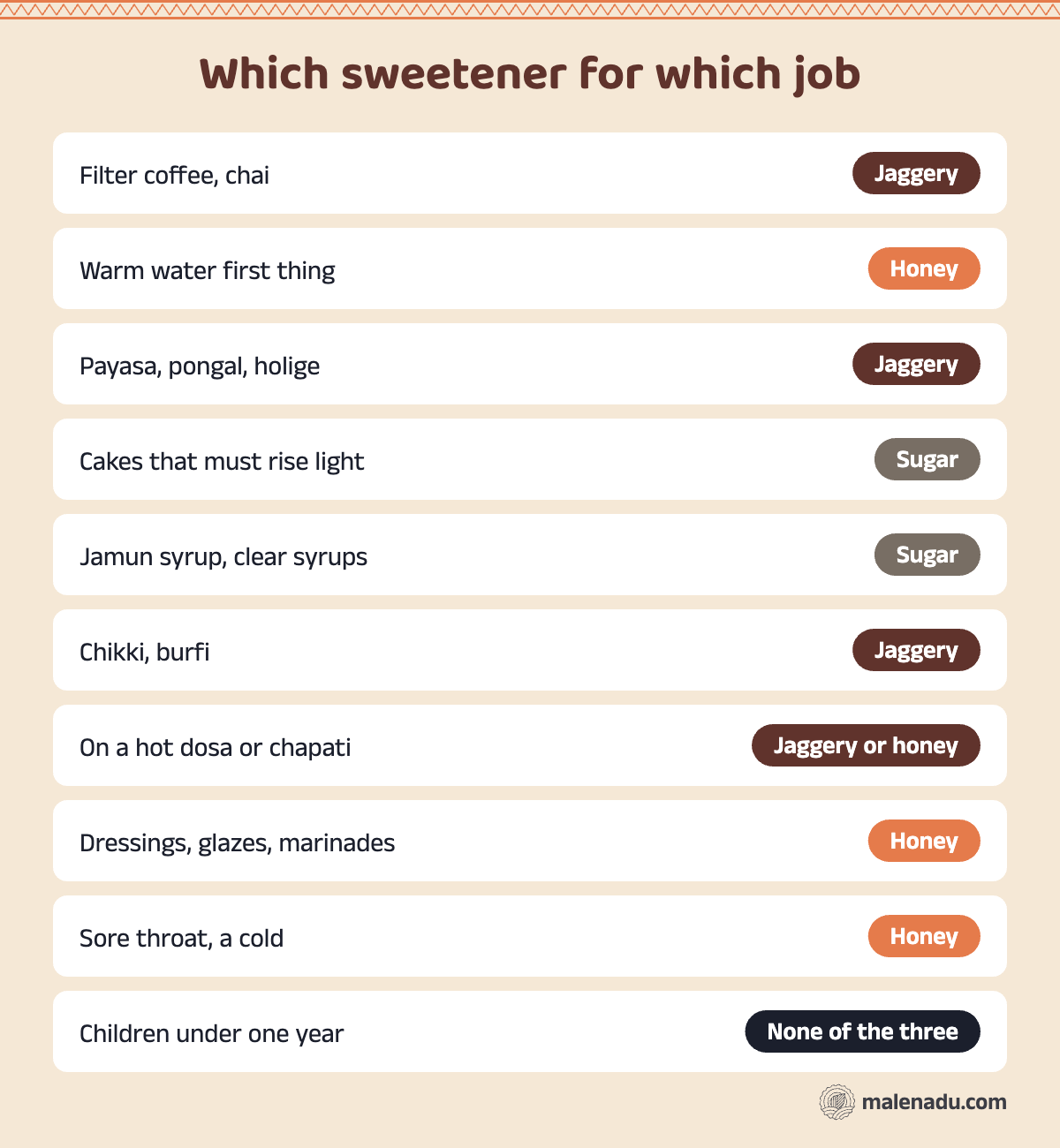
Below is how the jaggery vs sugar vs honey choice plays out in our own kitchens. Not a rule, a habit and one you can argue with.
Morning coffee or chai. Jaggery. A small spoon of liquid jaggery in filter coffee is the Malenadu way and once you are used to it, sugar coffee tastes thin. If you take honey in chai, add it to the cup, not the pan.
Warm water first thing. Honey, a spoon in a glass of warm water, not hot. This is the one habit where honey has no competition. Jaggery water is a different drink, heavier and traditionally taken after a meal rather than before.
Payasa, pongal, holige, obbattu, kadubu. Jaggery, every time. Sugar in a payasa is a sign that somebody ran out of bella. Liquid jaggery makes these faster because there is nothing to melt and strain.
Cakes, biscuits and anything that needs to rise and stay light. Sugar, unless the recipe was written for jaggery. Jaggery cakes are lovely, but they are their own thing, darker and moister. Go in expecting that.
Jamun syrup, clear sugar syrups, candy, brittles. Sugar for anything that must stay clear. Jaggery for chikki and anything where brown is the point.
Dosa, idli, chapati, roti with a sweetener on top. Liquid jaggery or honey, both work. Jaggery with ghee is the older Malenadu habit. Honey with ghee is the one children ask for.
Salad dressings, glazes, marinades. Honey. It emulsifies, it browns quickly under a grill and a little goes a long way.
Sore throat, cough, a cold. Honey, with warm water, ginger or tulsi. Jaggery with black pepper and ginger is the other old remedy and both have more tradition behind them than evidence, so take them as comfort rather than medicine.
Children under one year. None of the three. A baby under one needs no added sweetener, so no sugar, no jaggery and no honey. Honey carries a particular risk on top of that, because raw honey can carry spores that an infant’s gut cannot handle. This is standard advice from every paediatric body, including the NHS. It applies to the best honey in the world as much as to the worst.
Where each one loses
No jaggery vs sugar vs honey comparison is honest unless it says where each one does not belong, including our own products.
Jaggery loses in anything that must be white or clear, in anything delicate where its flavour would shout, in meringues and in most Western baking written for sugar. Solid jaggery also loses on convenience, because of the melting and straining, which is the problem liquid jaggery exists to solve. And jaggery loses on consistency. Two batches differ and if you need the same result every single time in a commercial kitchen, sugar is the safer bet.
Honey loses under high heat, in large quantities, on price and in any dish where you want sweetness without flavour. It also loses for anyone who does not like the taste, which is a real thing. Not everyone wants the forest in their chai.
Sugar loses everywhere flavour matters and everywhere you want to eat a little less of the sweet stuff, because it gives you nothing to stop at. It also loses on what it does not have. There are no minerals, no plant compounds and no story. It is clean energy and nothing else and sometimes that is exactly what a recipe wants.
How to tell a good jaggery from a doctored one
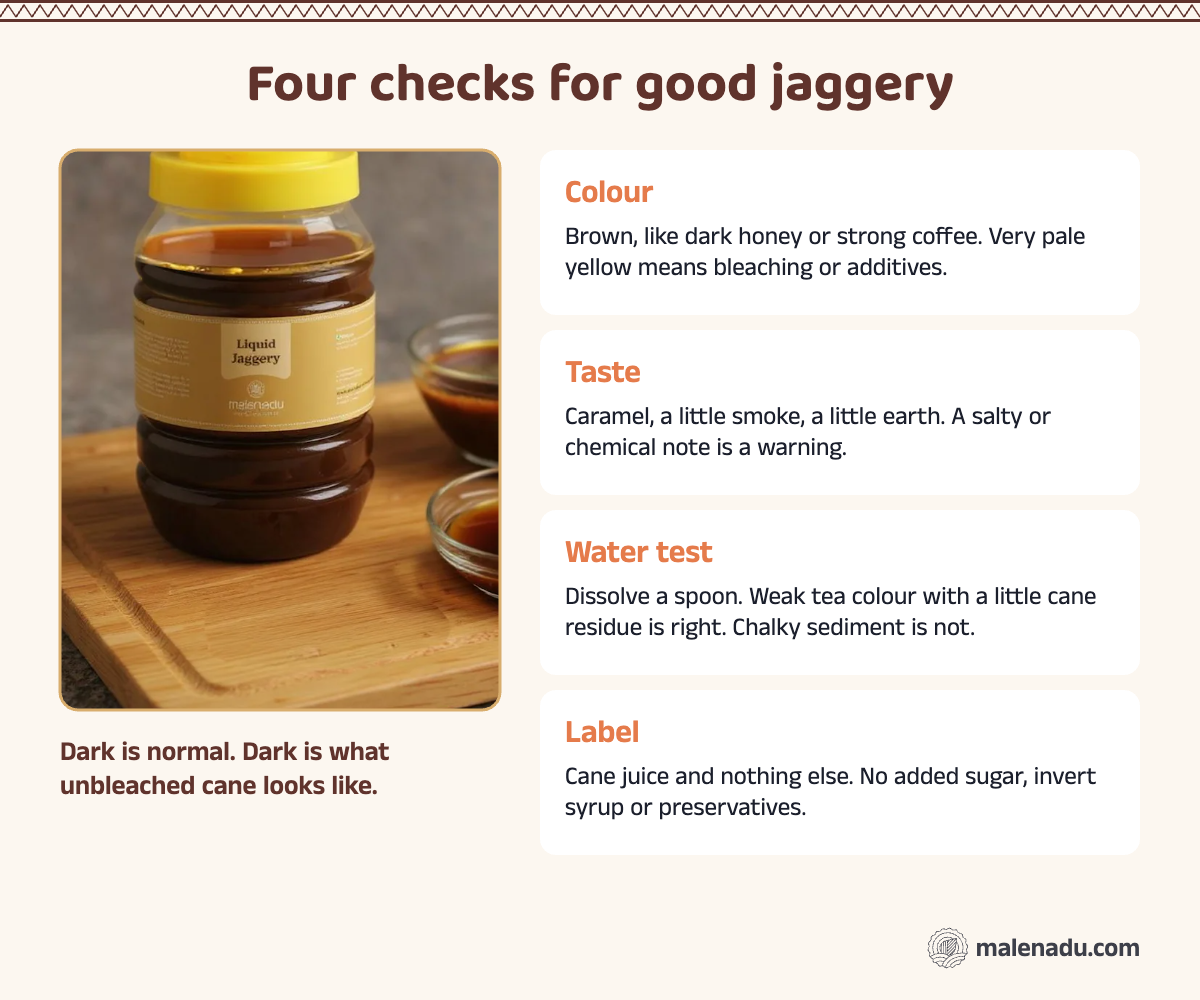
Since jaggery wins so many rounds of jaggery vs sugar vs honey, it is worth knowing how to buy it, because not all jaggery is what it claims to be.
Light golden jaggery is the first thing to be suspicious of. Cane syrup boiled in an open pan comes out brown, somewhere between dark honey and strong coffee. A very pale, uniform yellow usually means the syrup was treated with bleaching chemicals or had something added to lighten it. Dark is normal. Dark is what unbleached cane looks like.
Taste for salt and for sharpness. Some jaggery is made with additives to speed up setting or to improve the look. The giveaway is a faint salty or chemical note behind the sweetness. Good jaggery tastes of caramel, a little smoke and a little earth and the sweetness builds rather than hits.
Dissolve a spoon in a glass of water. Real jaggery leaves a small amount of fine cane residue at the bottom and the water goes the colour of weak tea. If it dissolves to a perfectly clear bright solution, ask what else is in it. If it leaves a lot of sand or chalky sediment, it was cut with something cheap.
For liquid jaggery specifically, check the label for added sugar, invert syrup or preservatives. Liquid jaggery should be cane juice reduced and nothing else. Ours is bottled that way and the ingredient line on our liquid jaggery page says exactly that, which is also where you will find the batch details.
Honey has its own tests and they deserve a post of their own, but the short version is that raw honey crystallises over time, has a smell that matches the flowers it came from and is never perfectly clear. A honey that never crystallises at all is worth a second look.
A simple swap table
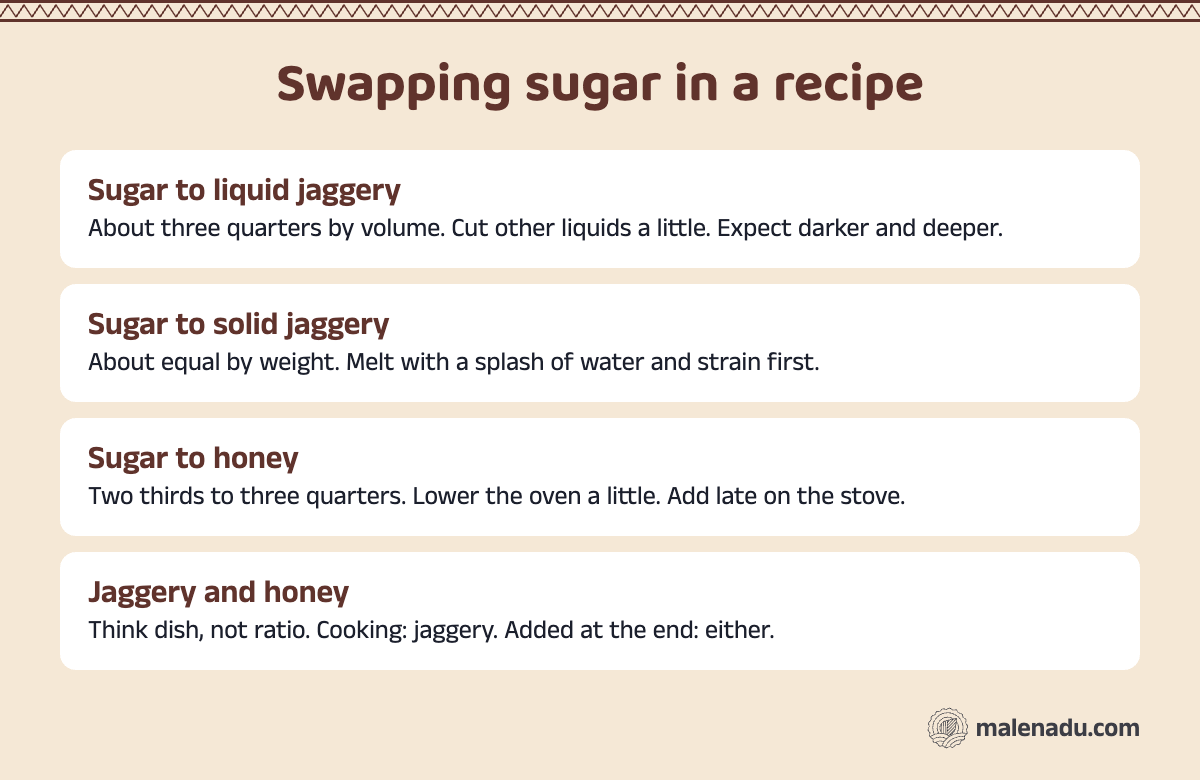
If you are moving a recipe from sugar to jaggery or honey, these are the rough jaggery vs sugar vs honey rules we use. Taste as you go, because jaggery and honey vary and sugar does not.
Sugar to liquid jaggery. Start with about three quarters of the amount by volume, because liquid jaggery is dense and rich. Add more if needed. Reduce any other liquid in the recipe a little, since liquid jaggery brings its own moisture. Expect a darker colour and a deeper taste.
Sugar to solid jaggery. Roughly equal by weight, but melt it with a splash of water and strain it first. Grated jaggery dissolves faster than chopped.
Sugar to honey. About two thirds to three quarters of the amount, because honey is sweeter. Cut the other liquids a little, lower the oven by a few degrees if you are baking because honey browns faster and add it late if the dish is on the stove.
Jaggery to honey or honey to jaggery. Think about the dish, not the ratio. If the recipe needs cooking, use jaggery. If the sweetener goes in at the end, either works and it comes down to which flavour you want.
Frequently asked questions about jaggery vs sugar vs honey
Is jaggery healthier than sugar?
In the jaggery vs sugar vs honey debate this is the most asked question. Jaggery is less processed and keeps a small amount of the minerals from the cane and its flavour means most people use less of it. But it is still mostly sugar and it raises blood sugar in much the same way. Think of it as a better sweetener, not a health food.
Is honey healthier than jaggery?
In jaggery vs sugar vs honey terms, these two are different rather than one being better. Honey is sweeter so you use less and raw honey carries a little pollen and some enzymes. Jaggery has more minerals and holds up to cooking. For a hot dish, jaggery. For something you add at the end or stir into warm water, honey.
Can people with diabetes use jaggery or honey instead of sugar?
Not as a free swap. In jaggery vs sugar vs honey, all three raise blood sugar and anyone managing diabetes should follow their doctor’s advice on quantity rather than switch sweeteners and carry on as before. If your doctor allows a small amount, a sweetener with flavour helps you keep it small.
What is liquid jaggery and how is it different from solid jaggery?
Liquid jaggery (joni bella in Kannada) is the same boiled cane syrup stopped before it sets. It has the same taste and the same minerals as solid bella, but it pours and dissolves straight from the jar, so there is no melting and straining. It is the easiest form for coffee, dosa and payasa.
Does heating honey make it toxic?
No. Strong or long heating flattens its flavour and reduces whatever delicate compounds raw honey has, which is a waste of good honey, but it does not make it harmful. Add honey at the end of cooking for the best taste.
Why is some jaggery light yellow and some dark brown?
Unbleached cane syrup is brown. Very pale jaggery has usually been treated with chemicals to lighten it or had something added. Dark colour on its own is not a fault. Taste and the water test tell you more than colour does.
Can I give honey or jaggery to a baby?
No. A baby under one year needs no added sweetener, so no sugar, no jaggery and no honey. Honey carries an extra risk, infant botulism, which is why paediatricians single it out, but the advice for all three in the first year is the same.
How should I store jaggery and honey?
Storage is the one place jaggery vs sugar vs honey is easy. Both jaggery and honey keep well in a cool, dry cupboard with the lid closed. Liquid jaggery may thicken slightly over time and solid jaggery may sweat a little in humid weather, neither of which is spoilage. Raw honey will crystallise, which is a sign it is real. Stand the jar in warm water to loosen it.
One last thought
The jaggery vs sugar vs honey question has a different answer in every dish and that is a good thing. It means you can keep all three on the shelf and stop treating any of them as a villain or a cure. Use sugar where you need structure and clarity. Use jaggery where you want depth, colour and a sweetener you can taste and stop at. Use honey where it can be itself, in warm water, on a hot dosa, at the end of the cooking rather than the beginning.
If your jaggery jar is empty, our liquid jaggery is the easiest place to start and our honey is the one to keep for the mornings. Everything else in the natural sweeteners section is there for the days you want something sweet that tastes of where it came from.